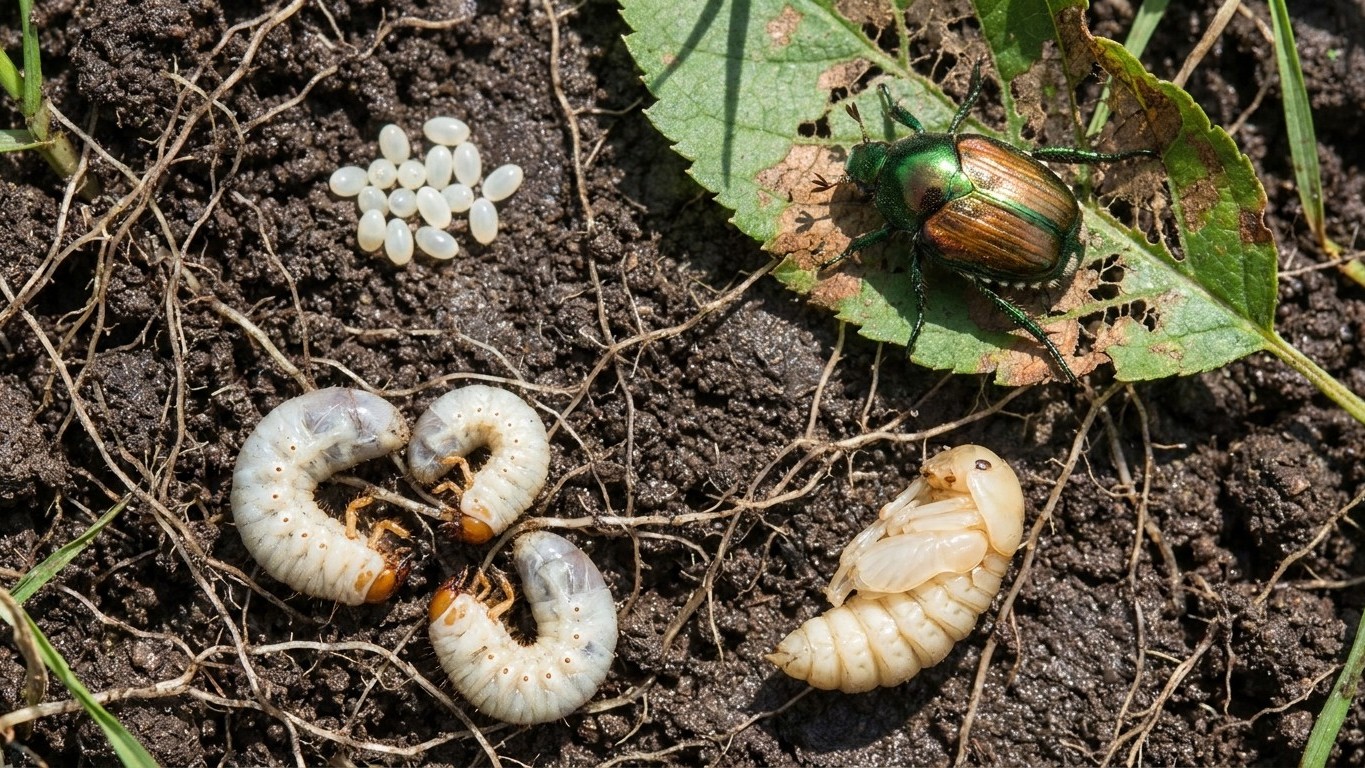

The Japanese beetle (Popillia japonica) runs through four life stages in a single year across most of the country: egg, grub, pupa, and adult beetle. The adults are the ones skeletonizing your rose bushes and linden trees in midsummer; the grubs are the ones chewing lawn roots from below, usually without anyone noticing until the turf turns brown and lifts like carpet.
The stages, in order
Everything about this insect’s damage pattern traces back to where each stage lives. An adult female lays her eggs a few inches down in moist soil, favoring turf over bare ground. Within about two weeks those eggs hatch into small white grubs with a brown head capsule, and those grubs spend the rest of the season doing exactly one thing: eating grass roots from underneath.
The grub stage is also the longest by far. It molts through three instars, growing steadily bigger, and it’s this larval body that survives the cold months buried in soil (more on that later). Come the following spring, the grub resumes feeding for a short window, then transitions into a pupa, a quiet, non-feeding stage tucked a few inches underground where the transformation into an adult beetle actually happens.
Adults emerge from the soil already looking for two things: food and a mate. This is the stage almost everyone recognizes, a metallic green body with coppery-bronze wing covers, roughly the size of a coffee bean. Adults skeletonize leaves by eating the tissue between veins, leaving a lace-like pattern behind on more than 300 species of plants, with roses, grapes, linden trees, and crabapples among the favorites.
What a gardener sees, and what they don’t
Here’s the split that trips people up: homeowners see the adult damage on leaves and flowers because it happens in daylight, in July, right in front of them. They almost never see the grub damage happening at the same time, underground, in their own lawn. A patch of turf that feels spongy and pulls up easily in September is often the season’s grub population finishing its root-feeding phase before winter, not a lawn disease.
Two problems, one insect, two different parts of the yard. That’s the single most useful thing to understand about this pest before deciding where to spend any effort.
When it appears, and why that varies
Japanese beetle emergence isn’t tied to a date on the calendar. It’s tied to accumulated soil warmth, measured by entomologists as growing degree days, a running total of heat units that builds from early spring onward. Once the soil and the overwintering grubs inside it cross a certain accumulated-warmth threshold, pupation finishes and adults start pushing up out of the ground.
That mechanism is why the same species shows up weeks apart in different parts of the country. A yard in the Mid-Atlantic can see adult beetles flying well before a yard in the Upper Midwest or New England hits the same point in its own degree-day accumulation, even though both locations are dealing with the exact same insect and the exact same biological trigger. Elevation, soil type, and a warm or cool spring all shift the math too, which is why two towns 50 miles apart in the same state can see slightly different emergence windows in the same year.
Because the trigger is heat accumulation rather than a fixed week in July, no single date works as a national rule, and no single degree-day number applies everywhere either. University extension services track this locally, season by season, because soil temperature data and regional beetle activity get monitored right where you live. That’s also why this cocoon carries a dedicated page for each territory: the emergence window, the degree-day threshold your local extension uses, and the timing that matters for your yard specifically all live there, sourced to that state’s extension office.
What stays true everywhere is the order of events. Warming soil wakes the overwintering grubs, they finish feeding briefly, they pupate, and adults emerge over a period of several weeks rather than all at once. Peak adult activity usually runs four to six weeks after the first beetles appear, then tapers off as the population ages and finishes its above-ground business for the year.
One generation or several
This is the fact that decides how long you actually need to pay attention. The Japanese beetle is a one-generation-per-year pest across nearly all of the territory it occupies in the United States. Adults you see in summer are not going to be followed by a second wave of freshly emerged adults later that same season.
That single-generation biology changes the whole strategy compared to a pest that cycles through multiple generations in one year. With a multi-generation insect, missing a treatment window just means you deal with the next wave a few weeks later. With the Japanese beetle, the adult flight period is the one window for that calendar year. Once it closes, typically after several weeks of feeding, mating, and egg-laying, the above-ground problem is over until the following summer.
The egg-laying that happens during that single flight period is what sets up next year’s grub population, though, so the story doesn’t actually end when the adults die off. Females that fed and mated in July have already laid eggs in nearby turf by the time anyone stops seeing beetles on the roses. Those eggs become the grubs that feed on lawn roots through late summer and early fall, pause for winter, then finish their development the following spring before turning into the next crop of adults.
So while there’s only one generation, there isn’t only one window of vulnerability in the yard. The adult stage gives one clear, visible period to watch foliage. The grub stage gives a separate period, later in the same year, when lawn damage becomes noticeable, followed by another window the following spring before pupation begins again. One species, one generation per year, but two distinct times when it’s actively causing damage in two different places on the same property.
Natural enemies factor into how big next year’s generation gets. Istocheta aldrichi, a parasitic fly, lays eggs directly on adult beetles and can meaningfully reduce local populations where it’s established. Tiphia vernalis, a parasitic wasp, targets the grub stage underground. Neither shows up in a bag from the store, and both are reasons to think twice before broad-spectrum treatments that don’t distinguish between the beetle and the insects working against it.
Where it spends the winter
Overwintering is the part of the cycle that makes next year’s problem predictable, and it happens almost entirely out of sight. As soil temperatures drop in fall, third-instar grubs dig deeper, typically several inches down, below the frost line, where they go dormant for the winter rather than dying off or leaving.
They aren’t hiding in leaf piles or garden debris the way some overwintering insects do. The grub stage rides out winter as buried larvae in soil, specifically in turf and other grassy areas where the eggs were laid the previous summer. That’s a meaningfully different overwintering strategy than pests that shelter in bark crevices, plant debris, or structures, and it’s why raking leaves in November does essentially nothing to reduce next year’s beetle population.
What autumn soil conditions actually do influence outcomes. Moist soil in early fall favors both egg survival and grub movement to a safe overwintering depth, while a dry fall can push egg and early-instar mortality higher before the grubs ever get the chance to bury down for winter. That single detail is why irrigation habits in August and September end up connected to beetle pressure the following July, a link that isn’t obvious until you know where the insect is actually spending its winter.
Come spring, warming soil pulls those grubs back up toward the root zone for a short final feeding period before pupation starts the whole cycle over again. Nothing new arrives from outside during this stage; the following year’s adult population is already determined, sitting quietly in the ground, by the time winter sets in.
Common questions
Do Japanese beetles come back every year, or is an infestation a one-time event?
They return annually wherever the species is established, because the single generation each year lays eggs that become next year’s overwintering grubs. A heavy beetle year in the yard is a strong sign of grub activity underground that same season, not an isolated incident.
Can I see grubs in my lawn before the adults show up?
Yes, grubs are present in soil for most of the year, feeding actively in late summer/early fall and again briefly in spring, then dormant through winter. Adults are the shorter, more visible above-ground stage that appears once soil warmth crosses the local emergence threshold.
Does killing adult beetles on my plants reduce next year’s grub population?
It can help somewhat, since fewer surviving females means fewer eggs laid nearby, but beetles fly in from neighboring properties too. Grub-stage management in turf and preserving natural enemies like Istocheta aldrichi and Tiphia vernalis address the population more directly than adult removal alone.
Why does my extension office give a different emergence date than a neighboring state?
Because emergence tracks accumulated soil warmth (growing degree days) rather than a calendar date, and that accumulation depends on regional climate, elevation, and the specific spring’s temperatures. Each state’s extension service monitors its own degree-day data and publishes the threshold and typical window that apply locally.