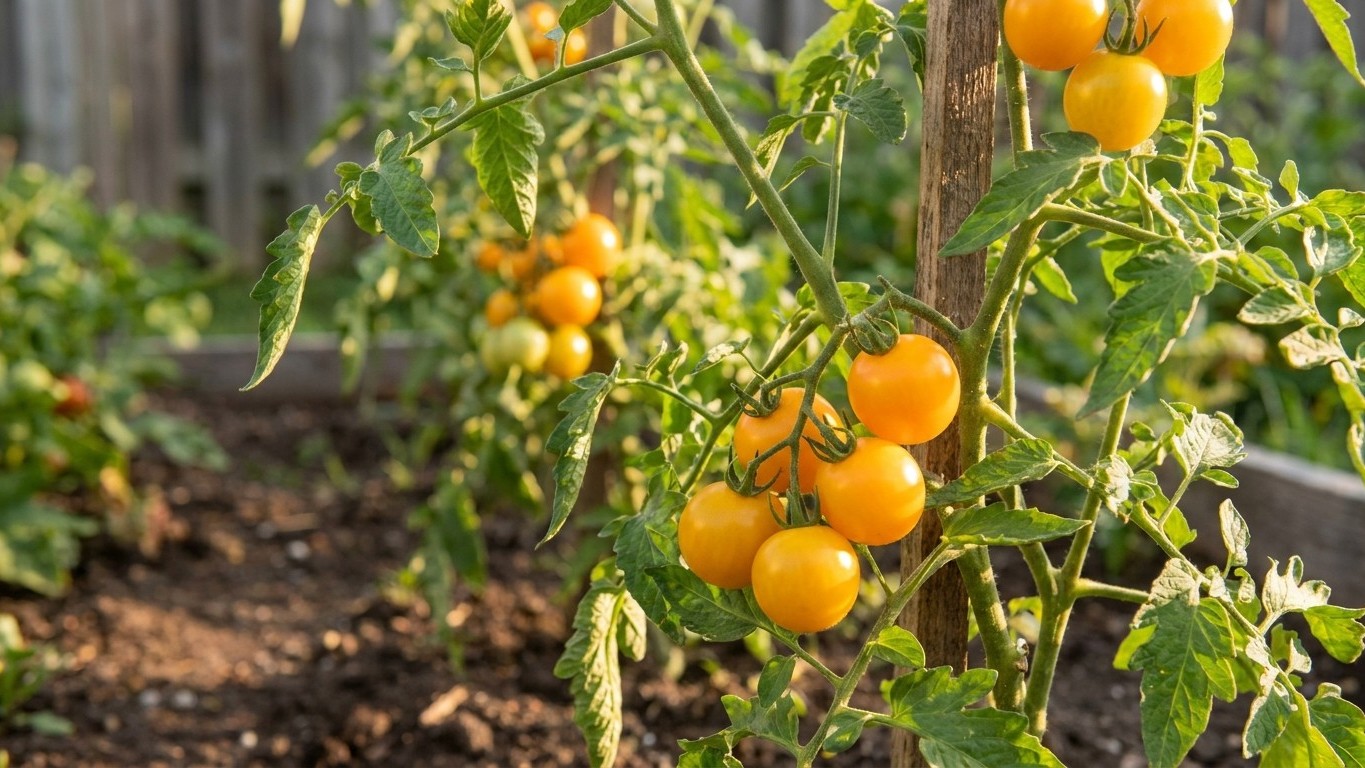

Red Torch is a specialty tomato grown for its two-inch yellow fruit and standout flavor, not for reliability across every climate. Counted from transplant, it needs 65 days to start producing, and because it’s an indeterminate vine, that first fruit is only the beginning of a season that keeps going until frost. Whether that math works in your yard depends on more than the calendar.
What Red Torch actually is
Red Torch falls into the specialty tomato category, bred for eye-catching appearance and eating quality rather than for canning volume or shipping toughness. The fruit ripens yellow, stays compact at about 2 inches across, and is described by growers as having superb flavor to match its stunning appearance, a combination that makes it a fixture for salads and snacking rather than sauce pots.
The variety is indeterminate. That single word changes how you plan the whole bed: the vine does not stop growing or setting fruit once it reaches a certain height. It keeps climbing and cropping until frost cuts it down, which means it needs a tall cage or a sturdy stake from the start, not the modest wire ring that works for a compact bush type.
Days to maturity is listed at 65, and that figure is counted from transplant into the garden, not from the day you sow seed indoors. This distinction matters more than it sounds. Seed started six to eight weeks before your last frost date, then hardened off and set into warm soil, is the clock’s real starting line. Count from seed instead, and you’ll misjudge your harvest by weeks.
Where it ripens in time, and where it is a gamble
The arithmetic behind any tomato’s success is simple once you lay it out, and it’s the same arithmetic every gardener should run before choosing a variety, regardless of what a seed packet promises. Start with your area’s frost-free window, the stretch between your average last spring frost and your average first fall frost. Subtract roughly two weeks from the front end, because tomato roots stall in cold soil and most growers wait until the ground has warmed into the mid-60s before setting plants out, even if the air is technically frost-free by then. From what’s left, subtract the 65 days Red Torch needs to produce its first ripe fruit. Whatever remains is your actual harvest window, the stretch of weeks you get to actually pick tomatoes rather than watch them size up.
In regions with a long, forgiving frost-free season, that leftover window is generous. Coastal California, the Gulf Coast, and much of the Southeast typically offer frost-free stretches well past six months, so a 65-day tomato transplanted in reasonably warm soil has months of picking ahead of it before any frost threat returns. In those places, Red Torch isn’t just workable, it’s a low-stress choice: even a late, rough spring rarely eats far enough into the calendar to put the harvest at risk.
The calculation gets tighter in short-season regions: the northern Great Plains, the interior Mountain West, and northern New England, where frost can arrive early and the soil is slow to warm in spring. There, the two weeks lost waiting for warm soil and the 65 days to first fruit can eat most of the frost-free window, leaving a picking season measured in weeks rather than months. That’s not a reason to rule Red Torch out in those areas, but it is a reason to start seed indoors on schedule, use a wall-o-water or black plastic mulch to warm the bed faster, and treat the harvest window as something to protect rather than something to take for granted. No specific city-by-city frost-date figures are published in this dataset, so the honest move for any gardener is to pull their own area’s average frost dates from a local extension office or the NOAA National Centers for Environmental Information records and run the math above with their real numbers, not a national average.
The two ways a season goes wrong
A long frost-free window on paper doesn’t guarantee a good tomato season, and this is where a lot of gardeners get surprised. In northern gardens, the frost-free count can look reasonable while the accumulated warmth underneath it stays short. Tomatoes don’t just need days without frost, they need warm nights, and when temperatures fall below 50°F overnight, pollen doesn’t shed properly and blossoms drop without setting fruit. A cool, cloudy summer in the Upper Midwest or the Pacific Northwest can leave a Red Torch vine loaded with flowers and short on fruit, even with weeks of frost-free calendar left to use.
The opposite failure shows up in hot climates. Once daytime highs push past roughly 86°F for a sustained stretch, tomato pollen goes sterile and fruit set stalls out completely, which is exactly why growers across the Deep South and the desert Southwest don’t treat their frost-free window as one long growing season. Instead they run a spring crop that finishes before the worst heat hits, then a second planting in late summer that ripens once temperatures ease in fall.
For a 65-day variety like Red Torch, the cold-night problem is the one to watch more closely in most of the country. Because it matures relatively fast, it has a better chance of slipping its main harvest into a comfortable stretch before either extreme sets in, but growers in the hottest zones should still plan for two shorter windows rather than one continuous season, and growers in cool, short-summer regions should watch nighttime lows as closely as the frost date itself.
What it resists, and what it does not
Red Torch carries no published disease resistances. That’s worth stating plainly rather than glossing over, because it’s tempting to assume any modern tomato variety comes with some built-in protection against common problems like fusarium wilt, verticillium wilt, or nematodes. This one doesn’t, at least not according to available catalogue data, and treating it as though it has some baked-in defense is the kind of assumption that costs a crop.
Practically, that means the usual cultural safeguards matter more here than they would with a resistant hybrid. Rotate tomatoes out of the same bed for at least two to three years if wilt diseases have shown up before, since the pathogens persist in soil regardless of what you plant next. Choose a planting site with good drainage and full sun, since stressed plants in soggy or shaded ground are the ones most likely to succumb to whatever disease pressure is already present in the soil. Mulch to cut down on soil splashing onto lower leaves, which is one of the more common ways foliar diseases get their start.
None of this makes Red Torch fragile. Plenty of specialty varieties without resistance codes produce a full, healthy season in a well-managed garden. It just means the work of prevention falls on the grower rather than on genetics, and it’s worth going in with that expectation rather than being caught off guard mid-season.
Growing it without the usual mistakes
Because Red Torch is indeterminate, the support structure has to be built for the long haul, not for a single flush of fruit. A short tomato cage sized for a determinate bush will be outgrown by midsummer, leaving a sprawling vine that’s harder to harvest and more prone to disease from foliage sitting on damp soil. A stake of at least 6 feet, or a heavy-gauge cage of similar height, gives the vine somewhere to go for the whole season. Space plants roughly 24 to 36 inches apart to keep airflow moving between them, which matters even more given the lack of published disease resistance.
Feeding follows the same indeterminate logic. Because the plant keeps producing new growth and new fruit clusters until frost, it benefits from a steady, moderate feeding schedule rather than one heavy early dose. Where growers most often go wrong is easing off too soon, assuming that once the first fruits ripen around day 65 the plant’s work is mostly done. It isn’t. An indeterminate vine left unfed midseason will slow its new fruit set exactly when the harvest window should be widest.
Pruning suckers lightly to one or two main stems helps concentrate the plant’s energy into fruit rather than foliage, and it makes staking far more manageable as the vine climbs. Given the 2-inch fruit size and the salad-and-snacking use this variety is suited for, frequent light picking as tomatoes ripen keeps the vine producing rather than letting fruit hang and slow new sets, which is the mistake this particular timing invites: treat a 65-day tomato like a one-and-done harvest, and you leave weeks of potential production on the table.
Common questions
Is Red Torch the same as a cherry tomato?
Not quite. At around 2 inches across, the fruit sits between a true cherry tomato and a standard slicer, which is part of why it’s grouped as a specialty type rather than filed under either category.
Can I start harvesting exactly on day 65?
Day 65 from transplant marks the first ripe fruit under typical conditions, not a guaranteed date. Cooler nights, inconsistent watering, or a late transplant into cold soil can all push that first harvest later.
Does Red Torch need a greenhouse in short-season climates?
Not necessarily, but season-extension tools like black plastic mulch, row cover, or wall-o-water devices around transplants help close the gap between a short frost-free window and the 65 days this variety needs.
Why does the catalogue list no disease resistance codes?
Some specialty varieties are bred primarily for flavor and appearance rather than for the broad resistance packages found in many commercial hybrids. That tradeoff means the grower carries more responsibility for prevention through rotation, spacing, and site selection.