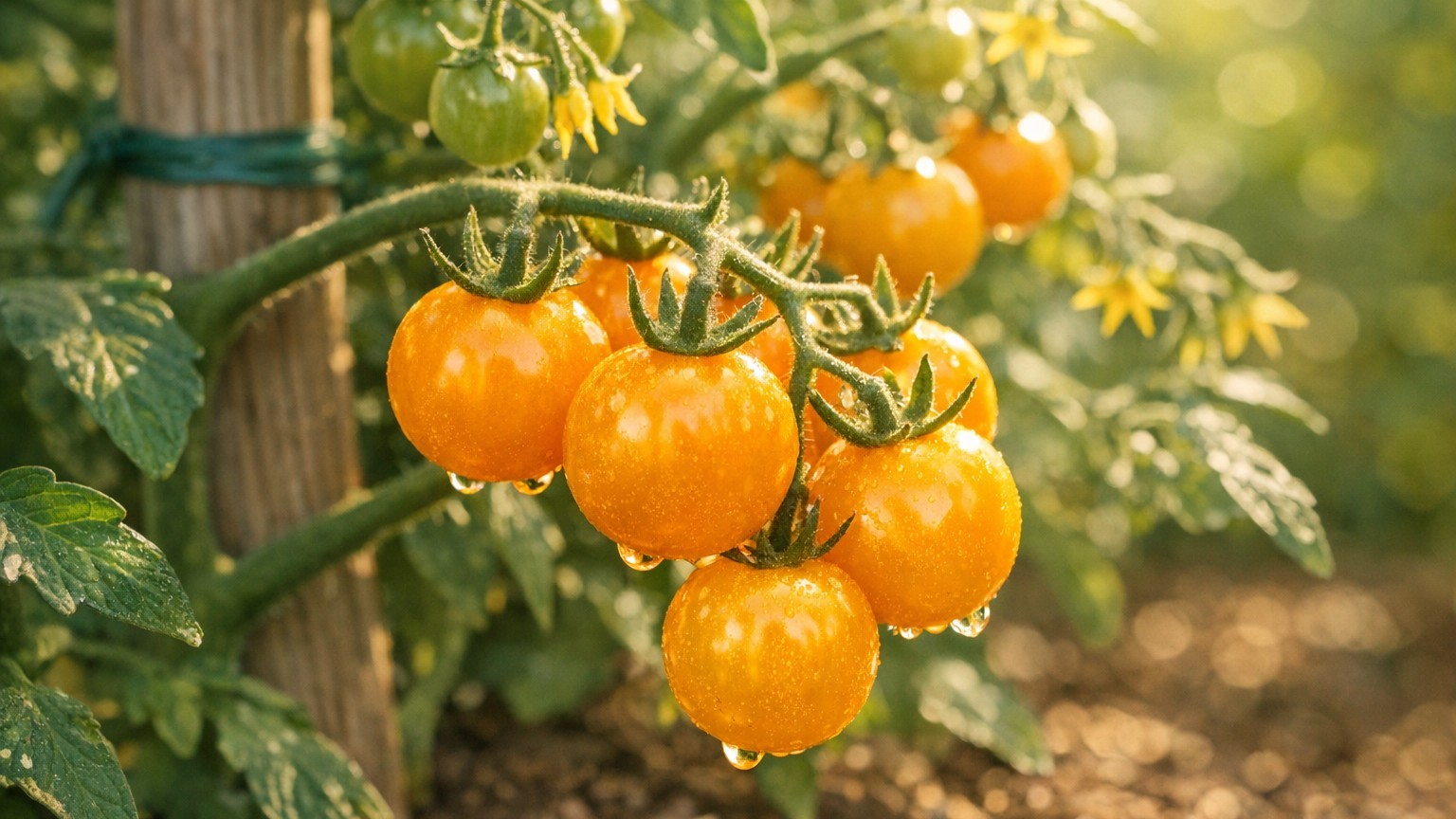

Sun Sugar is a yellow cherry tomato that ripens about 75 days after you set transplants in the ground, and because the vine is indeterminate, it keeps setting and ripening fruit clear through to the season’s first hard frost. That combination, a moderate wait followed by months of steady picking, decides whether it fits a given garden and how much support the vine will need once it takes off.
What Sun Sugar actually is
Sun Sugar belongs to the cherry tomato group, grown for small, snack-sized fruit rather than slicing tomatoes for sandwiches. The vine is indeterminate, meaning it does not stop growing at a set height and does not ripen its crop in one flush. It keeps extending, flowering, and fruiting all season, which is the reason seed catalogues flag it as needing a tall cage or a sturdy stake rather than the short, self-supporting cage that works for a compact determinate plant.
The fruit itself is small and thin-skinned, described in catalogue notes as sweet and rich with just enough tartness to keep it from tasting flat. That balance is what makes cherry tomatoes like this one better suited to salads and to eating straight out of the bowl than to cooking down into sauce, where a thicker-walled paste tomato does more work.
The figure that matters most for planning is 75 days to maturity, and the catalogue basis for that number is transplant date, not the day seed went into a starter tray. That distinction changes how a gardener plans a season. Someone counting from seed will land on a ripening date weeks later than the catalogue promises, because the plant spends its early life indoors or in a cold frame before it ever goes into garden soil. Every planning calculation later in this article starts from the transplant date for that reason.
Where it ripens in time, and where it is a gamble
The arithmetic behind this question is simple enough to redo for any yard: take the local frost-free window, subtract roughly two weeks for the soil to warm enough that a young transplant grows instead of sulking in cold ground, then subtract the 75 days to maturity. What is left over is the harvest margin, the stretch of weeks a gardener actually gets to pick fruit before frost ends the season.
For an indeterminate variety like Sun Sugar, that margin matters more than it would for a determinate tomato that ripens once and is done. A determinate variety just needs enough time to reach its single harvest window. An indeterminate vine is still flowering and setting new fruit for as long as conditions allow, so every extra week of margin translates directly into more pounds of tomatoes rather than just an earlier single picking.
In regions with a short frost-free season, the Upper Midwest, northern New England, and high mountain valleys through the Rockies among them, that margin can run thin. A 75-day variety started as early as it is safely possible to transplant, right after the last spring frost risk passes, still needs the full stretch of a short summer to produce more than a token crop before fall frost arrives. Gardeners in these areas are not necessarily locked out, but they get fewer weeks of continuous harvest than gardeners further south, and every delay in transplanting eats directly into that.
Regions with a long frost-free season sit at the other end. Along the Gulf Coast, through the Deep South, and in much of coastal California, 75 days is a small fraction of the total growing season, leaving room not just for a comfortable harvest window but for staggered plantings or a second round of transplants later in the year. The Mid-Atlantic, the Pacific Northwest lowlands, and the Midwest Corn Belt generally sit in between, with enough season to grow this variety without racing the calendar the way a short-season gardener does.
None of this makes Sun Sugar impossible in a short-season climate. It changes how much slack a gardener has for mistakes: a late transplant, a cool spell that stalls growth, or a wet spring that delays soil warming costs a short-season grower real harvest weeks in a way it barely touches a grower in a long-season state.
The two ways a season goes wrong
A frost date on a calendar does not tell the whole story, and two separate limits can undercut a season even when the frost-free window looks generous on paper.
In the north, the problem is accumulated warmth rather than raw day count. A region can have a frost-free window that looks adequate in weeks while still running short on the actual heat a tomato plant needs to grow and set fruit, because cool nights slow everything down even without frost. Tomato flowers will not set fruit at all once nighttime temperatures drop below 50F, regardless of how many frost-free days remain on the calendar. For Sun Sugar’s 75-day timeline, this matters less than it does for a slower 90-day beefsteak, but it still means a string of cool nights early or late in the season can quietly shrink the productive window even without a frost ever touching the plant.
In the south, the failure runs the opposite direction. Once temperatures climb above roughly 86F, tomato pollen turns sterile and flowers drop without setting fruit, which is why the hottest stretch of summer in much of the Deep South and the desert Southwest produces plenty of foliage and few tomatoes. Growers in those regions typically plant a spring crop timed to finish before the worst heat arrives, then set out a second round of transplants in late summer for an autumn crop, rather than expecting one plant to produce steadily from spring through fall.
For a relatively quick 75-day variety like Sun Sugar, the heat-sterility limit is the one that deserves more attention in hot climates. A vine set out early enough to mature before peak summer heat can get a solid early harvest in, then face a slowdown mid-summer before picking back up as temperatures ease in fall, rather than producing in one uninterrupted run.
What it resists, and what it does not
Catalogue data lists two disease resistances for Sun Sugar: Fusarium Wilt and Tomato Mosaic Virus. Neither is graded to a specific level in that catalogue data, meaning there is no published distinction here between “High” resistance and “Intermediate” resistance for this variety. That gap matters, because those two ratings mean different things in practice. High resistance means a plant is unlikely to develop meaningful disease symptoms even under pressure. Intermediate resistance means the plant can still get sick, just more slowly or less severely than a variety with no resistance at all. Without that grade specified, a gardener should not assume the strongest possible protection against either disease.
What the catalogue does not list matters just as much. There is no published resistance for Sun Sugar against early blight, late blight, Septoria leaf spot, Verticillium wilt, or root-knot nematodes, some of the most common tomato problems in home gardens across the country. In areas where those diseases show up reliably, especially humid regions prone to blight, genetics will not do the work here. That leaves the usual cultural defenses: spacing plants for airflow, mulching to keep soil-borne spores from splashing onto lower leaves, rotating tomato beds year to year, and watering at the soil line rather than overhead.
Growing it without the usual mistakes
Because Sun Sugar is indeterminate, it needs a plan built for the whole season rather than for one harvest. A tall cage, at minimum five to six feet, or a stake with regular tying as the vine climbs, keeps the plant from collapsing under its own weight partway through summer. A short tomato cage sized for a compact patio variety will not hold this plant once it starts producing in volume.
The mistake this timing invites is treating a 75-day maturity date as the finish line. That number marks when the first ripe fruit shows up, not when the plant is done. Gardeners who scale back watering and feeding once the first tomatoes turn yellow are cutting off a vine that, left alone, would keep flowering and ripening fruit for months. Regular, moderate fertilizing through the growing season supports that continued production instead of a single early flush followed by a tired plant.
Spacing also matters more here than it does for a compact determinate variety. Indeterminate vines need room for airflow around a plant that will keep adding foliage all season, which also helps limit the fungal problems this variety has no genetic resistance against. And because cherry tomatoes ripen in clusters and keep coming once they start, frequent picking, every two to three days once fruit begins to color, prevents overripe tomatoes from splitting on the vine or dropping to the ground, where they invite pests and rot that can spread to the rest of the plant.
Common questions
Does the 75-day figure count from when I start seeds indoors?
No. The published maturity date counts from transplant into the garden, not from the sowing date. Starting seeds indoors adds several additional weeks before that clock even begins.
How long will Sun Sugar keep producing once it starts ripening?
As an indeterminate variety, it keeps flowering and setting new fruit continuously until frost stops the plant, rather than ripening everything in one flush the way a determinate tomato does.
What kind of support does it actually need?
A tall cage or a stake with regular tying, sized for a vine that keeps growing all season. A short cage built for a compact plant will not hold up once this variety fills out.
Is Sun Sugar resistant to blight?
No blight resistance is listed. Its published resistances cover Fusarium Wilt and Tomato Mosaic Virus only, at an unspecified level, so gardens prone to early or late blight need cultural controls rather than relying on the variety’s genetics.