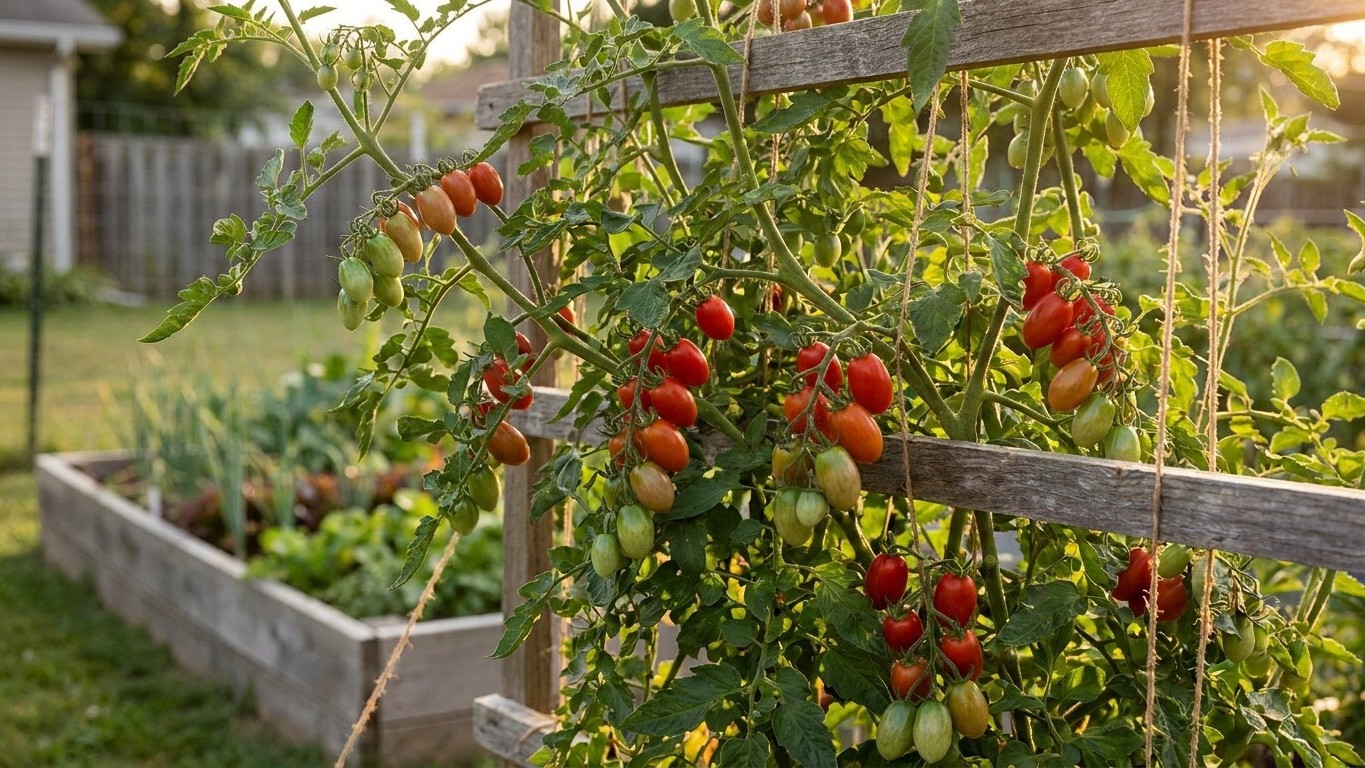

Tami G is a fast, indeterminate grape tomato that reaches its first ripe fruit in 62 days from transplant, which puts it well within reach of nearly every U.S. growing season. The real question isn’t whether it will ripen in time almost anywhere it’s planted, but whether the plant gets enough warm nights on both ends of the season to keep setting fruit once it starts.
What Tami G actually is
Tami G is a grape tomato: small, oblong fruit bred for snacking and salads rather than slicing or sauce. The catalogue describes the flavor as firm and sweet, which is the profile growers expect from the grape type generally, distinct from the softer, juicier flesh of a cherry tomato.
Two facts decide how you grow it. First, the habit is indeterminate. The vine does not stop at a set size and ripen its fruit in one flush the way a determinate plant does; it keeps growing and setting new fruit until frost kills it. That single trait dictates the support plan, covered further down, because an indeterminate grape tomato left on a short cage will collapse under its own growth by midsummer.
Second, the maturity figure: 62 days to first ripe fruit, counted from transplant, not from the date you sowed seed indoors. That basis matters. A gardener who counts from seeding will think the plant is running late when it isn’t; the clock only starts once a seedling goes into the ground. Catalogue data lists no separate days-to-germination or days-to-transplant-size figure here, so plan your indoor start using your own seed-starting schedule and treat the 62 days as the second half of the calendar, the part that runs from the garden bed to the first ripe fruit.
Where it ripens in time, and where it is a gamble
Because Tami G needs only 62 days, season length by itself is rarely the limiting factor in the continental United States. The arithmetic that matters is simple, and it’s worth doing for your own garden rather than trusting a national average: take your area’s frost-free window, subtract about two weeks at the front end because tomato roots don’t grow well in cold soil even after the frost risk has passed, then subtract the 62 days to maturity. What’s left is your cushion, the number of extra days the vine has to keep producing before fall frost ends the season.
Say a garden has a frost-free window of around 180 days, which is typical of a lot of the mid-latitude U.S., from the Mid-Atlantic through much of the Midwest and into the Pacific Northwest’s warmer valleys. Subtract the two-week soil-warming buffer and the 62 days, and there’s still well over 100 days of harvest left before frost. That’s a wide margin, and it’s the reason a fast grape tomato like this one is often recommended for gardeners who want a long, forgiving harvest window rather than a race against the calendar.
The picture tightens in the shortest-season pockets of the country: far-northern states, interior valleys at high elevation in the Rockies, and similar cold-air-drainage sites where a frost-free window can run under 100 days. Even there, 62 days plus the two-week soil buffer leaves roughly a month of cushion in a 100-day window, which is workable but not generous, especially if a late spring cold snap or an early fall frost eats into either end. Gardeners in those areas do better starting seed indoors on schedule and setting out sturdy transplants right at the local frost-free date rather than gambling on an earlier planting that risks stalled growth in cold soil.
No specific city-by-city frost-date dataset is included in this piece; local last-spring-frost and first-fall-frost dates vary by county, and the most reliable way to check yours is a local extension office or a home weather record kept over a few seasons. The method above, frost-free window minus two weeks minus 62 days, works the same no matter where those two dates fall.
The two ways a season goes wrong
A long frost-free window on paper doesn’t guarantee a good crop, because two thermal limits sit inside that window and a frost table doesn’t show either one. In the north, accumulated warmth during the season can run short even when the calendar between frosts looks generous, because cool, cloudy stretches slow a tomato plant down regardless of how many frost-free days are technically available. On top of that, tomato flowers won’t set fruit when nighttime temperatures drop below 50°F; the blossoms simply drop instead of pollinating.
In the south, the opposite problem shows up in the middle of summer. Once daytime temperatures climb past roughly 86°F, tomato pollen becomes sterile and flowering stalls even though the plant looks healthy and keeps growing. That’s why southern growers often split the season into a spring crop that finishes before the worst heat and a second planting for autumn, rather than expecting one plant to produce straight through July and August.
For Tami G specifically, the cold-night limit is the one to plan around. Because it’s indeterminate and bred to keep cropping until frost, its season naturally stretches into the cool shoulder months at both ends, exactly where the 50°F threshold does its damage. Its short 62-day maturity actually works in its favor against the heat problem: a spring-set plant can get its first flush of fruit ripe and moving before the hottest stretch of summer arrives, then keep flowering into September and October, when the real risk becomes an early cold snap stalling new fruit set rather than the plant overheating in July.
What it resists, and what it does not
Catalogue data lists two disease resistances for Tami G: Fusarium Wilt and Gray Leaf Spot. Neither is graded as high or intermediate in the published figures, so the honest answer is that the plant carries some documented resistance to both diseases without a stated strength level. That distinction matters in practice. Resistance is not immunity, and even a variety with a high rating can still show symptoms under heavy disease pressure; it simply slows the infection rather than blocking it outright. With no strength level published here, treat the resistance as real but unquantified, and don’t assume the plant is protected against a bad outbreak of either disease.
Just as important is what isn’t on that list. No resistance to early blight, late blight, Septoria leaf spot, Verticillium wilt, or root-knot nematodes is published for this variety, which means the usual precautions still apply as if the plant had no protection against them at all. Crop rotation away from last year’s tomato bed, mulching to keep soil-borne spores from splashing onto lower leaves, and spacing plants for airflow all remain necessary. The two named resistances buy some insurance against two specific problems; they don’t cover the rest of the tomato disease list, and treating them as broader protection than they are is the kind of assumption that costs a grower a crop late in the season.
Growing it without the usual mistakes
The indeterminate habit is the detail that trips people up most. Because Tami G keeps growing and setting fruit until frost, it needs support built for a full season’s growth from the start, a tall cage or a stake driven deep enough to hold a heavy, sprawling vine by August, not the short tomato cage sold for a compact determinate variety. Installing that support at transplant time, before the plant needs it, avoids the common mistake of trying to wrestle a collapsing, fruit-loaded vine into a cage in midsummer.
Spacing should account for that same long growth: give the plant enough room that its indeterminate side branches don’t crowd its neighbors and cut off the airflow that helps limit Gray Leaf Spot, since no strong resistance figure is published for it here. Light, regular pruning of the lowest suckers keeps foliage off the soil, which also helps against the unlisted diseases like early blight that thrive in low, damp leaves.
Because the plant is being asked to produce continuously rather than in one flush, feeding strategy differs from a determinate variety grown for a single harvest window. Once fruiting is well underway, easing off high-nitrogen feeding keeps the plant from pouring energy into vine growth at the expense of new fruit set, a mistake that shows up as a lush, leafy plant with disappointing yields. Picking ripe fruit promptly and often, rather than letting it sit on the vine, is also part of keeping an indeterminate variety like this one productive: a plant that isn’t holding ripe fruit puts more energy into setting the next round.
Common questions
How many days does Tami G need to ripen? The published figure is 62 days, counted from the date of transplant into the garden, not from seed sowing.
Is Tami G a determinate or indeterminate tomato? It’s indeterminate, which means the vine keeps growing and setting new fruit until frost, and it needs a tall cage or stake set up at planting time rather than a short determinate-style cage.
What diseases does Tami G resist? Catalogue data lists resistance to Fusarium Wilt and Gray Leaf Spot, without a specified strength level. No resistance is published for early blight, late blight, Septoria leaf spot, Verticillium wilt, or root-knot nematodes, so standard prevention practices still apply against those.
Can Tami G be grown in a short-season climate? Its 62-day maturity gives it a workable margin even in frost-free windows under 100 days, as long as transplants go in right at the local frost-free date and the plant gets warm nights above 50°F to keep setting fruit into fall.