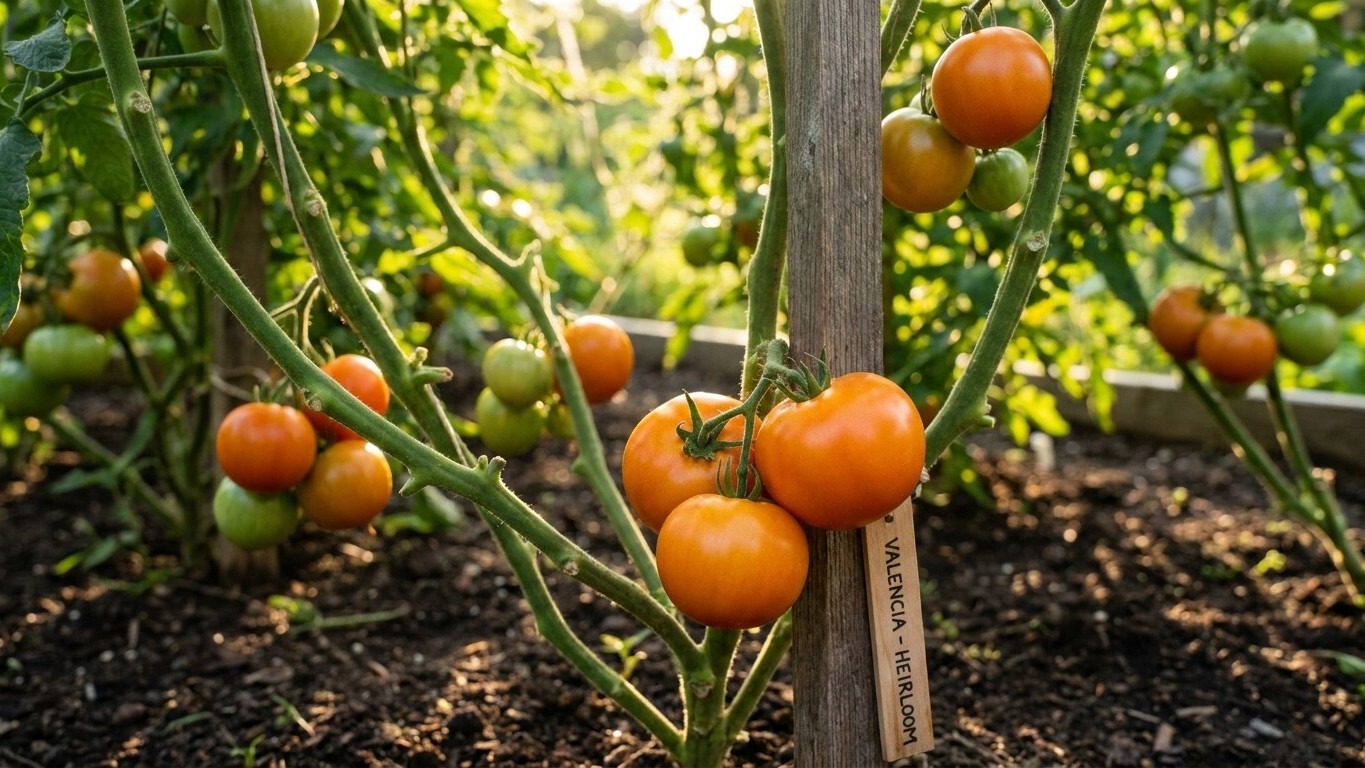

A Valencia tomato is an orange-fruited heirloom slicer that needs 76 days from transplant to first ripe fruit, and because it’s indeterminate, that first harvest is just the opening act. The plant keeps climbing and setting fruit until frost cuts it down, which changes how you plant it, stake it, and time it against your local weather.
What Brandywine actually is
Start with the numbers that actually decide whether this tomato belongs in your garden. Valencia needs 76 days from transplant to first harvest, and that figure is measured from the day you set a started plant in the ground, not from the day you sowed seed indoors. Skip that distinction and you’ll misjudge your whole season by three to four weeks, since most tomato seedlings spend five to seven weeks under lights before they ever see soil.
The growth habit is indeterminate. That single word carries a lot of weight: unlike a determinate variety that grows to a set size, flowers in one window, and ripens most of its crop together, Valencia keeps producing new stems, new flower clusters, and new fruit right up until a hard frost stops it. A short stake or a small tomato cage won’t hold it past midsummer. It wants a tall cage, at minimum, or a stake driven deep enough to anchor a plant that may reach well past head height.
The fruit itself is a slicing tomato, orange-skinned, running 8 to 10 ounces per fruit, with what’s described as full tomato flavor in a sunny orange package. That size and shape point it toward the sandwich plate and the salad bowl rather than the canning pot, so plan your bed space around how many fresh slicers your household actually eats in a week, not around how many quarts you want to put by.
Where it ripens in time, and where it is a gamble
The 76-day clock only tells half the story. What matters is whether your growing season has room for it once you account for everything that happens before and after that window.
Here’s the arithmetic, and you can run it yourself with your own local frost dates. Take your frost-free window, the stretch between your last spring frost and your first fall frost. Subtract roughly two weeks at the front end, because soil needs to warm before a transplant will actually grow instead of just sitting there stalled. Then subtract the 76 days to maturity. Whatever remains is your margin for actually picking a crop rather than racing to beat the cold.
In a region with a long, reliably warm season, say a frost-free window stretching from mid-April to late October (roughly 195 days), the math is forgiving. Take off two weeks for soil warm-up, subtract 76 days to first fruit, and you’re still left with well over two months of harvest before frost. That’s the kind of margin that lets an indeterminate plant do what it does best: keep climbing and keep fruiting through a long, hot summer.
Compare that to a short-season region where the frost-free window runs from late May to mid-September, closer to 110 days. Take off two weeks for soil warm-up and the 76 days to maturity, and you’re left with maybe two to three weeks of actual harvest before the first fall frost ends things. That’s not impossible, but it’s tight. A grower in that situation is gambling on an early spring, a late fall, or both, and any cold snap in either direction eats directly into the picking window.
The lesson isn’t that Valencia is a warm-climate-only variety. It’s that the arithmetic is unforgiving toward short seasons specifically because the plant is indeterminate and the maturity date is already on the later side of the mid-season range. A determinate tomato ripening in 60 days would have far more slack in that same short-season math. Valencia doesn’t, so gardeners in shorter-season regions should treat every week of season extension, black plastic mulch, row cover at planting, a sheltered south-facing bed, as directly convertible into pounds of ripe fruit rather than a nice-to-have.
The two ways a season goes wrong
A long frost-free window on paper doesn’t guarantee a good tomato season, and this is where a lot of gardeners get burned despite doing the frost-date math correctly.
The first failure mode shows up in the north, even in places with a technically adequate frost-free stretch. Total accumulated warmth, not just the count of frost-free days, is what actually pushes a tomato plant through flowering and fruit set. A region can log 130 frost-free days and still deliver a string of cool nights that stall growth, because tomato flowers won’t set fruit once nighttime temperatures drop below 50°F. Pollen becomes unreliable in that cold, blossoms drop instead of setting, and the plant essentially pauses even though the calendar says it has weeks left to work with.
The second failure mode is the opposite problem, and it belongs to hot climates. Once daytime temperatures push above roughly 86°F for extended stretches, tomato pollen turns sterile and fruit set drops off, sometimes to nearly nothing. That’s the reason experienced growers in hot-summer regions plant two separate crops rather than one continuous season: an early spring planting that fruits before the worst heat arrives, and a second planting timed to fruit again once temperatures ease off in early fall. The middle of summer, in that model, isn’t a growing period at all. It’s a gap.
For Valencia specifically, the 76-day maturity and indeterminate habit tilt the risk toward the cold-night problem rather than the heat problem. A plant that’s still setting new flower clusters into September needs those nights to stay above 50°F for the fruit to finish, which makes cool-night regions the ones that should watch this threshold most closely. Growers in hot-summer regions need to plan around the heat gap, but Valencia’s long, late-season fruiting habit means the cold end of the calendar is where most of the risk actually sits.
What it resists, and what it does not
This is a heirloom with no published disease resistances. That’s not a gap in reporting, it’s the catalogue fact, and it changes how you should manage the plant compared to a modern hybrid bred for resistance codes.
Plenty of newer tomato varieties carry catalogue letters like V, F, N, or T, shorthand for resistance to specific strains of verticillium wilt, fusarium wilt, nematodes, or tobacco mosaic virus. Some of those resistances are graded as high, meaning the plant largely fends off the disease, and others as intermediate, meaning the plant slows the disease’s progress without stopping it outright. That distinction matters: an intermediate rating is not the same as protection, and a gardener who treats it as full immunity ends up blindsided when symptoms show up anyway, just later and milder than they would on an unprotected plant.
Valencia carries none of those codes. No resistance is claimed on the catalogue listing, full stop. That means the plant has no built-in defense against soil-borne wilts or nematode pressure, and if your garden has a history of verticillium or fusarium in the soil, this variety offers nothing to fall back on genetically.
The practical response is cultural rather than genetic. Rotate tomatoes out of any bed where wilts have shown up in the past three to four years, since the pathogens persist in soil. Water at the base rather than overhead to limit the splash that spreads fungal spores onto lower leaves, and space plants generously, since this is an indeterminate variety that will fill in a lot of airflow-blocking foliage by midsummer if it’s crowded.
Growing it without the usual mistakes
The single biggest mistake with Valencia is underestimating its indeterminate habit and staking for a plant half its eventual size. Because it keeps growing until frost, a standard three-foot tomato cage will be outgrown by midsummer, leaving heavy branches sprawling on the ground where fruit rots and disease spreads more easily. Plan for a stake in the range of six to seven feet driven at least a foot into the soil, or a heavy-gauge cage of similar height, set at transplant time before roots make driving a stake risky.
Spacing needs to account for that same sprawling habit. Crowding an indeterminate plant that’s still producing new growth in September chokes off airflow right when humid late-summer weather makes fungal disease most likely. Give it room, at least 24 to 36 inches from its neighbors, so the vine has somewhere to go besides sideways into the next plant.
Feeding follows the fruiting timeline rather than a fixed calendar date. Because Valencia keeps setting new flower clusters through the season, it also keeps demanding potassium and calcium to finish those fruit properly. Where a determinate variety can be fed heavily early and then largely ignored once it sets its one big flush, an indeterminate plant like this one benefits from a lighter, steadier feeding through midsummer rather than a single early dose, tapering off nitrogen specifically as fall approaches so the plant puts energy into ripening existing fruit rather than pushing new leafy growth that won’t have time to produce.
The timing mistake specific to this variety is planting too late and expecting the long indeterminate habit to make up for it. Because the fruiting window stretches out rather than concentrating, gardeners sometimes assume they have slack to delay transplanting. But every week lost at the front end is a week that has to be recovered against a hard frost date that doesn’t move, and an indeterminate plant caught by frost mid-fruit-set loses far more unripe fruit than a determinate variety that had already finished its single flush.
Common questions
Is Valencia a determinate or indeterminate tomato?
Indeterminate. The plant keeps growing and setting new fruit until frost stops it, rather than growing to a fixed size and ripening its crop in one flush.
How many days does Valencia take to produce ripe fruit?
76 days, counted from the date of transplant into the garden, not from the date you sowed seed indoors.
Does Valencia resist common tomato diseases?
No disease resistances are published for this variety. Gardeners with a history of soil-borne wilts should rely on crop rotation and cultural practices rather than genetic resistance.
What size cage or stake does Valencia need?
Because it’s indeterminate and keeps growing through the season, a standard short cage isn’t enough. A stake or cage in the six- to seven-foot range, set at transplanting, gives the vine room to grow without collapsing under its own weight later in the season.