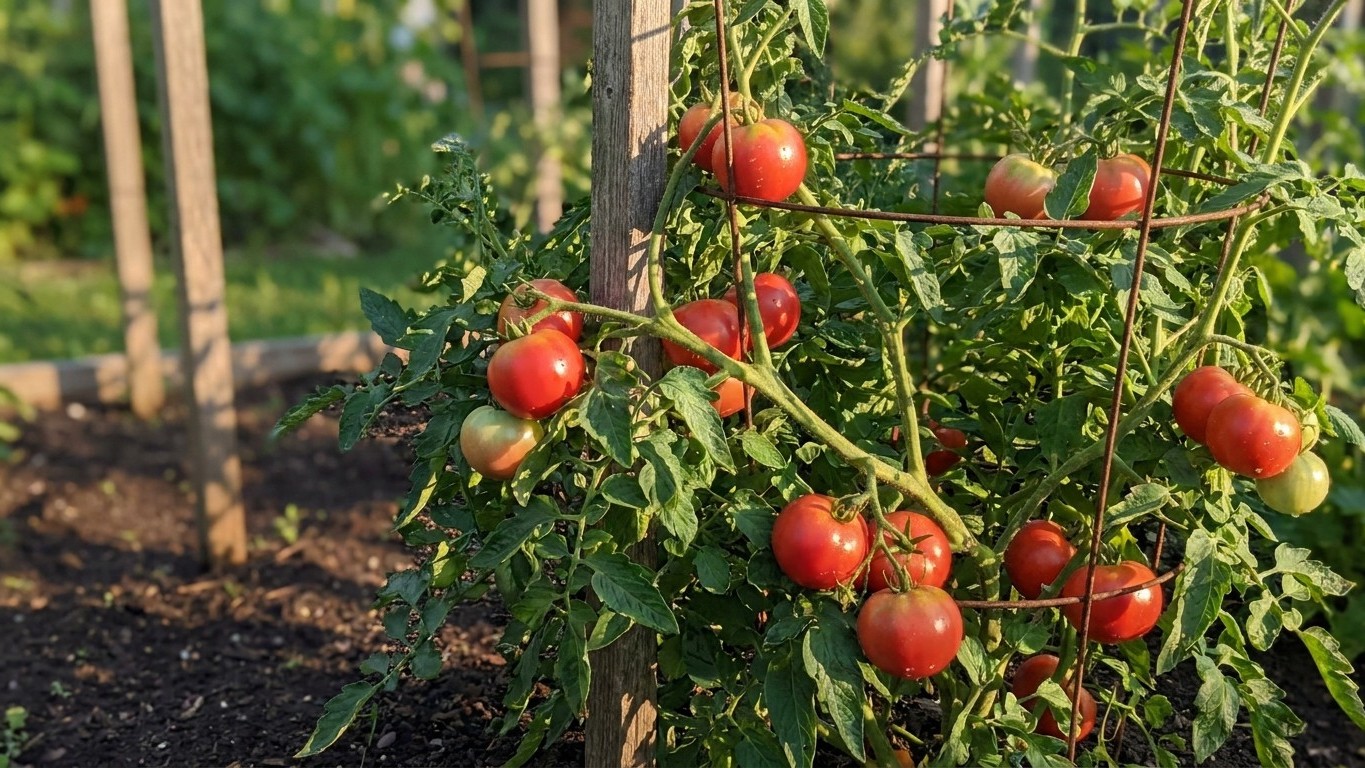

Wisconsin 55 ripens in about 80 days from transplant, which puts it comfortably in the midseason range for a slicer. That figure alone tells you almost nothing until you set it against your own frost dates, your soil temperature in spring, and what your summer nights do to fruit set. That’s the arithmetic worth doing before you order seed.
What Wisconsin 55 actually is
Wisconsin 55 is a slicing tomato, indeterminate in habit, meaning the vine keeps growing and setting new flower clusters until frost cuts it down rather than stopping after one flush. That single fact drives almost every other decision you’ll make about it: it needs a tall cage or a sturdy stake, and it needs that support in place from the day it goes in the ground, not added later once the vine has sprawled.
The fruit runs 6 to 8 ounces, a size that slices cleanly for a sandwich without being unwieldy on a plate. Catalogue listings describe the flavor in the plain sense: a workhorse slicer, nothing eccentric, nothing you’d call tangy or unusually sweet compared to specialty heirlooms. What sets it apart in the kitchen isn’t the raw eating experience so much as its double duty. It’s suited to fresh eating and it has a long-standing reputation as a favorite for stewed tomatoes, which is a meaningful distinction: not every slicer holds its texture and flavor through a canner the way this one does.
The 80-day figure is counted from transplant, not from seed. That basis matters because a lot of gardeners mentally shift their planting calendar by the wrong two or three weeks if they mix up the two counts. If you’re starting seed indoors, add the 5 to 7 weeks of indoor growing time before you ever set the clock running on those 80 days.
Where it ripens in time, and where it is a gamble
The way to test any tomato variety against your climate is a simple subtraction, and it works the same way everywhere in the country. Start with your frost-free window, the number of days between your average last spring frost and your average first fall frost. Subtract about two weeks, because soil needs to warm before a tomato transplant will actually take off rather than sit and sulk. Then subtract the variety’s days to maturity, 80 in this case. Whatever is left is your harvest window, the stretch of time you actually get to pick fruit before frost ends the season.
In the Upper Midwest, using a reference point like Duluth, Minnesota, where the frost-free window runs roughly 120 days, that math looks tight: 120 minus 14 for soil warmup minus 80 for maturity leaves around 26 days of harvest. That’s workable, but it means a Wisconsin 55 planted a week late, or hit by an early September cold snap, can lose a meaningful share of its picking season. Gardeners in similarly short-season pockets of the northern Plains, the Great Lakes region, and higher-elevation parts of the Rockies are working with a comparable margin and should treat transplant timing as non-negotiable.
Move south to somewhere like Richmond, Virginia, with a frost-free window closer to 200 days, and the same subtraction leaves over 100 days of harvest. That’s an entirely different growing experience: a missed week at planting barely registers, and the vine has time to run through several full waves of fruit before frost becomes a concern. Most of the Mid-Atlantic, the Ohio Valley, and the transition zone states share this kind of comfortable margin.
Go further south, to a reference city like Atlanta, Georgia, with a frost-free window near 220 days, and the arithmetic stops being the limiting factor entirely. The math leaves well over 100 harvest days on paper, but as the next section explains, the calendar isn’t the thing that trips this variety up in the Deep South. The frost date stops mattering long before the season does.
Coastal and desert regions complicate the picture in the opposite direction. Places with very long frost-free windows, like much of the Pacific Northwest lowlands or the low desert Southwest, don’t run out of days. They run into a different ceiling, which is the subject of the next section.
The two ways a season goes wrong
A long frost-free window is not the same thing as a good growing season, and this is where a lot of planting guides stop short. Two thresholds sit outside the frost calculation entirely, and either one can gut a harvest even when the calendar looks generous on paper.
In the north, the problem is accumulated warmth, not raw day count. A region can have a technically long enough frost-free window and still fall short on actual growing degree days, because a string of cool, cloudy weeks in June or a chilly stretch in early September doesn’t show up on a frost date chart. Tomato flowers also have a hard biological floor: pollen doesn’t set fruit well once nighttime temperatures drop below 50°F, so a cold snap that never reaches frost can still stall production for a week or two at a time. For a variety like Wisconsin 55, sitting at a moderate 80 days rather than a very long-season heirloom, this cold-nights problem is the more relevant risk. Its harvest window in short-season states is already narrow enough that a single cool spell can eat into it noticeably.
In the south, the limit runs the opposite direction. Once daytime temperatures push past roughly 86°F for extended stretches, tomato pollen becomes sterile and flowers drop without setting fruit, regardless of how much water or fertilizer the plant gets. This is why experienced Deep South and Gulf Coast growers don’t plan one long season for their tomatoes. They plant a spring crop early enough to finish before the worst heat arrives, then set out a second crop in late summer to catch the cooler, fall stretch before frost. For an indeterminate variety like this one, that heat window effectively splits the growing calendar into two working periods rather than one continuous harvest, even though the frost dates alone would suggest months of uninterrupted picking.
Given its 80-day timing, the cold-nights threshold matters more for gardeners at the northern edge of its range, while the heat-sterility threshold matters more for anyone gardening south of the transition zone. Neither shows up on a basic frost map, which is exactly why relying on frost dates alone overstates how forgiving this tomato is at either extreme.
What it resists, and what it does not
Catalogue listings for Wisconsin 55 don’t carry a published disease-resistance code, which is worth stating plainly rather than glossing over. No resistance to verticillium wilt, fusarium wilt, or root-knot nematodes is claimed for this variety, and no letter code (V, F, N, T, or otherwise) appears on the seed packet or listing. That’s different from a variety carrying an intermediate rating, which at least slows a disease’s progress. Here, there’s nothing on record to slow it at all.
That absence has practical consequences. If you’re gardening in soil with a known history of verticillium or fusarium wilt, or in a region where root-knot nematodes are common in sandy soils, Wisconsin 55 offers no built-in defense the way a resistance-bred hybrid would. The workaround is entirely cultural rather than genetic: rotate tomatoes and other nightshades (peppers, eggplant, potatoes) out of the same bed for at least three years, avoid working in wet foliage to limit fungal spread, and consider solarizing or amending soil in beds with a known disease history before planting into them again.
Early blight and other common foliar fungal diseases aren’t addressed by any resistance claim either, so mulching to keep soil-borne spores from splashing onto lower leaves, and giving plants enough spacing for airflow, does more real protective work here than it would for a variety bred with built-in resistance.
Growing it without the usual mistakes
Because Wisconsin 55 is indeterminate, the support structure has to go in on planting day, not weeks later. A tomato cage tall enough to handle a vine that keeps climbing until frost, or a sturdy stake with soft ties added every week or two as new growth appears, both work better than anything sized for a compact determinate plant. Space plants roughly 24 to 36 inches apart to leave room for that continued growth and to keep airflow moving through the foliage, which matters more here given the lack of published disease resistance.
Feeding is a second place where indeterminate habit changes the playbook. Nitrogen-heavy fertilizer applied once fruit sets tends to push the plant into more leafy growth at the expense of flowering, which is a bigger risk with a variety that’s already going to keep growing all season regardless. Easing off nitrogen once the first fruit clusters form, and switching to a lower-nitrogen, higher-potassium feed, keeps the plant’s energy going toward fruit rather than vine.
The timing mistake specific to this variety involves canning plans. Because it ripens in a steady, rolling wave rather than one determinate flush, gardeners who plan a single big canning day, expecting a full bushel to ripen at once, often end up either short on tomatoes for that day or letting a later wave over-ripen on the vine while they wait. Small, repeated canning sessions every week or two as fruit comes ripe match this variety’s actual rhythm far better than one large batch scheduled around a calendar guess.
Common questions
Is Wisconsin 55 the same as Wisconsin 55 Improved?
The names refer to related but distinct listings from different sources. Always check the days-to-maturity and resistance details on the specific packet or listing you’re buying, since minor differences between similarly named strains do exist.
Does Wisconsin 55 need a special canning recipe?
No. It’s suited to standard stewed-tomato and canning recipes using any tested, current canning guideline, since it holds up well to cooking rather than breaking down into mush the way some thinner-walled slicers do.
How tall does the cage or stake need to be?
There’s no published height figure for this specific variety, but because it’s indeterminate and keeps growing until frost, undersized supports (the short, cone-shaped cages sold for determinate plants) are a common and avoidable mistake.
Can I grow Wisconsin 55 in a short-season northern garden at all?
Yes, but the arithmetic leaves a narrower margin than in longer-season regions. Starting transplants indoors on schedule, hardening them off properly, and getting them into warmed soil right at your local frost-free start date matters more here than it would for a shorter-maturity variety.