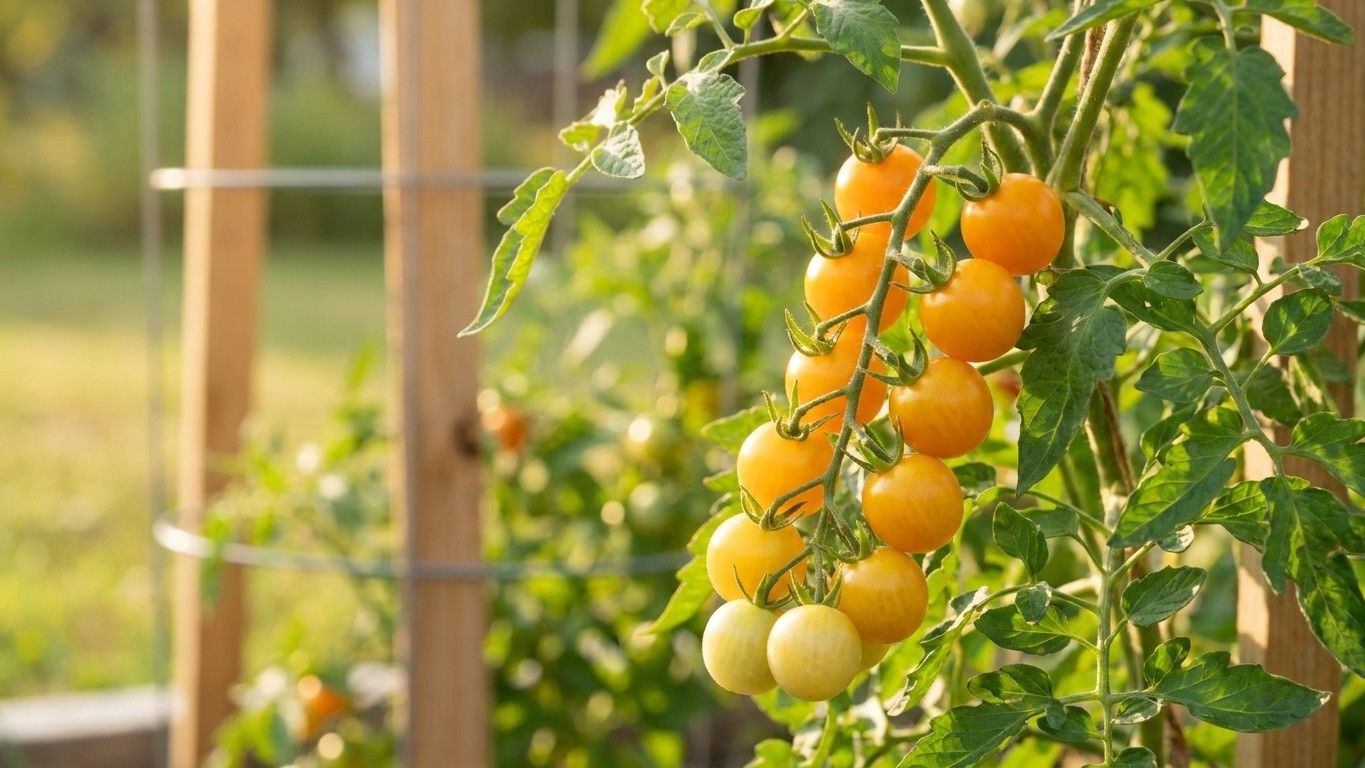

The yellow mini tomato is a small, high-sugar cherry variety built for salads and snacking, not sauce. It reaches its first ripe fruit in 57 days from transplant, carries fair disease resistance on paper, but keeps growing and setting new clusters until frost takes the vine down. That last detail changes almost everything about where it belongs and how it gets grown.
What Brandywine actually is
This tomato is a cherry type, fruit running 15 to 20 grams, so a small handful per cluster rather than a single slicing fruit. The growth habit is indeterminate, meaning the vine does not stop at a set height or a single flush of fruit. It keeps extending, flowering, and setting new tomatoes right up until cold or disease shuts it down. That habit is the reason it needs a tall cage or a stake rather than the low hoop that works for a compact bush variety; without support, an indeterminate cherry vine this productive will sprawl, tangle, and rot fruit on the ground.
Days to maturity is listed at 57, and that figure is counted from transplant, not from the day seed goes into a starter tray. Anyone comparing catalogue numbers across varieties needs to keep that basis consistent, because a 57-day count from transplant and a 70-day count from seed can describe two tomatoes that actually ripen within a week of each other once six to eight weeks of indoor growing is added back in.
In the kitchen, the fruit is described as having excellent sweet, juicy flavor, and its practical use sits squarely in salads and snacking, the way most small yellow cherries do. It is not the tomato to plan a canning batch around.
Where it ripens in time, and where it is a gamble
The question that actually matters for a gardener is simple: does the local frost-free window leave enough days after transplant to reach that 57-day mark, with a cushion for picking. The arithmetic runs the same way in every state. Start with the average frost-free window, the stretch between the last spring frost and the first fall frost. Subtract roughly two weeks, because soil needs to warm before a tomato transplant sets root and starts real growth rather than sitting still. Subtract the 57 days to first ripe fruit. What is left over is the harvest window, the number of days the plant actually spends producing rather than just growing toward its first tomato.
Run that math with a long frost-free window and the harvest window is generous, often stretching into months rather than weeks, which suits an indeterminate vine that keeps cropping. Run it with a short frost-free window and the picture tightens fast. A gardener in a region where frost-free days barely clear the 90-day mark is left with very little slack once the two-week soil warm-up and the 57-day maturity count come out of the total, and a single cold snap or a late, wet spring can erase what little margin remains.
This isn’t a case where exact figures for a specific weather station can be borrowed from somewhere else and presented as gospel for every reader. Frost dates vary by county, by elevation, and by how close a garden sits to a lake or a slope that pools cold air. Those precise local dates aren’t published here. The National Centers for Environmental Information keeps historical climate normals, including freeze and frost dates, searchable by station, and running this variety’s numbers against the actual data for a specific zip code is worth five minutes before committing garden space to it: NOAA NCEI climate data.
As a general pattern, growers in regions with long, humid summers and mild winters tend to have frost-free windows generous enough that 57 days from transplant is a minor consideration. Growers in short-summer regions, where the ground can still be cold in late May and frost can return by mid-September, are the ones who need to run the subtraction carefully before assuming an indeterminate cherry tomato will finish its full season outdoors.
The two ways a season goes wrong
A long frost-free window on paper does not guarantee a good crop, because a frost date table cannot show two separate limits that have nothing to do with the calendar.
In cooler, short-summer regions, the frost-free window can look adequate while the accumulated warmth across that window stays low. Tomatoes don’t just need days without frost, they need nights warm enough to set fruit, and pollination effectively stalls once nighttime temperatures fall below 50 degrees Fahrenheit. A garden that is technically frost-free for 120 days but spends a third of those nights in the 40s will produce far less than the raw day count suggests.
In hot, long-summer regions, the opposite failure shows up. Once daytime temperatures climb above roughly 86 degrees Fahrenheit, tomato pollen turns sterile and flowers drop without setting fruit. That is why growers in the hottest parts of the country don’t run one long tomato season, they run a spring crop that finishes before the worst heat and a second, autumn crop planted once temperatures ease back down, skipping the sterile middle of summer entirely.
For a variety that reaches maturity in just 57 days, the cold-night limit matters more than the heat-sterility limit in most gardens. A fast cherry tomato like this one is well suited to slipping a full harvest window into the cooler end of the season, spring or fall, in regions where the summer peak runs too hot for fruit set. The short maturity count is an advantage precisely because it doesn’t need the long, unbroken heat window that a 90-day slicing tomato requires.
What it resists, and what it does not
The published resistance on this variety covers exactly one pathogen: Tobacco Mosaic Virus, rated High. That is a meaningful protection where TMV pressure is a known problem, since a high rating means the plant is bred to fend off infection rather than simply slow it down.
What the catalogue does not list matters just as much. There is no published resistance to Fusarium wilt, Verticillium wilt, nematodes, or the various leaf-spot and blight pathogens that commonly move through home tomato patches. That is not a flaw hidden in fine print, it is simply the scope of what this variety has been bred and tested against. A gardener growing this tomato in soil with a history of Fusarium or Verticillium should treat it as having no built-in defense against those diseases, because none is claimed.
It is also worth being precise about what “resistance” means even where it is rated. A High rating for TMV is not the same as immunity. It means the plant has a strong, tested ability to resist infection under typical exposure, not a guarantee against every possible viral load. Growers who handle tobacco products before touching plants, a known TMV transmission route, still benefit from washing up first, resistant variety or not.
Where no resistance is listed for a disease, the honest reading is that none exists on paper, not that the omission implies some unlisted, unproven protection.
Growing it without the usual mistakes
Because this is an indeterminate vine, the growing plan looks different from a determinate cherry tomato that ripens most of its fruit in one flush and then tapers off. A determinate variety can get by with a shorter stake or a simple cage sized to its final, fixed height. This vine keeps extending all season, so the support needs to be tall enough, or the trellis system flexible enough, to keep adding height through midsummer without the plant outgrowing its stake by August.
Spacing should account for that same continued growth. Crowding an indeterminate cherry tomato early in the season looks fine in June and becomes a tangled, poorly ventilated mass by late July, which raises the risk of the foliar diseases this variety has no listed resistance against. Good airflow between plants matters more here than it would with a compact bush type.
Feeding follows the growth habit rather than a fixed date. A determinate tomato can be tapered off nitrogen once fruit sets, since there won’t be much more vegetative growth to support. This variety keeps producing new growth and new fruit clusters through the season, so a lighter, steady feeding program that continues into midsummer serves it better than a single early feed followed by nothing.
The most common mistake with a fast, 57-day cherry tomato is treating the early maturity date as the end of the story and easing off on care once the first tomatoes ripen. For an indeterminate variety, that first ripe fruit is the start of months of production, not the finish line, and the plant still needs its support, its water schedule, and its feeding through to frost.
Common questions
Is 57 days to maturity counted from seed or from transplant?
From transplant. Add the weeks spent growing seedlings indoors before that count applies to a planting calendar.
Does this variety need a full-size tomato cage?
It needs a tall cage or a stake sized for continued growth through the season, since the indeterminate habit means the vine keeps extending rather than stopping at a fixed height.
Will it resist common tomato diseases like Fusarium wilt?
No resistance to Fusarium wilt, Verticillium wilt, or nematodes is published for this variety. The only listed resistance is High resistance to Tobacco Mosaic Virus.
Can it be grown through a hot summer without a break?
In regions where daytime temperatures regularly exceed roughly 86 degrees Fahrenheit, fruit set stalls regardless of variety. Its short maturity window makes it well suited to a spring or fall planting that avoids that peak-heat stretch rather than pushing straight through it.