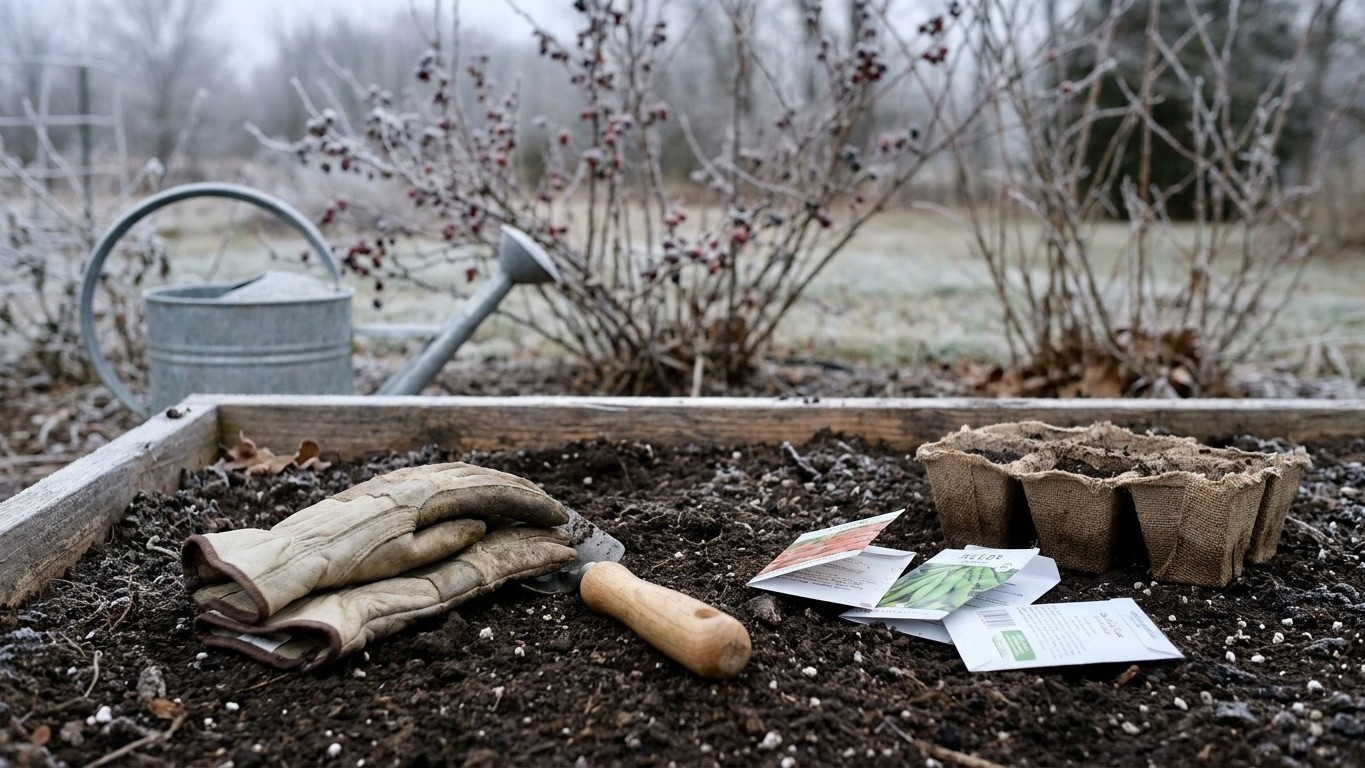

February in Ontario sits close to the coldest point of the year, roughly three months before the province’s average last frost. Direct sowing outdoors is off the table almost everywhere. What actually happens this month is dormant pruning, seed ordering, indoor starts for the crops with the longest runway, and garlic or shallots going into ground that hasn’t frozen solid. The real planting activity lives indoors and under cover, not in open beds.
What goes in the ground in February

Soil temperature, not the page on the calendar, decides what survives outdoors. Environment and Climate Change Canada’s climate normals for the Toronto Lester B. Pearson station put the average last spring frost at April 30. That’s a mean date, not a safe one: in one year out of two, frost arrives later than that. February sits about three months ahead of it, which puts almost every open-ground planting out of reach for most of the province.
There are exceptions, and they matter. Garlic and shallots planted in fall continue their slow root development underground through winter and need nothing from the gardener now except mulch left in place. Where the ground genuinely thaws for a stretch, usually in the milder pockets near Lake Erie and Lake Ontario, a late round of garlic cloves can still go in, but this is a narrow window and depends entirely on local conditions rather than the date on the wall.
Cold frames and low tunnels change the math. Inside one of these, soil temperature runs several degrees warmer than the open bed beside it, enough to keep hardy greens like spinach, mâche, and claytonia ticking along from a fall sowing, or to start a very early tray of peas under glass for transplant once the frame’s interior warms further. Bare-root fruit trees, canes, and dormant shrubs can also go into the ground during any thaw long enough to dig a proper hole, since these plants are biologically asleep and don’t need warm soil to establish roots.
Indoors, forcing is the quiet trick many Ontario gardeners skip. Potted rhubarb crowns brought into a dark, cool space produce tender pale stalks weeks ahead of the outdoor crop. Chicory roots dug in fall and forced in a dark box or bucket yield witloof, the pale, slightly bitter shoots prized in French and Belgian kitchens. Neither needs a greenhouse, just darkness and a spot above freezing.
What to start under cover
Seed starting this month is arithmetic worked backward from the frost window, not forward from today’s date. With an average last frost of April 30, the crops that need the longest head start go first. Onions and leeks from seed typically want ten to twelve weeks under lights before transplant, which puts their start squarely in this window. Peppers, notoriously slow to germinate and grow, usually need eight to ten weeks indoors, another crop that belongs on the tray now in much of the province.
Tomatoes are trickier. Most varieties want six to eight weeks before transplant out, which for an April 30 average means they can wait a little longer without losing ground, though a gardener in the coolest districts north of the Pearson station’s climate should count from a later personal frost estimate, not the provincial average.
The two ways this goes wrong are mirror images of each other. Start too early and the seedlings outgrow their pots weeks before it’s safe to plant them out, ending up rootbound, stretched, and stressed by the time the soil finally warms. Start too late and slow crops like onions or peppers never reach a productive size before the growing season runs out from the other end, at the average first fall frost of October 16. Both mistakes trace back to the same error: counting from the wrong date, or not counting at all.
A heat mat under the trays speeds germination for peppers and tomatoes, both of which sulk in cool soil even indoors. A simple shop-light fixture, kept just above the leaves and moved up as seedlings grow, does more for stocky, non-leggy transplants than any fertilizer.
What is ready to pick
Outdoors, February gives up almost nothing fresh across most of the province. That’s the honest answer, and it’s worth saying plainly rather than padding a list with crops that aren’t really there. What keeps a household fed from the garden this month comes from what was tucked away earlier in the season.
Kale and leeks left in the ground under a blanket of snow often taste better after hard cold, since the plant concentrates sugars as a natural antifreeze. Digging leeks out from under snow and frozen crust takes some effort but the reward is a genuinely sweeter vegetable than the same crop pulled in October. A cold frame with fall-sown spinach, mâche, or arugula can still be producing small, slow harvests on any day the frame’s interior climbs enough for the plants to open up.
Indoors, sprouts and microgreens fill the gap in days rather than months. A jar of sprouting mung beans or lentils on the counter, or a shallow tray of pea shoots or sunflower greens under a window, gives fresh green food inside a week or ten days with no soil frost to fight.
Stored crops need checking now, not later. Squash, potatoes, and onions put away in fall are three or four months into storage by February, long enough for the first soft spots and sprouts to show up. Go through the bins: any squash with a soft or sunken patch should be used immediately, any potato that’s sprouting or turning green near the skin should be pulled from the batch, and any onion gone soft at the neck won’t hold much longer.
The jobs that matter this month

A quiet-looking month on the calendar still carries real deadlines in the garden, and February in Ontario has plenty of them. Dormant pruning of apple, pear, and stone fruit trees, along with raspberry and currant canes, is best done while the plant is fully asleep and the branch structure is easy to see without leaves in the way. Wait too long and the tree starts pushing sap, making cuts messier and slower to heal.
Seed ordering has its own clock, separate from the garden’s. Popular varieties, especially of tomatoes, peppers, and anything grown from open-pollinated or heirloom seed, sell out from smaller suppliers well before spring. Ordering now, while starting seed indoors anyway, avoids the scramble of a March order arriving too late for a proper head start.
Planning next season’s bed rotation matters more in February than it will once the soil is workable and the pressure to just get planting takes over. Nightshades, brassicas, and legumes each draw down and add back different things to the soil, and a written rotation plan drafted now, on paper rather than from memory, prevents the same family of crops from landing in the same bed two years running.
Soil testing and amending, where the ground is workable, gives lime or sulfur time to shift pH before spring planting. Turning the compost pile, even a frozen one, keeps the pile from compacting into an anaerobic block. Cleaning and sharpening pruners, hoes, and shovels now means no delay once the ground opens up. Fences, cold frame hinges, and raised bed corners worth repairing are far easier to fix without a foot of snow in the way, and stored crops, as covered above, need another pass through for rot before spring use.
What not to do in February
The most common mistake this month has nothing to do with cold, it has to do with a warm afternoon. A run of unusually mild days convinces gardeners the season has turned, and warm-season starts get pushed outdoors, or seed goes into ground that’s still cold three inches down even though the air feels like spring. Soil warms far slower than air, and a thermometer pushed into the bed tells the truth better than a jacket left at home.
Uncovering cold frames or removing winter mulch after that same mild spell is the second version of the error. Ontario’s weather swings back hard after a warm stretch, and plants or crowns exposed too early can be hit by a return freeze they’d have shrugged off if left covered. Mulch and frame lids come off on a trend, not on a single sunny afternoon.
Feeding nitrogen at the wrong point in the season causes its own quiet damage. Applying a high-nitrogen fertilizer to dormant fruit trees or perennials this early pushes soft new growth right before the next freeze, growth that’s far more vulnerable to cold damage than growth that waits for the soil to warm on its own schedule. Nitrogen belongs later, timed to active growth, not to a gardener’s impatience in the depth of winter.
Finally, treating the province’s average last frost, April 30, as a hard rule rather than a midpoint causes more failed transplants than almost anything else. Half of all years run later than that average, and a transplant moved outdoors on the assumption that the average date is a guarantee is a gamble dressed up as a schedule.
Checking this against your own county
A province-wide month is a starting point, never an instruction on its own. Ontario stretches from the shoreline of Lake Erie to districts far to the north, and elevation, lake effect, and the simple distance between the south and the north of the province can shift these windows by weeks in either direction. The frost dates and hardiness zone cited on this page come from a single reference station, and a garden even a short drive away can run measurably colder or warmer.
The Canadian hardiness zone system used here, built from seven climate variables rather than the single winter-low figure behind the American system, doesn’t convert cleanly across the border either, so treat it as its own scale. For a local check, the Ontario Ministry of Agriculture, Food and Rural Affairs and Natural Resources Canada’s plant hardiness site both let a gardener look up figures closer to their own municipality rather than a single provincial average.
Common questions
Can anything actually be planted outdoors in Ontario in February?
Very little, and only in specific conditions. Garlic or shallots can occasionally still go into ground that hasn’t frozen, mostly in the milder Lake Erie and Lake Ontario districts, and bare-root fruit trees or dormant shrubs can be planted during any thaw deep enough to dig a proper hole. Everything else waits for warmer soil.
Is it too early to start tomato and pepper seeds indoors?
Peppers, which usually need eight to ten weeks before transplant, are often right on schedule this month given an average last frost of April 30. Tomatoes, needing six to eight weeks, can sometimes wait a little longer without falling behind, depending on how far north or how close to the Great Lakes the garden sits.
What does the average last frost date of April 30 actually mean?
It’s a mean figure from Environment and Climate Change Canada’s climate normals at the Toronto Pearson station, not a guarantee. In roughly half of all years, frost arrives after that date, so treating it as a safe planting cutoff rather than the midpoint of a range is a common way transplants get caught by a late freeze.
Why does this page mention a Canadian hardiness zone instead of a USDA zone?
Ontario uses the Canadian hardiness system, built from seven climate variables rather than the single winter-low temperature the USDA system relies on. The reference city on this page sits in Canadian zone 7a, and Natural Resources Canada is explicit that the two systems don’t convert directly, so a Canadian zone number shouldn’t be read against a USDA map.