
January in Ontario means frozen ground, short daylight, and a growing season that is still three to four months away. The honest answer to what goes outdoors this month is: almost nothing. What actually moves the needle now is indoor seed-starting arithmetic, dormant-season maintenance, and protecting whatever you already tucked into the soil last fall.
What goes in the ground in January

Nothing goes into open, unprotected soil in Ontario this month, and no seed catalog claim changes that. The average last spring frost for the region, based on the Toronto Lester B. Pearson station, falls around April 30, and that date is a midpoint, not a guarantee. In roughly half of all years the last frost lands even later. January sits four months before that midpoint, with frozen or waterlogged ground for most of the province. Working soil that is frozen solid or saturated with meltwater does more harm than good: it compacts structure and destroys the pore space roots depend on later.
That does not mean the garden goes untouched. If garlic and shallots were already planted in the fall, this is the month to check that mulch cover has not blown off or washed thin, since exposed cloves can heave out of the ground during freeze-thaw cycles. Anyone in a milder pocket, closer to Lake Erie or Lake Ontario where the water moderates temperature swings, may catch a brief thaw where the top few inches of soil become workable; even then, save that window for finishing fall cleanup rather than new plantings.
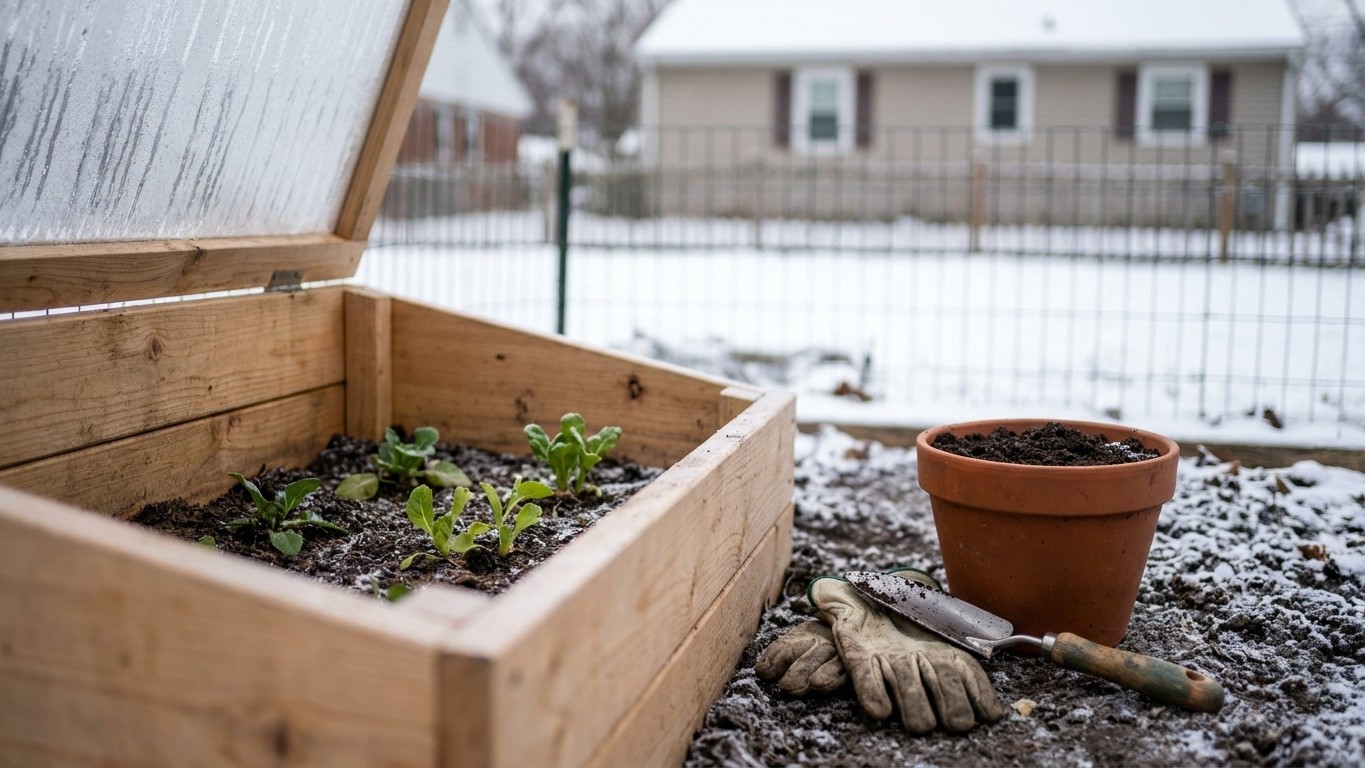
Cold frames and unheated hoop tunnels are the closest thing to “planting” that makes sense in January. If one was set up in the fall over spinach, mâche, or claytonia, it can keep producing slowly through the coldest stretch, though growth nearly stops below a certain light and temperature threshold. Bare-root fruit trees and dormant canes can sometimes be heeled into a trench if the ground is workable, but most nurseries will not even ship them this early. Forcing rhubarb crowns or Belgian endive (chicory) roots indoors, in a dark, cool space, is a realistic January project that delivers something to harvest within weeks, using stored energy rather than new sunlight.
What to start under cover
Seed-starting math runs backward from the frost window, not forward from the calendar. With an average last frost around April 30, the slowest-growing transplants, onions and leeks started from seed, are typically begun 12 to 14 weeks ahead of that date. Counted back, that lands in mid-to-late January, which makes onions and leeks the main candidates for indoor sowing this month. Peppers and eggplant, which need roughly 8 to 10 weeks under lights before transplanting, are usually still too early in January; starting them now often means leggy, rootbound seedlings well before the soil or the weather is ready for them outside.
| Crop | Weeks before last frost to sow indoors | Approximate sowing window from an April 30 average frost |
|---|---|---|
| Onions (seed) | 12-14 weeks | Late January |
| Leeks | 10-12 weeks | Early-to-mid February |
| Celery | 10-12 weeks | Early-to-mid February |
| Peppers | 8-10 weeks | Mid-to-late February |
| Tomatoes | 6-8 weeks | Early-to-mid March |
The two failure modes are predictable. Starting warm-season seedlings like tomatoes or peppers in January means fighting weak winter light for two extra months, and by transplant time they are often stretched, pale, and struggling to recover. The opposite mistake, waiting until the soil warms outside to sow anything indoors, leaves slow crops like leeks and celery without enough runway to size up before the season ends. January’s real job is starting the slow growers and holding off on everything else.
What is ready to pick
Outdoors, there is little to nothing coming out of an open Ontario garden in January. Snow cover and hard-frozen ground put a stop to active harvest, though a few things can still be pulled if they were left in place deliberately. Kale, and sometimes leeks, planted for overwintering can be dug or cut from under snow in a mild spell, since both tolerate hard freezes and often taste sweeter after cold exposure converts starches to sugar. A cold frame with hardy greens can still yield small, slow-growing leaves for salads.
Indoors, the harvest shifts to what you control entirely: sprouts from a jar on the counter, and microgreens grown under a simple light setup, both ready within one to two weeks of sowing. These are worth leaning on in January precisely because they do not depend on the weather at all.
The other January harvest job is really an inspection. Stored squash, potatoes, and onions from last season’s crop need a walk-through now, since this is typically when the first signs of rot or sprouting show up. Squash with a soft spot or a sweetish smell should be used immediately rather than left to spread decay to the rest of the batch. Potatoes that have started sprouting eyes are still edible once the sprouts are removed, but they are past their storage life and should move to the front of the meal plan. Onions that have gone soft at the neck are the ones to pull and use first.
The jobs that matter this month

January carries more real work than its quiet appearance suggests, and skipping it costs the season, not just the month. Dormant pruning of fruit trees, currants, and raspberry canes is best done now, while the plants are fully dormant and the branch structure is visible without leaves in the way; pruning cuts made in winter also close and heal before pests and disease are active again in spring.
Seed ordering belongs on this month’s list too, and not as an afterthought. Popular varieties, especially disease-resistant tomatoes and heirloom types, sell out from seed companies well before planting season, and ordering in January means the seed arrives with time to spare for the backward-counting math described above.
Soil testing is another task that pays off more in winter than in any other season, since results and any recommended amendments have months to work into the soil before planting starts. Turning an outdoor compost pile, even a half-frozen one, keeps decomposition moving and prevents it from going anaerobic under a crust of ice. Indoors, this is also the month to clean and sharpen pruners, shovels, and hoes, since rust and dull edges accumulated over a season of use are far easier to fix on a workbench in January than mid-task in June.
Rounding out the list: repairing raised bed frames, fence posts, or trellis hardware that a fall inspection flagged, and sketching out next season’s crop rotation on paper while last year’s layout is still fresh in memory. None of these tasks are flashy, but each one saves hours, or a lost crop, later in the year.
What not to do in January
The most common January mistake is trusting a mild afternoon over the calendar. A stretch of unseasonably warm air does not mean the soil below has warmed with it; ground temperature lags behind air temperature by weeks, and any warm-season seed sown into cold soil will simply rot rather than germinate. The fix is to keep those seeds indoors under lights and let the soil catch up on its own schedule.
A related error is pulling row cover or opening a cold frame fully during a warm spell, only to have a hard freeze move back in a few days later and damage plants that had just started actively growing again. Cold frames and tunnels should be vented for excess heat and humidity on mild days, not opened wide, and covers should go back on well before nightfall.
Feeding overwintered crops or fruit trees with a nitrogen-heavy fertilizer this month is also counterproductive. Nitrogen pushes soft, leafy growth, and that new growth has no cold tolerance; a following freeze can kill it back and stress the plant right when it needs to stay dormant. Hold off on nitrogen until growth naturally resumes closer to the frost-free window, and use January instead for phosphorus and potassium amendments based on a soil test, which support root and structural health without triggering a growth flush.
Checking this against your own county
A province-wide January calendar is a starting point, not a fixed instruction, and Ontario is large enough that the same month plays out very differently from one county to the next. Elevation, distance from the Great Lakes, and simple north-south geography can shift frost windows by several weeks in either direction; a lakeshore garden near Niagara often thaws earlier than one just an hour north. The reference frost dates above come from a single station, Toronto Lester B. Pearson, and the Canadian hardiness zone rating of 7a applies specifically to that reference city, not to the whole province.
For local adjustments, the Ontario Ministry of Agriculture, Food and Rural Affairs is the place to check current guidance and regional planting resources before locking in a schedule based on provincial averages alone.
Common questions
Can I plant garlic in January in Ontario?
No. Garlic is planted in the fall, months before the ground freezes, so it can establish roots before winter. January is for checking that fall-planted garlic still has adequate mulch cover, not for planting new cloves.
Is it too late to start seeds indoors in January?
No, but timing matters by crop. Onions and leeks, which need 12 to 14 weeks before the average April 30 last frost, are appropriately started in January. Tomatoes and peppers are still too early and should wait.
What Canadian hardiness zone is Ontario in?
The reference city used in these figures, based on the Toronto Lester B. Pearson station, rates as zone 7a in the Canadian system. This is not a USDA zone and does not convert directly to the American scale, since the two systems use different climate variables. Zones vary widely across the province, and northern or upland districts run several zones colder.
Why can’t I just plant when the weather feels warm?
Air temperature and soil temperature move on different schedules. A mild afternoon can feel like spring while the ground several inches down is still near freezing, and seeds sown into that cold soil typically rot rather than sprout.