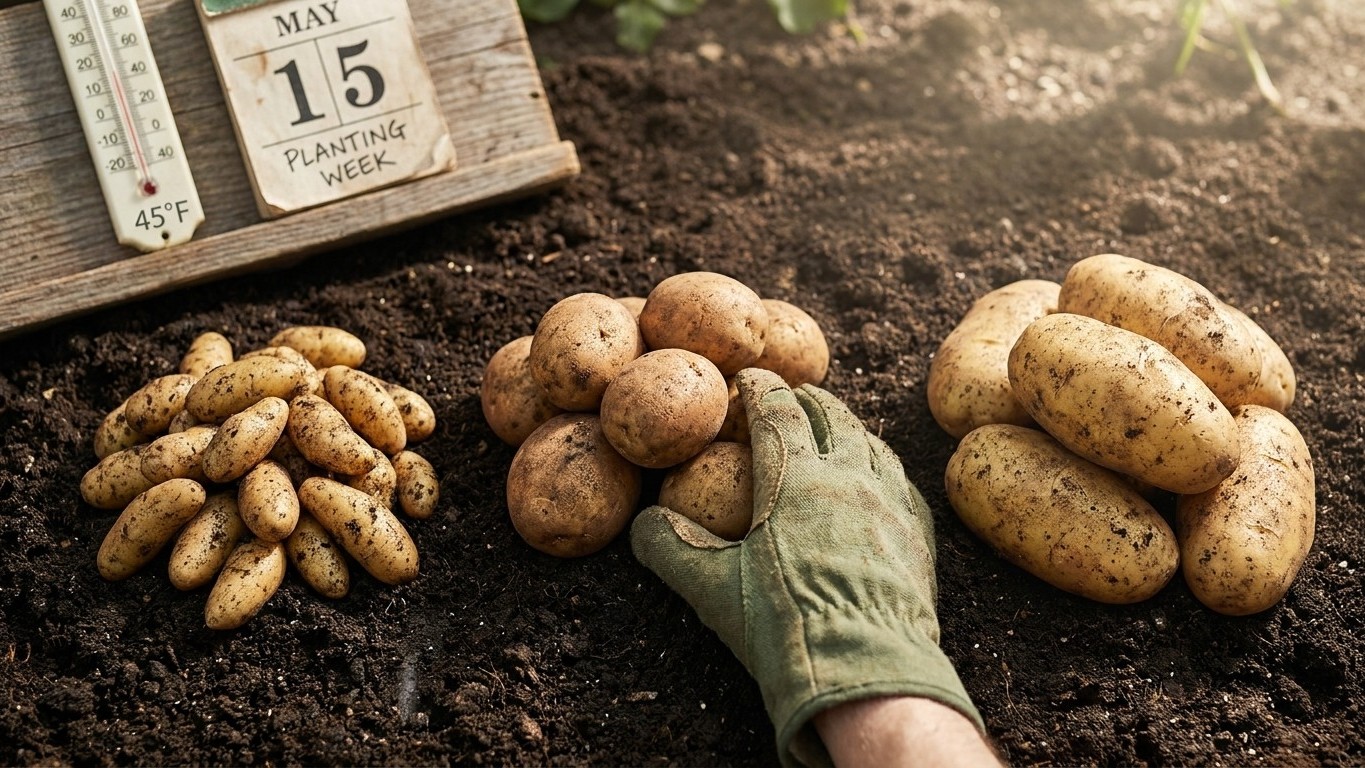

Ontario’s growing window opens later than most gardeners plan for, and it can close early if a hot stretch settles in. The last spring frost averages April 30 at Toronto Pearson, according to Environment and Climate Change Canada’s Canadian Climate Normals, but that average is a midpoint, not a safe date. What actually decides which potatoes suit the province is season class, matched to soil temperature and heat tolerance, not a brand name on a seed bag. Early types get out of the ground before the worst heat; late types need a longer cool stretch this climate does not always deliver.
The short answer
The figure that anchors every planting decision in Ontario is that April 30 mean last-frost date from Environment and Climate Change Canada’s Canadian Climate Normals, read at the Toronto Lester B. Pearson International Airport station. That number is not a promise. It is a 1981-2010 average, and in roughly half the years on record, frost has arrived after it. Anyone planning a potato bed off a single calendar date is already gambling with half the odds against them.
Season class is what actually answers the question in the title. Utah State University Extension and the University of Maine Cooperative Extension both classify potatoes as early, mid-season, or late, based on how much of the growing season each type needs to finish sizing tubers. Neither source publishes a days-to-maturity count, and any number claiming to be one is not coming from these two authorities. What they do publish is the mechanism: potatoes go into the ground once soil reaches 50 F, a point that lands 14 to 21 days before the last frost date, and tuber set and fill shut down once soil climbs past 90 F.
Put those two facts together and the shape of an Ontario answer appears. A grower working off the Toronto Pearson normal has a planting target sometime before the April 30 mean, adjusted for how cold the local soil runs. From there, the choice between early, mid-season, and late classes comes down to how much of the summer that garden typically spends above the 90 F soil threshold, not a calendar count of days. Southern Ontario gardens with hot, exposed soil favor early types that finish sizing before peak heat. Cooler, shaded, or northern sites can carry a mid-season or late class further into the year, but only if the soil stays under that 90 F ceiling.
Neither source in play here recommends a specific named variety for Ontario. What they hand a gardener instead is a decision rule: match season class to your own soil’s heat curve, and choose the type by end use, baking or boiling, rather than by a texture label neither extension office uses.
What actually decides it
Soil temperature starts the clock, not the frost date
The last-frost date gets all the attention, but it is not what triggers planting. Utah State University Extension and the University of Maine Cooperative Extension both tie planting to soil temperature reaching 50 F, a point that typically falls 14 to 21 days ahead of the last frost. That window matters more in Ontario than in milder climates, because a mean frost date pulled from one station, Toronto Pearson, does not describe a whole province. Soil in a low-lying, poorly drained garden warms slower than soil in a raised, south-facing bed even a short drive away. Two gardeners reading the same April 30 average can be two weeks apart on the actual day their soil clears 50 F.
The 90 F ceiling ends the growing story, not the vine
Once soil temperature crosses 90 F, tuber set and fill stop, regardless of how healthy the foliage looks above ground. That is the mechanism a gardener needs to plan around, because it is invisible from the surface. A vine can stay green and full while the tubers underneath have already quit sizing. Watering more does not reverse it. This is why season class matters more than any variety name: an early class finishes its tuber-sizing work before a typical hot stretch arrives, while a late class is betting on a summer that stays cooler longer than most Ontario locations manage.
Certified seed decides whether the crop gets a fair shot at all
None of the above matters if the seed potato is already carrying virus. Uncertified seed is a known carrier, and it undercuts a well-timed planting before the soil temperature question even comes into play. This is a mechanism separate from climate: it is a starting condition, and it is the one variable a gardener controls completely, regardless of what the weather does.
How to do it
- Check your own soil temperature at planting depth rather than relying on the calendar; wait until it holds at 50 F, since that is the trigger both extension sources use, not the frost date itself.
- Count backward from your local expectation of the last frost, understanding that Toronto Pearson’s April 30 mean is a midpoint and that a colder microclimate or a northern district can run weeks behind it.
- Choose a season class, early, mid-season, or late, based on how many weeks your garden typically holds soil under 90 F before summer heat sets in.
- Source certified seed potatoes specifically; uncertified stock risks introducing virus before the plant has a chance to size a single tuber.
- Cut and cure seed pieces if needed, then plant once the 50 F soil threshold is confirmed, not before.
- Hill soil around the stems as the plants grow, keeping developing tubers covered and shaded from direct heat buildup at the surface.
- Watch the calendar for the point where local soil temperature is likely to approach 90 F, and treat that as the effective end of tuber sizing for the season, whatever the vines look like above ground.
- Harvest according to season class: early types typically come out before the hottest stretch of summer even begins; mid-season and late types stay in longer only where soil has stayed under that heat ceiling.
What goes wrong
- Planting by the frost date alone. Treating April 30 as a hard line rather than a mean invites a late frost to catch tender shoots; check actual soil temperature at planting depth instead of trusting a single calendar date.
- Using uncertified seed potatoes. Uncertified stock carries virus risk from the start, undermining the crop before soil temperature or season class ever come into play; buy certified seed specifically labeled as such.
- Assuming a hot summer can be watered around. Once soil crosses 90 F, tuber set and fill stop; extra irrigation does not restart that process, so the fix is choosing an earlier season class next time, not compensating in-season.
- Ignoring microclimate inside the same province. A single provincial or even station-level frost average, like the Toronto Pearson figure, does not describe a shaded, low-lying, or northern garden; track your own site’s soil warming pattern rather than applying one regional number everywhere.
- Picking a late-season class in a garden that runs hot early. A late class needs a longer stretch of cool soil to finish sizing; in a garden that regularly climbs past 90 F by midsummer, that stretch may not exist, and an early or mid-season class is the safer match.
Common questions
Is April 30 a safe planting date for Ontario gardens?
No. It is the mean last-frost date at the Toronto Pearson station from Environment and Climate Change Canada’s Canadian Climate Normals. In roughly half of recorded years, frost has occurred after that date, so it functions as a midpoint for planning, not a guarantee.
Should I plant potatoes based on the frost date or the soil temperature?
Soil temperature. Utah State University Extension and the University of Maine Cooperative Extension both identify 50 F soil as the planting trigger, a point that generally falls 14 to 21 days before the last frost date, meaning the frost date is a reference, not the actual signal.
What happens to potatoes once soil gets too hot?
Once soil temperature passes 90 F, tuber set and fill are inhibited. The plant can still look healthy above ground while the tubers beneath it have stopped sizing, and additional watering will not reverse that.
Does one variety name suit all of Ontario?
Neither Utah State University Extension nor the University of Maine Cooperative Extension publishes a single recommended variety for a province this size. What they publish is a framework: match season class, early, mid-season, or late, to how long your specific garden’s soil stays below the 90 F ceiling, and choose type by intended use, baking or boiling, since that is what the sources actually classify.