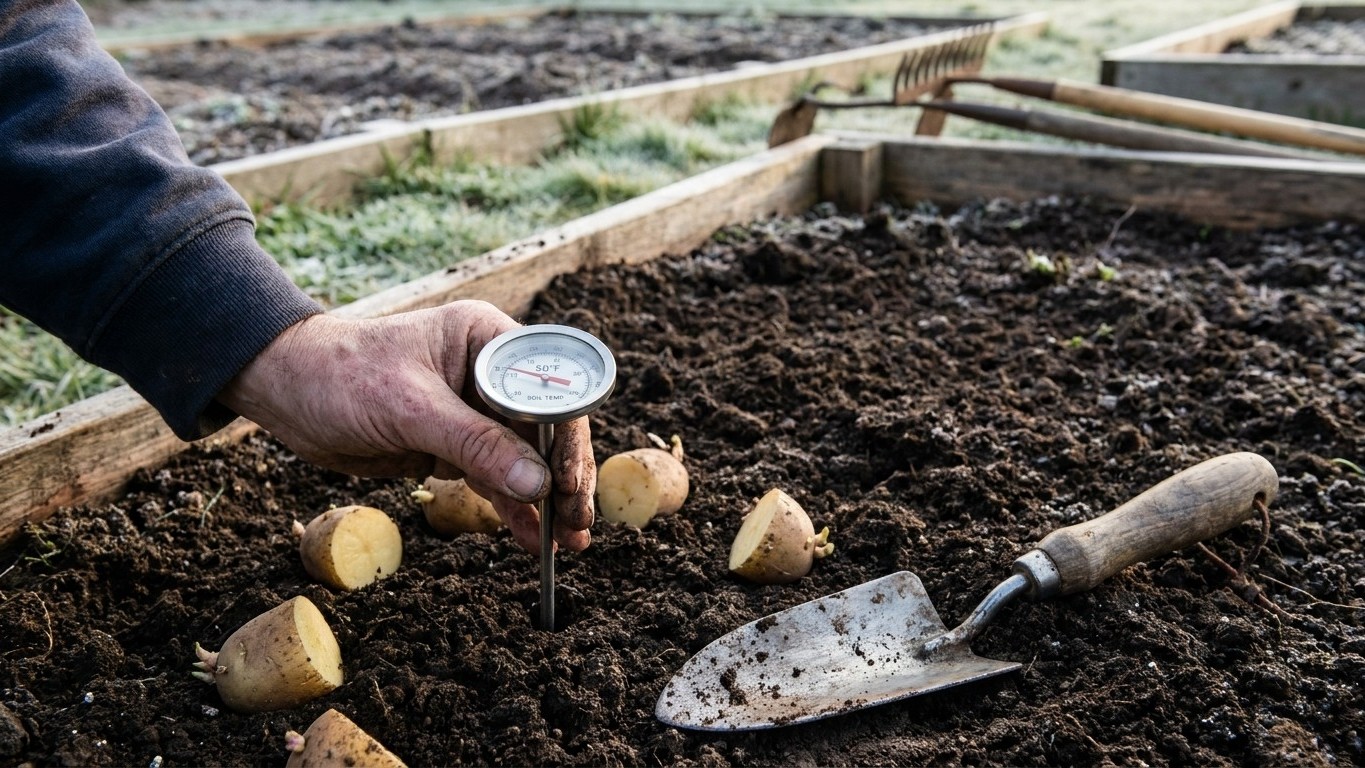

The reliable answer starts with soil, not the calendar. Potatoes go in the ground once soil temperature hits 50°F, and that point falls 14 to 21 days before the last frost date, according to Utah State University Extension and the University of Maine Cooperative Extension. For the Toronto Pearson reference station, Environment and Climate Change Canada puts the average last spring frost at April 30, which means the soil-ready window lands roughly in the first half of April there.
The short answer
Environment and Climate Change Canada’s Canadian Climate Normals, drawn from the Toronto Lester B. Pearson International Airport station and covering the 1981-2010 period, list April 30 as the average date of the last spring frost. Count backward 14 to 21 days from that date, following the Utah State and Maine guidance on soil temperature, and you land somewhere between April 9 and April 16 for that specific station’s area. That is the window when soil there typically warms past 50°F, the threshold both extension services identify as the moment potatoes go in the ground.
That number belongs to one station, not to Ontario as a whole. A province stretching from the Niagara peninsula to the Hudson Bay lowlands does not share a single frost calendar, and the Toronto Pearson figure is only useful as a reference point for growers near that specific location. Anyone farther north, at higher elevation, or farther from the moderating effect of Lake Ontario should expect their own last frost to fall later, sometimes by weeks, which pushes the whole planting window later too.
The other detail worth sitting with is what “average” actually means here. This is a mean date, not a safe date and not a probability band. In roughly half of all years on record, the last frost at that Toronto station came after April 30. Treat the date as the midpoint of a range, not a line you can plant right up against. A gardener who plants exactly on the mean date is gambling on a coin flip that frost won’t return.
So the honest short answer reads like this: for a garden near the Toronto Pearson reference point, soil is likely warm enough for potatoes sometime in the first half of April, but that estimate carries real uncertainty baked into it by definition. For anywhere else in Ontario, the right move is to find the last-frost normal for the nearest weather station and run the same 14-to-21-day count backward from there, rather than borrowing the Toronto figure and hoping it transfers.
What actually decides it
Soil temperature is the trigger, not the date on the wall
Potatoes do not read calendars. What triggers healthy sprouting and early root development is soil that has reached 50°F, a threshold documented by both Utah State University Extension and the University of Maine Cooperative Extension. Cold, wet soil below that mark slows sprouting and invites rot before the plant ever gets a fair start. That is why the extension guidance frames planting around a soil temperature reading, with the 14-to-21-day-before-last-frost figure as a rule of thumb that maps to when soil typically warms up, not as an independent rule on its own.
The 90°F ceiling that ends the season from the other direction
The frost date sets the early boundary, but heat sets the late one, and it is easy to miss. Tuber set and fill get inhibited once soil temperature climbs above 90°F, per Utah State and Maine extension research. This is not something a gardener can water their way out of. Once soil crosses that ceiling, the plant’s energy stops going into sizing tubers, no matter how much irrigation follows. That single fact reframes the whole planting decision: in a region where summer soil regularly pushes past 90°F, the answer is not to plant later and hope for a longer season. The answer is to plant as early as soil allows and treat the harvest as a spring crop that beats the heat, rather than a summer crop that tries to outlast it.
Why the frost date itself moves depending on where you stand
A last-frost normal is a station-specific average, built from decades of temperature readings at one physical location. Move away from that station and the number stops applying with the same confidence. Elevation matters, because cold air pools in low ground and drains away from high ground. Proximity to a large lake matters too, since lake-moderated air holds heat longer into spring than inland air does. None of this shows up in a single provincial number, which is exactly why the Toronto Pearson figure should be treated as a worked example of the method, not as a province-wide fact.
How to do it
- Find the last-frost normal for the weather station closest to your garden, not just the nearest city name, since microclimates shift the number even within short distances.
- Count back 14 to 21 days from that date to estimate when local soil is likely to reach 50°F, following the window Utah State University Extension and the University of Maine Cooperative Extension both describe.
- Confirm the estimate with a soil thermometer pushed 4 inches deep, checked on a few consecutive mornings, rather than relying on the calculation alone.
- Buy certified seed potatoes rather than saving pieces from a previous harvest or using grocery-store potatoes, since uncertified seed carries virus that a healthy-looking tuber will not reveal.
- Cut larger seed potatoes into pieces with at least one eye each, and let the cut surfaces callus for a day or two before planting to reduce rot risk in cool soil.
- Plant once soil has reached 50°F, choosing an early-season variety if your area’s summer soil is likely to climb past 90°F before a mid-season or late variety would finish sizing.
- Hill soil up around the stems as the plants grow, which keeps developing tubers covered and shaded rather than exposed near the surface where heat and light reach them fastest.
- Track the season toward harvest by watching plant condition and soil temperature rather than counting days, since neither Utah State nor Maine publishes a fixed days-to-maturity number for any variety, only the season class: early, mid-season, or late.
What goes wrong
- Planting on a fixed calendar date instead of checking soil. A date that worked one season can land in soil still under 50°F the next, since the last-frost figure is a long-term average, not a guarantee for any single year. Check soil temperature directly before planting rather than trusting the date alone.
- Using saved or grocery-store potatoes as seed. Potatoes without certified seed status carry a real risk of virus that reduces yield and can build up in garden soil over successive plantings. Buying certified seed potatoes each season is the one habit both extension sources treat as non-negotiable.
- Ignoring the heat ceiling and planting late hoping for a bigger harvest. Once soil passes 90°F, tuber set and fill shut down regardless of watering, according to Utah State and Maine extension guidance. In areas prone to hot summer soil, plant as early as the soil allows and pick an early or mid-season variety rather than gambling on a late one.
- Skipping the hilling step. Tubers that push up near the soil surface get exposed to light and heat sooner, which pushes them toward that same 90°F problem earlier in the season. Regular hilling keeps them buried and cooler for longer.
- Planting in cold, waterlogged soil to “get ahead” of the season. Soil below 50°F slows sprouting and raises rot risk, undoing any head start the early planting date was meant to buy. Waiting for the actual temperature reading beats guessing from the calendar.
Common questions
Does the Toronto Pearson last-frost date apply to the rest of Ontario?
No. It applies to that specific station and its immediate area. Environment and Climate Change Canada’s Canadian Climate Normals are station-based, and a province with as much variation in latitude, elevation, and lake influence as Ontario will have last-frost dates that shift by weeks depending on location.
Should I plant exactly on the average last-frost date?
No. That date is a mean, meaning frost arrives after it in roughly half of all recorded years. Planting well before or on that exact date without checking soil temperature carries real frost risk for the young sprouts.
What if my soil is still cold when the calculated window arrives?
Wait for the soil, not the calculation. The 14-to-21-day count is a rule of thumb built around when soil typically reaches 50°F; a soil thermometer reading overrides the estimate when the two disagree.
Which potato variety should I choose if summers run hot?
Neither Utah State nor the University of Maine publishes days-to-maturity figures for specific varieties, but both identify season class. In areas where soil regularly exceeds 90°F in summer, an early or mid-season variety sized before peak heat arrives is the safer choice over a late-season one.