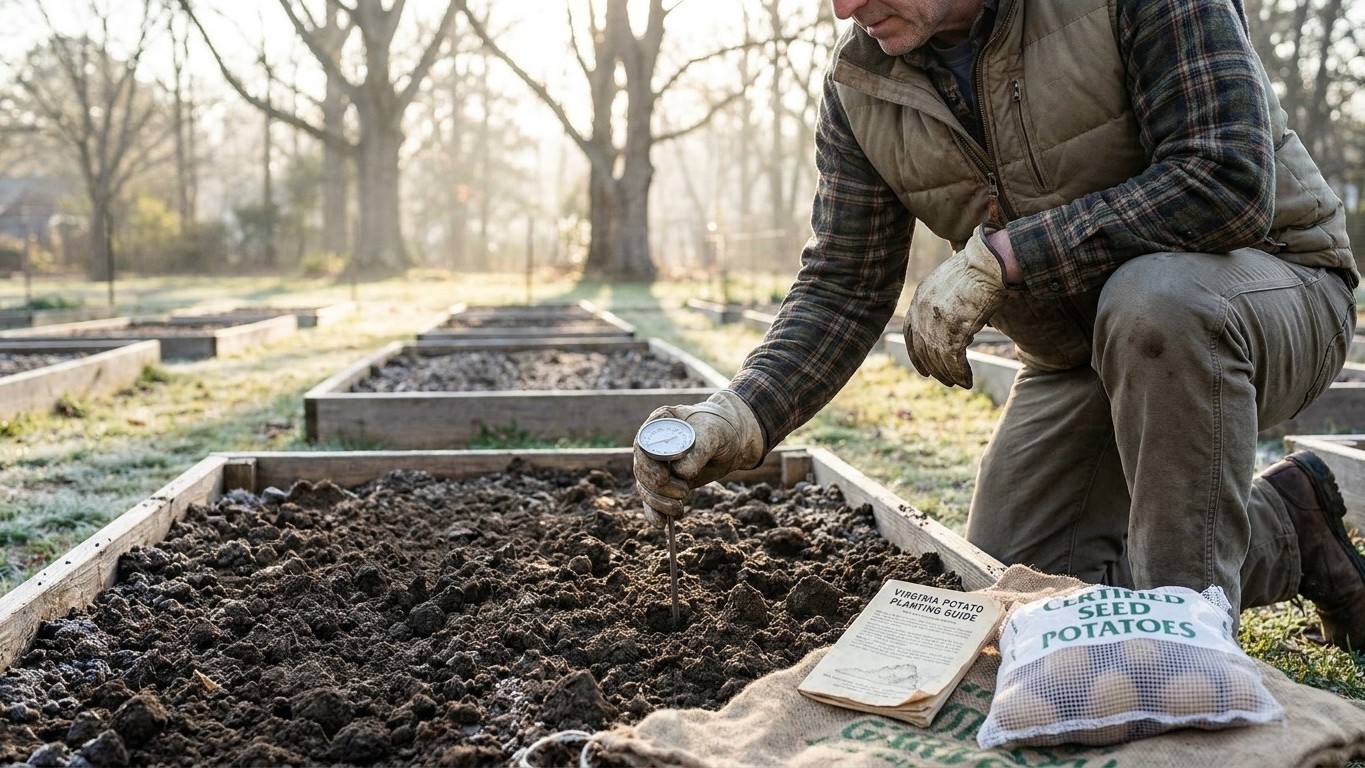

For coastal Virginia, count back 14 to 21 days from the last spring frost window of March 20 to April 3, based on NOAA’s Climate Normals for the NAS Oceana station near Virginia Beach. That lands potato planting in the first half of March for the mild end of the state. Inland and mountain gardeners work from a different frost line entirely, one that runs weeks later, so the calendar date matters less than what a soil thermometer reads under your own boots.
The short answer
NOAA NCEI’s 1991-2020 Climate Normals for station USW00013769, NAS Oceana near Virginia Beach, place the last spring frost (32 degrees F, 30 to 70 percent probability band) somewhere between March 20 and April 3. That’s the reference point, not the planting date itself. Utah State University Extension and the University of Maine Cooperative Extension both frame potato planting the same way: get seed pieces in the ground 14 to 21 days before the last frost, once soil temperature reaches 50 degrees F. Count back from April 3, the later end of the Virginia Beach window, and you land in the third week of March. Count from March 20, the earlier end, and early March is already workable soil.
That’s the coastal answer, and it’s specific to a coastal reference city for a reason. A frost date from one weather station describes the air a few feet off the ground at that station, not the ground temperature forty miles inland or eight hundred feet higher in elevation. The Piedmont around Richmond typically thaws later than the Oceana station’s readings suggest, and the Blue Ridge and far southwestern counties run weeks behind that again. No single figure in this piece is claimed to hold for the whole state, because it can’t.
What does travel statewide is the method, not the date. Whatever county you garden in, the sequence is the same: find your local last-frost window from your own regional data, subtract 14 to 21 days, and confirm the soil has actually reached 50 degrees F before you commit seed pieces to the ground. A calendar can be two weeks wrong in either direction depending on the spring you’re having. A soil thermometer pushed four inches down at mid-morning is not wrong.
So the short answer for the Virginia Beach area specifically: plant in the first half of March, verified against a thermometer, not just a date circled on a wall calendar. For everywhere else in Virginia, the short answer is a formula, not a date: your own last-frost window, minus 14 to 21 days, filtered through a 50-degree soil reading.
What actually decides it
The date on a seed packet or a frost map is a starting guess. Two thresholds, both from soil temperature rather than air temperature, do the actual deciding.
The 50-degree floor
Utah State University Extension and the University of Maine Cooperative Extension both anchor potato planting to soil reaching 50 degrees F, not to a frost-free date. Seed pieces sit in cold, wet soil below that threshold and rot before they sprout, or sprout so slowly that weeds and disease get a head start. Because soil warms more slowly than air, and more slowly still under mulch or in heavy clay, that 50-degree mark typically arrives 14 to 21 days before a region’s last frost date. That’s the window this page uses to count backward. It’s a range, not a single day, because how fast a particular garden bed warms depends on drainage, sun exposure, and whether the soil is bare or covered.
The 90-degree ceiling
The other end of the season is decided by heat, not cold. Once soil temperatures climb above 90 degrees F, tuber set and tuber fill are inhibited, according to Utah State Extension. Potatoes stop sizing up in soil that hot, and watering more does not reverse it. This is the mechanism that should reshape how a Virginia gardener thinks about the whole season, especially anywhere in the state that runs hot summers early. Where a region racks up a lot of 90-degree days, the strategy isn’t to fight the heat with irrigation. It’s to plant early enough that the crop matures and comes out of the ground before the soil itself crosses that ceiling. A gardener in a hot Piedmont or southern Virginia location is working against both edges of the season at once, a late-thawing spring on one side and an early heat spike on the other, which is exactly why the earliest safe planting date, verified by soil temperature rather than the calendar, matters more there than almost anywhere else in the state.
Elevation and region shift both edges
Frost retreats later, and heat arrives sooner or later, depending on where in Virginia you’re standing. Coastal ground near Virginia Beach warms fastest and holds heat longest. The Blue Ridge and far southwestern counties lag both the frost retreat and the summer heat buildup by weeks. That’s not a detail to smooth over. It means the same formula, count back 14 to 21 days from your local last frost, produces a March planting date on the coast and an April or later date in the mountains, and it’s the region’s own frost data that has to be plugged in, not a coastal station’s.
How to do it
- Find your own region’s last spring frost window rather than borrowing the Virginia Beach figure if you garden away from the coast; a local extension office or regional weather station data is the right source for that.
- Subtract 14 to 21 days from that local last-frost date to get a target planting window.
- Confirm soil temperature with a probe thermometer pushed about 4 inches deep, checked mid-morning on a few consecutive days, and wait until it holds at 50 degrees F before planting, regardless of what the calendar window suggests.
- Order certified seed potatoes rather than grocery-store tubers or saved stock; uncertified seed carries viruses that stunt the crop and can persist in garden soil for seasons.
- Choose a season class suited to your region’s heat timeline, an early or mid-season variety for areas that build up 90-degree soil days sooner, since Utah State Extension and the University of Maine do not publish specific maturity-day counts and neither should a gardener rely on one.
- Cut larger seed potatoes into pieces with at least one or two eyes each, and let the cut surfaces callus for a day or two before planting to reduce rot risk.
- Plant seed pieces once the soil threshold is met, in a furrow deep enough to allow hilling later as the plants grow.
- Hill soil up around the stems as the plants develop, both to protect emerging tubers from sun exposure and to buffer the root zone somewhat against temperature swings.
- Watch soil temperature again as summer approaches; in regions prone to early heat, plan the harvest of an early-season crop before soil temperatures push past the 90-degree tuber-set ceiling rather than trying to carry the same planting through the hottest stretch of summer.
What goes wrong
- Planting by the calendar date alone. A gardener plants on a fixed March date every season regardless of how the winter went, and ends up with seed pieces rotting in soil that hasn’t reached 50 degrees F yet. The fix is a soil thermometer, checked on the actual bed, not a date memorized from a previous season.
- Using the Virginia Beach frost window for an inland or mountain garden. The NOAA figure cited here comes from one coastal station; applying it to the Blue Ridge or southwest Virginia plants weeks too early into ground that’s still cold. The fix is pulling frost data specific to the gardener’s own region before doing the backward count.
- Skipping certified seed. Grocery-store potatoes or last year’s saved tubers can carry viruses invisible at planting time that show up as stunted, low-yield plants later, and once a virus is in a garden bed it can linger. Certified seed potatoes, sourced through the sequence Utah State Extension and the University of Maine both recommend, avoid that risk from the start.
- Treating a hot region like a cool one. A gardener in a part of the state that racks up many 90-degree soil days keeps the same planting date used in a milder area, and the crop stalls out mid-summer as tuber set and fill shut down in overheated soil. The fix is planting as early as the 50-degree soil threshold allows and harvesting before the heat ceiling hits, rather than trying to push a summer-long crop through peak heat.
- Guessing at a variety’s days to maturity. Neither Utah State Extension nor the University of Maine publishes a specific day count for potato varieties, so planning a harvest date around an invented number sets up disappointment. The fix is choosing by season class, early, mid-season, or late, and watching the plants and soil conditions rather than counting to a fixed day.
Common questions
Can I plant potatoes before the last frost date in Virginia?
Yes, and the whole point of the 14-to-21-day backward count is that potatoes go into the ground before the last frost date, not after it, as long as soil temperature has reached 50 degrees F. Foliage that emerges before frost risk passes can be protected with a light soil hilling if a late frost threatens.
What if my soil never seems to reach 50 degrees F on schedule?
Wait for the thermometer, not the calendar. A cold, wet spring pushes the 50-degree mark later than the 14-to-21-day estimate suggests, and Utah State Extension’s guidance is built around that actual soil reading, not a fixed date on paper.
Do I need different timing for a fall potato crop in a hot part of Virginia?
This page’s sourced guidance addresses spring planting timed to soil temperature and frost windows; a fall crop’s timing isn’t covered by the facts used here, so that’s not a figure to guess at.
Is there a difference between an early and a late potato variety beyond harvest timing?
Season class also affects how a variety is typically used. Extension guidance describes suitability by use, some varieties for baking, others for boiling, rather than by texture terms like waxy or floury, and choosing by that published use is more reliable than guessing at texture.