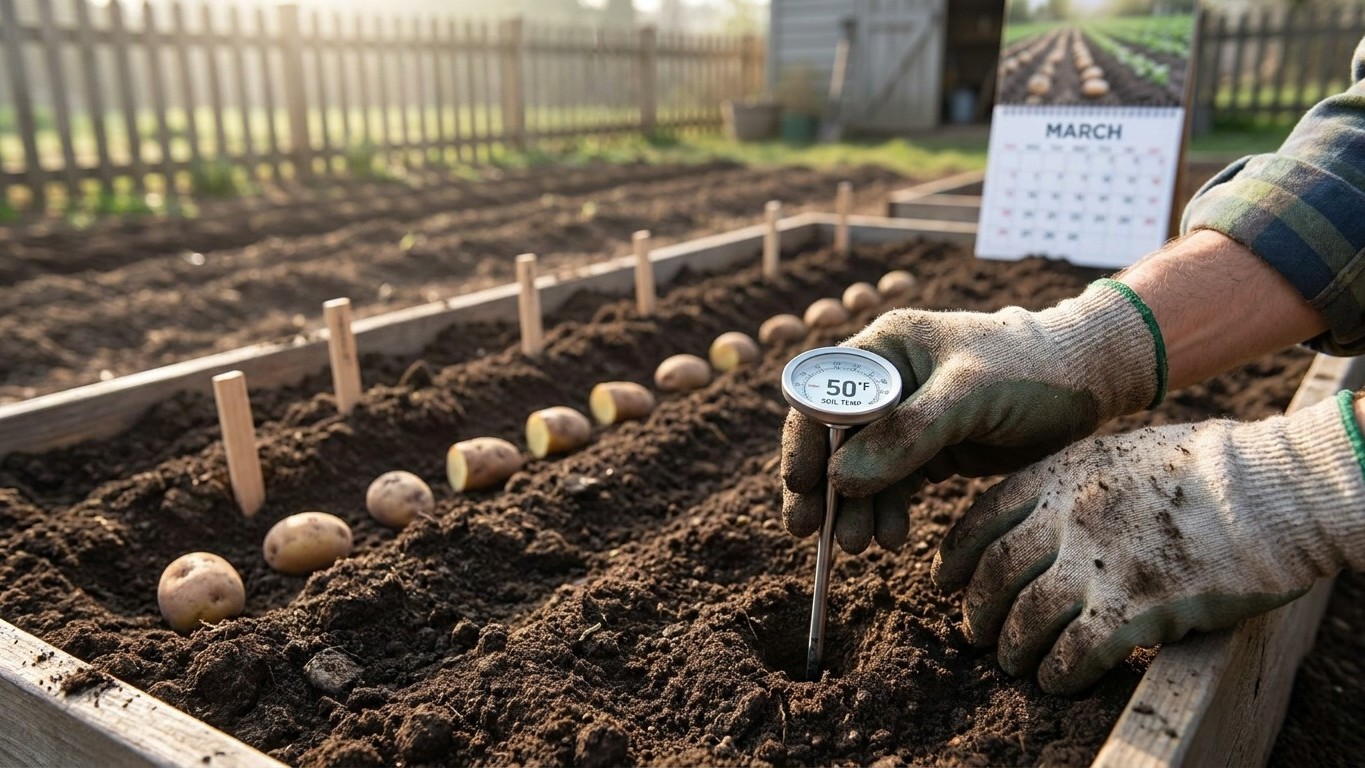

According to almanac tradition, potatoes belong to the root group, which goes in during the third quarter of the Moon, the stretch between full moon and last quarter. Gardeners who add the Moon sign look for fruitful or semi-fruitful signs. The traditional days for the potato months, February through May 2027, are tabulated below. No effect of the Moon on potatoes has been shown, so treat this as planting by the moon custom and not as a rule of growing.
What the tradition says about planting potatoes
The quarter rule
Almanacs sort crops into types, and each type gets a quarter of the lunar cycle. Potatoes fall under “root,” a group that also holds carrots, garlic, onions and beets, along with bulbs and perennials. The almanac rule is to plant that group in the third quarter. The Moon is shrinking night by night during those days, which is why the same idea turns up under the name planting in a waning moon.
| Quarter | Crop type in the almanac rule | Examples |
|---|---|---|
| First quarter (new moon to first quarter) | Leafy crops that bear above ground | Lettuce, spinach, cabbage, broccoli, celery |
| Second quarter (first quarter to full moon) | Above-ground crops that bear seed inside the fruit | Tomatoes, peppers, beans, squash, corn |
| Third quarter (full moon to last quarter) | Root crops, bulbs, perennials | Potatoes, carrots, garlic, onions, beets |
The fourth quarter, from last quarter to new moon, is a rest period in this scheme. Tradition reserves it for weeding, pruning, turning the soil and composting.
What is and is not proven
No effect of the Moon’s phase or sign on potatoes, on germination or on yield has been established. The physics does not help the case either. The Moon’s phase cycle runs 29.53 days, and its tidal pull at the Earth’s surface, calculated from the constants in NASA’s Moon Fact Sheet, is about 1.1 millionths of a meter per second squared at its strongest. That is roughly one ten-millionth of gravity, far too small to move anything as small as a seed or a root. The custom is old and widely kept, but it is a custom.
The sign filter, and a rival system
Many moon-sign almanacs add a second layer on top of the quarter. This convention labels Cancer, Scorpio and Pisces fruitful, Taurus, Libra and Capricorn semi-fruitful, and Aries, Gemini, Leo, Virgo, Sagittarius and Aquarius barren. Sources differ on Virgo, Sagittarius and Aquarius. The windows on this page ask for the third quarter plus a fruitful or semi-fruitful sign. The biodynamic calendar tied to Maria Thun works differently. It calls Taurus, Virgo and Capricorn root days, so its root days will not match the table below.
Traditional potatoes planting days, 2026 and 2027
The windows
| Month | Traditional days (Moon sign) |
|---|---|
| February 2027 | February 23-26 (Moon in Libra/Scorpio) |
| March 2027 | March 22-26 (Moon in Libra/Scorpio), March 29 (Moon in Capricorn) |
| April 2027 | April 21-22 (Moon in Scorpio), April 25-27 (Moon in Capricorn) |
| May 2027 | May 23-24 (Moon in Capricorn) |
The months shown are those when gardeners in much of the country plant potatoes, but your state may start earlier or later, so only the rows inside your own state’s window count. Days are read at noon ET and the Moon changes sign during the day, so treat the first and last day of a run as soft edges.
Reading the rows
An entry with two signs, such as Libra/Scorpio, means the Moon crosses from one to the other somewhere inside that run. This convention labels Libra semi-fruitful and Scorpio fruitful. Capricorn is labeled semi-fruitful. April holds two separate runs, the first with the Moon in Scorpio and the second with the Moon in Capricorn. March has a long run followed by a single day on March 29, and May has one short run.
The noon reading matters if you live west of the Eastern time zone. Noon ET is 9 a.m. on the Pacific coast, so a gardener there who plants late in the afternoon is working with the Moon a few hours further along than the table assumes. On a day in the middle of a run, that makes no difference. On the first or last day, it can.
One more thing about the layout. Each row lists days that meet both tests at once, the third quarter and an accepted sign. A day in the third quarter with the Moon in a barren sign is left out, which is why the runs look shorter than the full stretch from full moon to last quarter.
Check your state first: when to plant potatoes where you live
Start with the place, not the sky. Frost dates and soil temperature in your area decide whether potatoes can go into the ground at all. The Moon, if you choose to follow it, only picks among days that are already open. It never moves a planting earlier than your local calendar allows.
That gives a simple order of decisions:
- Find your state’s planting window for potatoes.
- Look for third-quarter days inside that window.
- If you also want the sign filter, keep only the days with the Moon in a fruitful or semi-fruitful sign.
For the first step, when to plant potatoes where you live lays out the timing question without any lunar overlay. Our state guides go further and tie the calendar to each state’s conditions. A gardener in the Midwest, for instance, can open the Ohio planting calendar for potatoes and see the full planting window laid out before looking at a single Moon date.
Once you have the window, lay the table above over it. Some rows will fall entirely inside, some will straddle the edge, and some will sit outside. Only the first kind is a candidate. A traditional day that lands before your state’s window opens is not a reason to plant early. It is a day to skip, and the next run in the table may do better.
Plenty of gardeners find that the state window is wide enough to hold two or three traditional runs. Others find only one, and a few find none that suit their schedule. Following the custom is optional, and so is following it strictly.
A fair way to try it
Taking a custom on faith is one option. Testing it on your own plot is another, and it takes only a little bookkeeping.
- Choose a planting week inside your state’s window, and pick one traditional day from the table that falls in that week.
- Split your seed potatoes into two equal lots of the same variety from the same source. Plant one lot on the traditional day and the other on an ordinary day in the same week, in beds with matching soil, sun and care.
- Label both lots with stakes marked by date and group, so nothing gets mixed up months later.
- Write down the planting dates, the date shoots first appear in each lot, the harvest date and the weight of each harvest.
- Next season, swap which bed gets which treatment, and compare again.
A single season will not settle anything. Weather, patches of soil and the condition of individual seed pieces can all outweigh whatever difference a lunar day might make, and one comparison cannot separate those effects. Even several seasons give a small sample. Still, this is the only way a home gardener can judge the tradition for their own plot, since a lab result on someone else’s field says little about yours. If the two lots come out the same year after year, you have your answer. If they differ, you have a question worth another season of notes.
Questions about planting potatoes by the moon
Does the tradition say to plant potatoes in a waxing or a waning moon?
Waning. According to almanac tradition, root crops go in during the third quarter, which runs from full moon to last quarter, while the Moon is shrinking. The waxing half is assigned to crops that bear above ground. Whether that distinction means anything for the potato crop has not been shown.
What if the traditional day falls on a frost?
The tradition gives no ruling that overrides local conditions, and this page does not either. Your state’s planting guide decides whether the ground is ready. If a traditional day lands when it is not, that day does not count, and you can wait for the next run in the table or plant on an ordinary day inside your window.
Do I need to follow the Moon sign as well?
No. The quarter rule is the older and simpler version, and plenty of almanacs stop there. The sign filter is an extra layer from moon-sign almanacs, and its sources disagree on Virgo, Sagittarius and Aquarius. The table above uses both, with days read at noon ET, so a run’s first and last days can shift if you plant late in the day, once the Moon has changed sign.