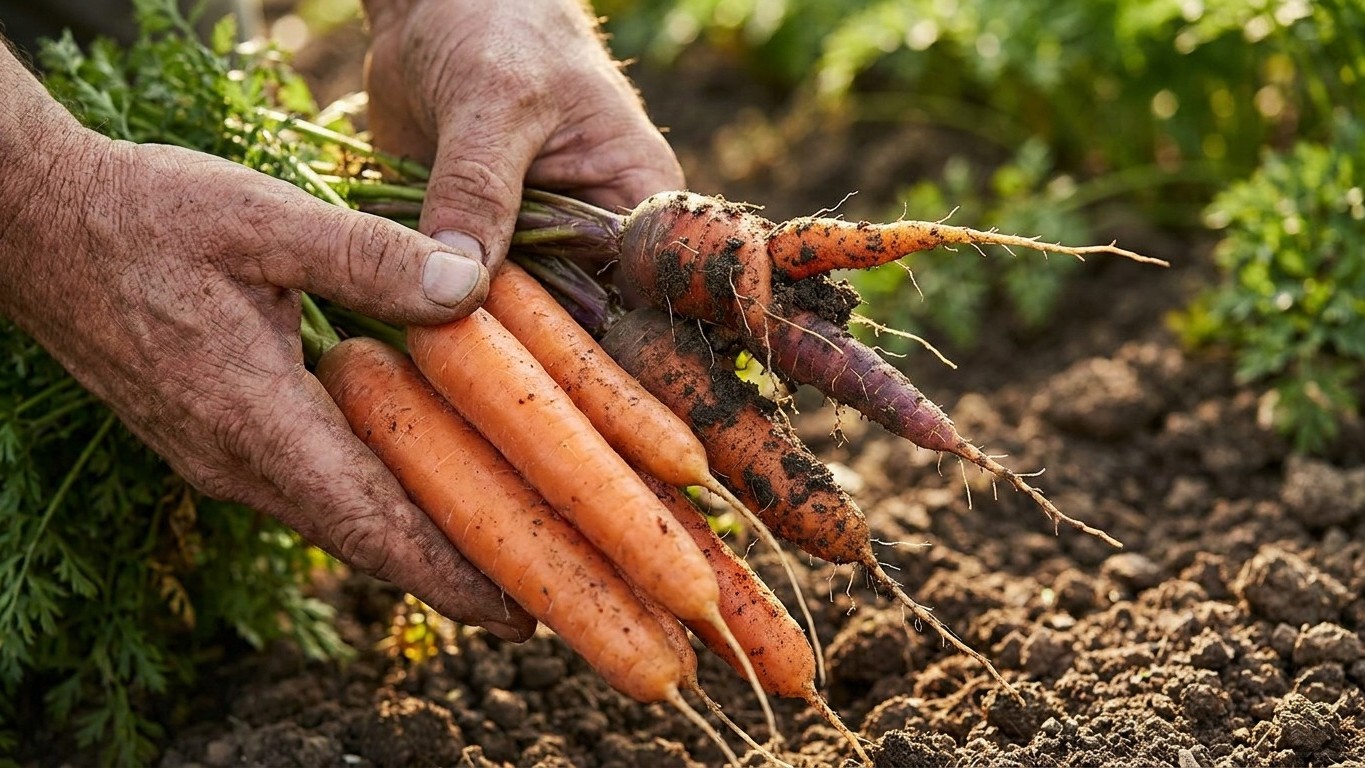

The Crider series, Kentucky’s official state soil, is a well-drained silt loam sitting at a surface pH near 6.2, which puts most gardens broadly in carrot territory. But that soil profile describes an average across the whole state, not the raised bed or back-corner patch you’re actually working. Whether your carrots come out straight or twisted depends on what’s under your boots, not what’s under Kentucky’s.
The short answer
Kentucky’s state soil, named by state law and tracked by the USDA’s National Cooperative Soil Survey, is the Crider series, an Alfisol formed under forest cover. Alfisols hold onto nutrients reasonably well, which is one reason Crider soils show up so often under Kentucky farmland. The surface horizon runs about 5 percent sand, 19 percent clay and 76 percent silt, a texture class that lands in loam to silt loam territory. Organic matter sits around 3.0 percent, and the drainage class is listed simply as well drained. Surface pH averages about 6.2, slightly on the acid side of neutral.
Put those numbers next to what a carrot actually wants. Utah State University Extension is blunt about it: carrots want deep, sandy, well-drained soil rich in organic matter, and heavy or rocky ground makes the root fork instead of running straight. A soil that’s mostly silt with under a fifth clay and good drainage, which is what Crider represents, isn’t the sandy ideal, but it isn’t the dense, waterlogged clay that guarantees forked roots either. It sits in a workable middle ground, and it’s worth asking directly: Will Carrots Fork in Kentucky Soil? The organic matter figure, about 3.0 percent, is on the lean side of what a carrot bed benefits from, which argues for building it up before you sow rather than assuming the ground is ready as-is.
If your soil resembles this profile, the practical move is straightforward: work in compost to lighten the silt and add organic matter, and loosen the bed to a full spade’s depth or more so roots aren’t forced to detour around a compacted layer a few inches down. Utah State’s fix for heavy or rocky ground is exactly this, generous compost and double digging, or building a raised bed filled with a loose, sifted mix if the native ground is worse than average. Once the bed itself is ready, timing matters too, so it’s worth checking When to Sow Carrots in Kentucky before you plant.
None of this is a diagnosis of your yard. Kentucky spans several hundred named soil series, and Crider represents one common pattern, mostly the rolling loess-covered uplands of the state’s Pennyroyal and Bluegrass regions. A river bottom a mile away can run to heavy clay or loose sand. Ground near a newer subdivision may have been scraped and regraded during construction, stripping off the original topsoil entirely and leaving compacted subsoil at the surface. Crider tells you what the region tends toward. It doesn’t tell you what’s in your bed.
The test that settles it in your own garden
- Dig a hole at least a foot deep where you plan to sow. Look at how far down the soil stays loose and dark before you hit a harder, paler, or rockier layer. Carrots need that top foot to be free of obstructions, since a stone or a hard clay pan is exactly what forces a root to split or curl around it.
- Check for stones and debris as you dig. Pull out anything larger than a pebble in the top 10 to 12 inches. Builder’s rubble, old brick fragments, and buried roots are common culprits in yards that have been regraded or that sit near an older structure.
- Feel the texture between your fingers. Grab a handful of moist soil and rub it. Gritty means sand-heavy. Slick and sticky, holding a ribbon shape when you squeeze it, means clay-heavy. Smooth but not sticky, closer to flour, points toward silt. Most Kentucky gardens will read somewhere between silty and clayey, but this is your soil, not the state’s average.
- Watch how water moves through it. Dig a hole about a foot deep, fill it with water, let it drain once, then fill it again and time how long it takes to disappear. Water that lingers for many hours signals poor drainage and a higher risk of forked or misshapen roots. Water that vanishes almost immediately suggests a sandier profile that may need more organic matter to hold moisture for germination.
None of these steps hands you a number to compare against a chart. What they give you is a direct read on whether your bed needs compost worked in, a raised frame built up, or nothing more than a light loosening before you sow.
When to sow here
Carrot seed germinates best when soil temperature sits between 55 and 65 degrees Fahrenheit, and it needs a floor of at least 40 degrees to sprout at all. Since carrots are sown directly into the ground rather than started indoors and transplanted, every date on this list counts from the seed going into the soil, not from any later step.
- Start from the frost window. Based on NOAA’s 1991-2020 climate normals for the 30 to 70 percent probability band of a 32-degree freeze, the last spring frost in this reference period typically falls between March 24 and April 4.
- Count back two to three weeks. Sowing carrots that early, ahead of the last expected frost, works because the crop tolerates cool soil far better than heat, and light frost on emerging seedlings rarely kills them outright. That puts a workable sowing window in roughly the first half of March for gardens tracking close to this frost pattern.
- Confirm soil temperature before you commit seed to the ground. A calendar date is a starting estimate, not a guarantee. If a cold snap has kept the soil below 40 degrees, wait, because seed sitting in soil that cold simply won’t sprout, and a poor stand from cold, wet ground is harder to fix than a week’s delay.
- Aim for the 55 to 65 degree sweet spot when it’s realistic. Germination is fastest and most even in that range, so a second sowing a few weeks after the first, once soil has warmed further, often fills in gaps left by an early, colder planting.
The National Weather Service has noted that the Louisville station behind these normals tends to run a bit later in spring and earlier in fall than the surrounding rural county, so gardens outside the immediate urban area should treat their own true last-frost date as arriving somewhat earlier, and plan a tighter window around it rather than assuming the full spread applies evenly everywhere.
What goes wrong here
- Forking in heavy or compacted ground. A carrot root pushing into clay-heavy or compacted soil hits resistance and splits around it instead of running straight down. Utah State University Extension’s remedy is direct: work in plenty of compost and double dig the bed, loosening soil well below the depth the root will reach, or switch to a raised bed filled with a looser mix if the native ground stays dense no matter how much is worked in.
- Poor germination during a hot stretch. Carrot seed sprouts best between 55 and 65 degrees Fahrenheit, and a sudden warm spell during a spring sowing window can push soil temperature well past that range, leaving seed to sit and rot rather than sprout. Sowing a bit earlier, while soil is still climbing through the target range rather than overshooting it, and keeping the bed consistently moist during germination, both help.
- Splitting from uneven watering. Carrot roots that go through a dry stretch and then get a heavy soaking, whether from a storm or a catch-up watering session, tend to swell too fast and crack open. A steady, even watering schedule through the growing period, rather than infrequent deep soaks after gaps, keeps root growth consistent and skin intact.
- Stunted growth in shallow or rocky beds. Even without outright forking, a root that hits a stone, a root mat, or a hard subsoil layer partway down will stop lengthening and grow stubby or misshapen. Clearing the top foot of debris before sowing, per the same double-digging approach, heads this off before the root ever meets the obstruction.
Checking this against your own county
The Crider series and the statewide frost normals are useful starting points, but soil and microclimate both shift from one county to the next, and sometimes from one side of a property to the other. The University of Kentucky Cooperative Extension Service, run through the state’s land-grant university system, is the resource built for that local layer of detail. Extension offices can point to county-level soil survey data, offer soil testing for actual pH and nutrient levels in your bed, and give planting guidance calibrated to your specific area rather than a statewide average. Before committing a full row of seed, a quick check with your local office, or a look at their published resources at extension.ca.uky.edu, is worth the ten minutes it takes.
Common questions
Does Kentucky’s state soil mean my garden will grow carrots without amendment?
Not necessarily. The Crider series describes a common regional pattern, well-drained silt loam with moderate organic matter, but it’s a statewide representative value, not a measurement of your bed. Dig a test hole and check texture and drainage yourself before assuming the state average applies.
Can I sow carrots as soon as the soil hits 40 degrees?
Seed can technically sprout at that floor, but germination is slow and uneven that cold. Waiting until soil trends toward the 55 to 65 degree range, or accepting a slower first sowing followed by a second once things warm, generally gives a fuller stand.
Why do my carrots come out short and forked even in loose soil?
Check for buried debris, old roots, or a compacted layer a few inches down that the naked eye misses at the surface. Double digging to a full spade’s depth, well past the length the root will reach, clears obstructions a shallow tilling pass leaves untouched.
Is there a hard-freeze date I should watch separately from the last frost date?
The published NOAA figures here cover the 32-degree freeze probability window only. No separate light-frost or hard-freeze threshold is included in that dataset, so treat the March 24 to April 4 window as the reference point rather than layering in additional assumed dates.