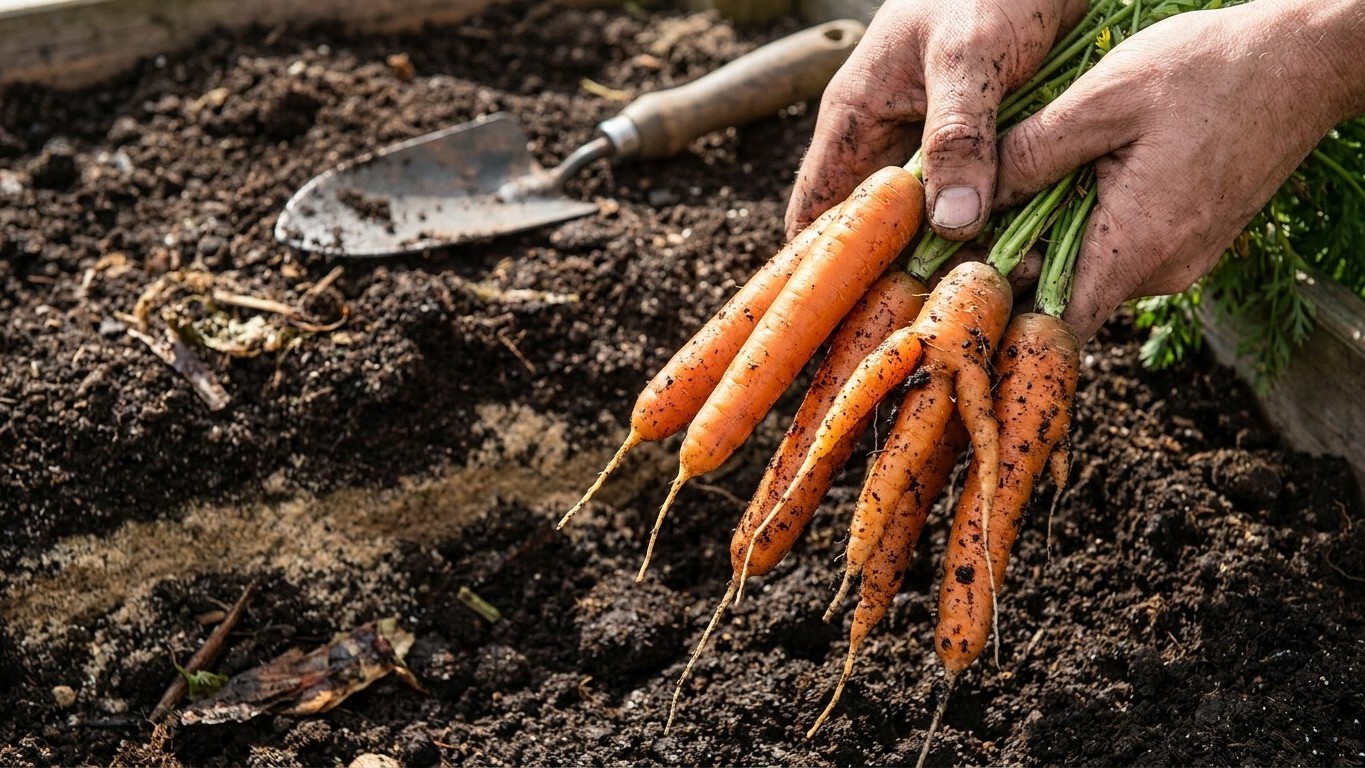

Saskatchewan’s farmland skews toward loamy, well-drained ground that carrots generally like, but that’s a provincial average, not your backyard. The real answer to Will Carrots Fork in Saskatchewan Soil? comes from a shovel test in your own soil, a When to Sow Carrots in Saskatchewan counted backward from a frost that’s really just a coin flip, and a watering routine that doesn’t swing between drought and flood.
The short answer
The dominant soil across Saskatchewan’s farmed regions is a Chernozem, the deep, dark grassland soil that built the province’s reputation for grain. It covers 68 percent of the mapped agricultural surface, with Solonetzic soils coming in second. The median surface sample runs 43 percent sand, 22 percent clay and 35 percent silt, which lands squarely in loam territory, with organic matter around 4.0 percent and a median pH near 6.8, close to neutral. Drainage is rated well drained.
For a carrot, that’s a decent starting hand. Utah State University Extension is blunt about what carrots need: deep, sandy, well-drained soil rich in organic matter. Heavy or rocky ground makes the root fork, splitting into two or three legs instead of growing down as one clean taproot. A loam with only 22 percent clay and good drainage doesn’t fit the profile of the heavy, compacted soil that typically causes forking. Roots should have a fair shot at growing straight, provided nothing underneath is blocking them.
That’s the caveat that matters more than the average. Solonetzic soils, the second most common type in the province, often carry a dense, structured subsoil layer that can behave more like a hardpan than the loam sitting above it. A garden built on that kind of ground will fork carrots regardless of what the topsoil looks like. And Chernozem itself isn’t one soil: it’s a soil order that spans hundreds of individual soil series across the province, from river-bottom silt to gravelly upland loam. The 4.0 percent organic matter and the loam texture are medians pulled from thousands of sampled components, not a promise about the dirt under your raised bed or the fill a previous owner trucked in.
So the province-level number is a reasonable place to start planning, not a diagnosis for your plot. If a shovel test (covered next) turns up compacted clay, a hardpan a foot down, or stones scattered through the top 12 inches, the fix is the same one Utah State recommends for any heavy ground: work in plenty of compost and double dig the bed to loosen and enrich the soil a full spade’s depth down, or skip the guesswork and build a raised bed filled with a loose, sandy growing mix. Either approach gives the taproot a straight, unobstructed path, which is the one thing a forking carrot is missing.
The test that settles it in your own garden
Averages describe the province. They don’t describe the twelve square feet where you’re planning to sow carrots. A short dig-and-feel test tells you more in twenty minutes than any soil map will.
- Dig a test hole at least 12 inches deep where you plan to sow. Carrots need a long, unobstructed run, so depth matters more than surface appearance.
- Look at what comes out of the hole. Note any change in color or texture as you go deeper, and check for a dense, compacted layer or a hardpan that would stop a root cold. Pull out any stones and rocks; scattered rocks in the root zone are a direct cause of forked and stunted carrots.
- Feel the texture between your fingers. Sandy soil feels loose and grainy and won’t hold a shape. Clay-heavy soil feels sticky and molds into a ribbon when squeezed. Loam sits in between, crumbly but able to hold a rough clump.
- Run a drainage check. Fill the hole with water and watch how it drains. Water that sits for a long stretch points to compacted or clay-heavy soil that will need amending or a raised bed; water that vanishes almost immediately points to sandy soil that will need extra organic matter to hold moisture for germination.
- Repeat in more than one spot if your garden is more than a few years old or has been reshaped, filled, or graded. Soil under a former path, a driveway edge, or fill brought in during construction can differ completely from soil ten feet away.
When to sow here
Carrots are sown directly into the ground. There’s no transplant date to count from, so every bit of timing has to run backward from the local frost window and forward from how fast the seed itself germinates.
- Start from the average last spring frost. At the Saskatoon SRC station, that date lands around May 18. That’s an average, not a guarantee: in roughly half of all years, frost arrives later than that date. Treat May 18 as the middle of a window, not a safe line to plant on.
- Check the soil temperature before the seed goes in. Carrot seed needs soil at a minimum of 40 F to germinate at all. Cold, wet Chernozem soil in early spring can sit below that mark even after the air feels mild, so a soil thermometer beats a guess based on the calendar.
- Sow 2 to 3 weeks before that average last frost date, once soil temperature has cleared 40 F. Carrot seedlings tolerate a light frost better than the heat and drought stress of a late-sown crop pushed into midsummer, which is one reason growers lean early rather than late.
- Watch for the germination sweet spot of 55 to 65 F soil temperature. That’s the range where carrot seed comes up fastest and most evenly. Sowing into cold soil right at the 40 F floor means a slow, patchy start; waiting until soil has warmed into the mid-50s and beyond speeds things up and improves your stand.
- Count 70 to 100 days from that seeding date, not from any later event, to estimate harvest. Because carrots go straight into the ground with no transplant step, that seeding date is the only clock that matters.
What goes wrong here
- Forking in heavy or compacted ground. Even though the provincial median soil is a well-drained loam, Solonetzic subsoils and any compacted or clay-heavy patch will split the taproot into two or three legs. The fix is compost worked in generously and double digging to loosen the bed a full spade deep, or a raised bed filled with loose, sandy soil if the native ground is too dense to fix by hand.
- Poor, patchy germination during a hot, dry spell. Carrot seed is small and sits near the surface, and it stalls out fast if the top inch of soil dries between waterings. Keep the seedbed evenly moist with light, frequent watering until seedlings are up, especially if a stretch of dry prairie wind rolls through right after sowing.
- Split or cracked roots from uneven watering later in the season. A long dry stretch followed by a heavy soak makes roots swell suddenly and crack. Watering on a steady schedule, rather than letting the bed dry out completely and then flooding it, keeps growth even and the root intact.
- Stunted or misshapen roots from rocks and debris in the bed. Any stone in the top foot of soil can deflect a growing taproot sideways or split it. Sifting the bed and removing stones before sowing, or working in enough compost and loose material to bury or displace them, clears the path.
Checking this against your own county
Province-wide soil medians and one frost-normal station can only take you so far. Saskatchewan’s own agriculture ministry maintains resources for farmers and gardeners across the province, and it’s the right next stop for anything specific to your district, from local soil survey detail to frost patterns that differ from Saskatoon’s. You can find it through the Saskatchewan agriculture and agribusiness resources page. Pair that with the dig-and-feel test in your own bed, and you’ve got a far better read on your carrots than any provincial average can give you on its own.
Common questions
Does Saskatchewan’s soil naturally suit carrots?
The province’s most common soil, a Chernozem loam that’s well drained with a median pH near neutral, is a reasonable match for carrots. But that’s a median across hundreds of soil series, and Solonetzic soils, the second most common type, often carry a denser subsoil layer that can cause forking regardless of the topsoil.
What’s the earliest safe date to sow carrots?
There’s no single safe date published here. The average last spring frost near Saskatoon falls around May 18, and carrots are typically sown 2 to 3 weeks before that average, once soil temperature has cleared 40 F. Because frost arrives later than average in roughly half of all years, treat that window as a guide, not a guarantee.
Why do my carrots keep coming out forked even in good soil?
Forking usually traces back to something blocking the taproot: compacted clay, a buried stone, or a hardpan layer a few inches down that isn’t visible from the surface. A 12-inch test dig in the exact spot you plan to sow will show whether the problem is texture, stones, or drainage, and each has a different fix.
How long from sowing to harvest?
Carrots are sown directly into the ground, with no transplant step, so count 70 to 100 days from the seeding date itself. That range depends on the variety and growing conditions, but the clock always starts at the seed, not at any later stage.