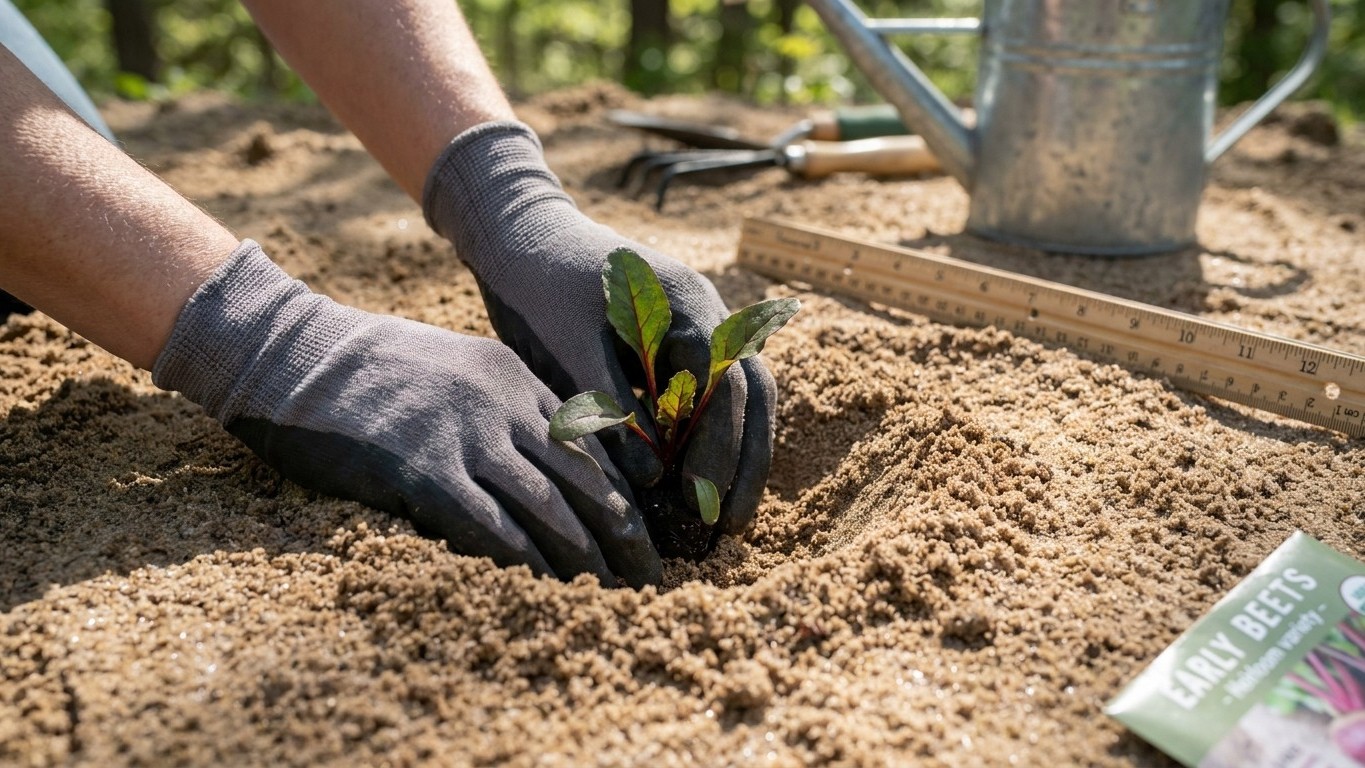

Michigan’s state soil runs sandy and acid, which means beet roots push through it easily but the ground drains fast and holds little moisture right when young seedlings need it most. When to Sow Beets in Michigan comes down to timing it two to three weeks before the last spring frost, keeping the top few inches of soil from drying out through the first six weeks, and staying alert once summer heat arrives. Get those three things right and the two failures that trip up Michigan gardeners, bolting and woody roots, mostly disappear.
The short answer
Michigan’s official state soil is the Kalkaska series, a Spodosol formed under conifers and named the state soil by Michigan law in 1990 under the USDA NRCS State Soils programme. It is not a soil built for vegetable beds. The surface horizon runs 86 percent sand, 5 percent clay and 9 percent silt, with a pH around 4.7, which is strongly acid, and it’s classed as somewhat excessively drained, according to USDA NRCS Soil Data Access records covering 332 mapped components of the series. Beets do want a sandy, deep, well-drained bed, per Utah State University Extension, so the texture itself is workable. The pH is the bigger problem: beets grow best closer to neutral, and 4.7 sits well below where most root vegetables thrive, so a garden sitting on ground like this needs a soil test and likely a lime correction before beets go in, a challenge covered in more detail in Beet Soil in Michigan.
One number in the USDA data needs a caveat. The organic matter figure for this series runs about 75 percent at the surface, which sounds generous but actually signals something else entirely: that value describes a natural forest litter layer, the kind of duff you’d find under pines, not a cultivated garden bed. Any worked vegetable plot will have far less organic matter than that once the litter layer is gone and the soil has been turned. Utah State’s guidance is the number to build a bed around instead: amend with no more than 1 inch of composted organic matter per 100 square feet. More than that, on a soil already this sandy, risks over-loosening a bed that needs some structure to hold moisture.
As for how many days a year the reference city spends above 90 F, that figure isn’t published in the data this article draws from, so it isn’t stated here as a number. What is documented is the threshold that actually matters for beets: temperatures above 85 F combined with water stress make roots woody, per Utah State Extension. That’s the number to watch through a Michigan summer, not a raw heat-day count.
None of this describes every backyard in the state. Michigan spans hundreds of distinct soil series, and a plot near a river, on a hillside, or on ground a builder graded and filled years ago can behave nothing like the Kalkaska profile. Treat these figures as a starting point for what the region’s ground tends to do, then confirm with a soil test pulled from the actual bed.
The six weeks that decide it here
Beets are direct-sown, never started as transplants and moved later, so the clock on maturity (60 to 80 days depending on variety, per Utah State Extension) starts the day seed goes into the ground. Sowing two to three weeks ahead of the last frost puts that critical early window squarely in Michigan’s spring. MSU Extension’s Frost-Free Dates data puts the last spring frost around April 30 in the Detroit area, with most of the Lower Peninsula seeing its last frost in early to mid May. That means a Detroit-area gardener sowing on schedule is planting in mid-to-late April, and someone farther north or inland is likely sowing into early May.
Spring in Michigan is shaped heavily by the Great Lakes, and that proximity tends to produce swings rather than a steady, predictable warm-up: a mild stretch can be followed by a cold snap, and dry days can alternate with sudden wet ones depending on how lake-effect systems move through. That variability matters more than any single average, because Utah State’s research is specific about the mechanism: water stress during the first six weeks after sowing is what pushes beets toward premature flowering, known as bolting. It isn’t a matter of the season being dry overall. It’s a matter of the plant going without water during a narrow, early developmental window.
Layer that timing onto Kalkaska-type sandy ground, which is somewhat excessively drained by definition, and the risk compounds. Sandy soil sheds water fast after a rain, so a week without rain during a swinging Michigan spring can dry out the top few inches exactly when beet seedlings have shallow, undeveloped roots and no reserve to draw on. The fix isn’t complicated, but it is time-sensitive: check soil moisture in that bed every few days for the first six weeks after sowing, rather than relying on whatever the sky happens to be doing that week.
What goes wrong here
- Bolting from dry spells in the first six weeks. Sandy, fast-draining soil combined with a Michigan spring that can swing from wet to dry within days means beet seedlings go thirsty right when Utah State Extension identifies the highest bolting risk. Water consistently through that window rather than waiting for visible wilting, and mulch lightly to slow evaporation from the surface.
- Acid soil holding back root development. A pH around 4.7, as recorded for the Kalkaska series, sits far below what beets prefer. Roots planted into unamended acid sand often stall or come up misshapen. Pull a soil test before sowing and correct pH with lime according to what that test recommends, not by guesswork.
- Over-amending a sandy bed. Because Kalkaska-type soil is naturally low in organic matter once its forest litter layer is gone, gardeners sometimes pile on compost to compensate. Utah State Extension caps the recommendation at 1 inch of composted organic matter per 100 square feet; going well past that on sandy soil can loosen it further and reduce its already-limited ability to hold moisture.
- Woody roots from midsummer heat plus dry soil. This is a separate failure from bolting, tied to later-season conditions rather than the first six weeks. Once temperatures push above 85 F, any accompanying water stress toughens the root’s texture, per Utah State Extension. Keep watering consistent through summer heat, not just in spring, and mulch to buffer soil temperature.
- Nutrients leaching out of excessively drained ground. Soil classed as somewhat excessively drained moves water, and whatever is dissolved in it, through the root zone quickly. A single spring fertilizer application may not carry a bed through the full season. A soil test partway through the growing season can flag whether a side-dress is needed.
Checking this against your own county
Everything above describes the state’s official soil and statewide frost data, not the specific ground in any one garden. The most reliable next step is a soil test through Michigan State University Extension, whose county-level outreach offices can pull an actual pH, texture and organic matter reading for a specific plot rather than a statewide representative series. MSU’s outreach directory lists local offices by county, and the same offices typically track county-specific frost timing that can run earlier or later than the Detroit-area or Lower Peninsula figures cited here. A five-minute call or a mailed soil sample beats guessing, especially on ground near a lakeshore, a river bottom, or any lot that’s been graded or filled at some point.
Common questions
How long do beets take to mature once sown in Michigan?
Beets run 60 to 80 days from seeding, according to Utah State University Extension, and that count starts the day seed goes into the ground since beets are always direct-sown rather than transplanted.
When is the right time to sow beets in Michigan?
Two to three weeks before the local last spring frost. MSU Extension puts that frost date around April 30 for the Detroit area and early to mid May across most of the Lower Peninsula, so sowing dates shift depending on where in the state a garden sits.
Does Michigan’s sandy soil need amendment before planting beets?
Likely yes, on ground resembling the Kalkaska series. Beets want organic matter and a workable pH, and Michigan’s state soil runs acid at roughly 4.7 with little organic matter left once the natural forest litter layer is disturbed. Utah State Extension recommends capping additions at 1 inch of composted organic matter per 100 square feet, with pH correction guided by an actual soil test.
What’s the difference between bolting and woody roots?
They’re separate problems with separate causes. Bolting comes from water stress during the first six weeks after sowing and shows up as premature flowering. Woody roots come later, when temperatures climb above 85 F while the plant is also short on water. Watering consistently helps both, but they aren’t the same failure and don’t happen at the same point in the season.