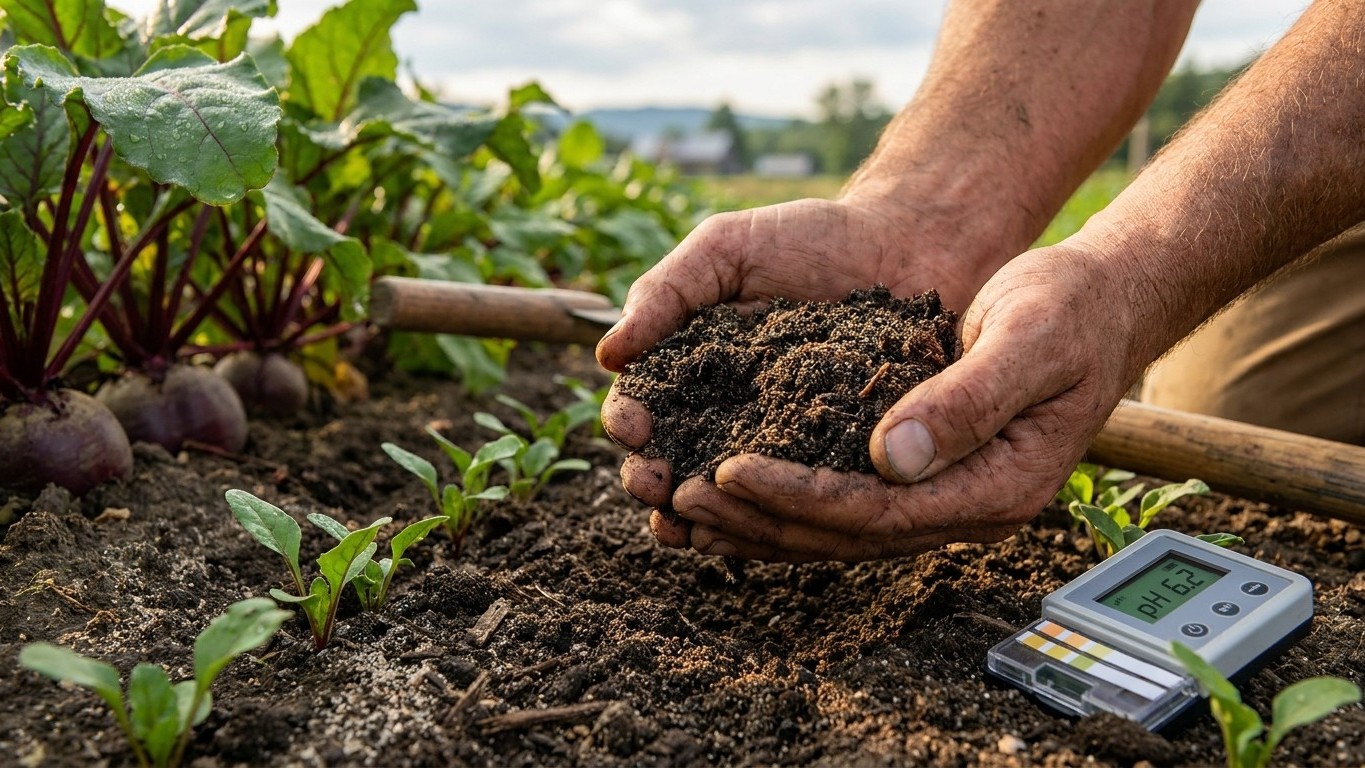

Vermont’s official state soil, the Tunbridge series, is sandy, strongly acid and naturally well drained, which is a mixed bag for beets: good drainage but poor water-holding, and a native pH far below what a beet root wants. The six weeks after sowing, not the whole season, decide whether that root swells or bolts, which is why knowing When to Sow Beets in Vermont matters as much as the soil itself.
The short answer
Vermont’s own state soil, the Tunbridge series, tells you a lot about what beets are up against here before you ever pick up a shovel. It’s a Spodosol, the kind of soil that forms under conifer forest through centuries of acid needle-drop leaching everything soluble out of the topsoil. The surface horizon runs about 79 percent sand and 21 percent clay, with no measurable silt, and the surface pH sits around 3.5, which is strongly acid, closer to black coffee than to garden soil. It’s classified well drained. That combination, sandy texture plus strong drainage, means water moves through fast and doesn’t linger for roots to draw on between rains.
For a beet, that matters directly. Utah State University Extension notes that beets want deep, sandy, well-drained soil rich in organic matter, so the texture side of Tunbridge is actually close to what the crop prefers. The acidity is the problem when it comes to Beet Soil in Vermont. A pH near 3.5 is well outside the range beets tolerate, and no amount of watering fixes that; it takes lime, tested and applied to the actual bed, not guessed at.
One figure worth flagging before it trips anyone up: the organic matter recorded for this series runs around 75 percent at the surface. That number describes a natural forest floor, duff and needle litter that has never been turned, not a dug and amended vegetable bed. A cultivated garden row won’t carry anything close to that once it’s been worked, so don’t read it as a target or a promise.
On the heat side, the published record for this page doesn’t carry a count of days above 90 F for a Vermont reference city, so that specific figure isn’t given here. What is established is the threshold that matters for beets: Utah State University Extension links heat above 85 F combined with water stress to woody roots. Vermont summers do produce stretches above that mark, particularly in the Champlain Valley and other low-lying river corridors, even though the state as a whole runs cooler than most of the country. The soil’s poor water retention is what turns an ordinary hot week into a stress event, because sandy, fast-draining ground dries out faster than loam holding the same rainfall.
None of this is a diagnosis for any one garden. Vermont spans hundreds of mapped soil series, and a yard in the Champlain lowlands, a hillside plot in the Northeast Kingdom, or a raised bed built on fill from a house foundation will each behave nothing like the representative Tunbridge profile. Treat the state soil as a sketch of regional tendencies, not a stand-in for a soil test on the actual bed.
The six weeks that decide it here
Beets are sown directly in the ground, never transplanted, and the standard advice is to get seed in 2 to 3 weeks ahead of the last spring frost. For most of Vermont, NOAA’s 1991-2020 climate normals put the last spring freeze between April 30 and May 10, based on the Burlington station. That puts a typical direct sowing window somewhere in mid to late April for gardens near Lake Champlain, and later for higher, colder ground. It’s worth remembering that Burlington sits on the lake, the mildest pocket in the state; the Green Mountains and the Northeast Kingdom see a shorter frost-free stretch and push that sowing date back further.
Whenever the actual date lands, the first six weeks after seed goes in are the ones that decide the crop, according to Utah State University Extension: water stress during that window is what triggers premature flowering, or bolting, in beets. In Vermont that window usually falls across April into early June, a stretch locally known for mud season tapering into a changeable, often wet spring. Rain is generally not scarce here in spring, but it doesn’t arrive evenly. Vermont’s weather swings between soggy stretches, when saturated Tunbridge-type ground can sit cold and slow to warm, and shorter dry spells when that same sandy surface drains fast and leaves a young beet row parched within days.
That swing is the real risk, more than a shortage of total rainfall. A garden that gets plenty of rain across April and May can still deliver a dry ten-day stretch to a beet seedling with shallow roots and a sandy, quick-draining bed underneath it. Because bolting is tied to stress in those first six weeks specifically, a gap in watering early on matters more than the same gap happening in July, after the root has already sized up. Consistent moisture right after sowing, not just total seasonal rainfall, is the variable to watch.
This is also why the sowing date itself carries weight beyond avoiding frost damage. Sow too early into cold, wet ground and germination drags or fails; sow too late and the first six weeks slide into the hotter, drier part of early summer, raising both the bolting risk from any dry spell and, later, the woodiness risk from heat above 85 F layered onto water stress. The window NOAA’s normals define for Burlington gives a starting point, but gardeners farther from the lake should expect that window to sit later and shorter.
What goes wrong here
- Acid soil stunts the root even with good moisture. A native pH near 3.5, typical of Tunbridge-type ground before any amendment, sits far outside what beets tolerate. The remedy is a soil test on the actual bed and lime applied to the tested result, not a guess based on the state soil figure.
- Sandy texture drains before the roots can use the water. With texture running toward 79 percent sand at the surface, rain passes through quickly instead of staying in reach of a young root system. Utah State University Extension’s guidance to amend with organic matter, capped at 1 inch of composted material per 100 square feet, is the way to slow that drainage without overdoing it.
- Mud season timing collides with the sowing window. Cold, saturated ground in April can delay germination right as the calendar says it’s time to sow 2 to 3 weeks before the last frost. Waiting for the bed to actually dry and warm, rather than sowing on a fixed date, avoids seed rotting in place.
- A dry stretch inside the first six weeks triggers bolting. Because Vermont spring rainfall is uneven rather than scarce, a garden can look wet overall and still deliver a rootzone dry-out during the exact window that matters. Even watering through that early stretch, rather than relying on rain totals, is the fix Utah State University Extension points to.
- Heat above 85 F layered on top of any water stress produces a woody root. This shows up later in the season, most often in warmer low-lying spots like the Champlain Valley, and it’s a separate failure from bolting. It comes from heat stress after the root has started sizing up, not from the early-season dry spell, so watering consistently through hot stretches later in the season matters just as much as it did in the first six weeks, for a different reason.
Checking this against your own county
Everything above starts from Vermont’s official state soil and statewide frost normals, and both are averages standing in for a huge range of actual dirt. The only way to know what’s really under a given garden is a soil test pulled from that specific bed, checked for pH and organic matter rather than assumed from the Tunbridge figures here.
The University of Vermont Extension (uvm.edu/extension) is the land-grant service for the state and the right first call for a county-specific soil test and a frost-date estimate closer to a particular town than the Burlington station can offer on its own. Higher elevations and the Northeast Kingdom in particular run colder and later than the Champlain Valley numbers suggest.
Common questions
Can beets be transplanted instead of direct sown in Vermont?
The maturity window, roughly 60 to 80 days for many beet varieties, is counted from seeding directly in the ground, not from a transplant date. Beet roots don’t take well to transplanting disturbance, so direct sowing in place is the standard approach regardless of region.
Does Vermont’s acid soil affect all vegetables the way it affects beets?
No. Different crops tolerate different pH ranges, and beets are on the sensitive side. The Tunbridge series figure of pH 3.5 describes an undisturbed forest surface horizon, not a worked garden bed, but it does signal that acid soil is a regional tendency worth testing for before planting beets specifically.
Is bolting the same problem as a woody beet root?
No, and they come from different causes. Bolting is premature flowering triggered by water stress in the first six weeks after sowing. Woodiness is a texture problem in the mature root, caused by heat above 85 F combined with water stress later in the season. Fixing one doesn’t automatically prevent the other.
How many days a year does Vermont see temperatures above 90 F?
That figure isn’t published in the sources behind this page. What is established is the 85 F threshold Utah State University Extension links to woody roots when paired with water stress, which is the more useful number for a beet grower regardless of the exact day count in any given year.