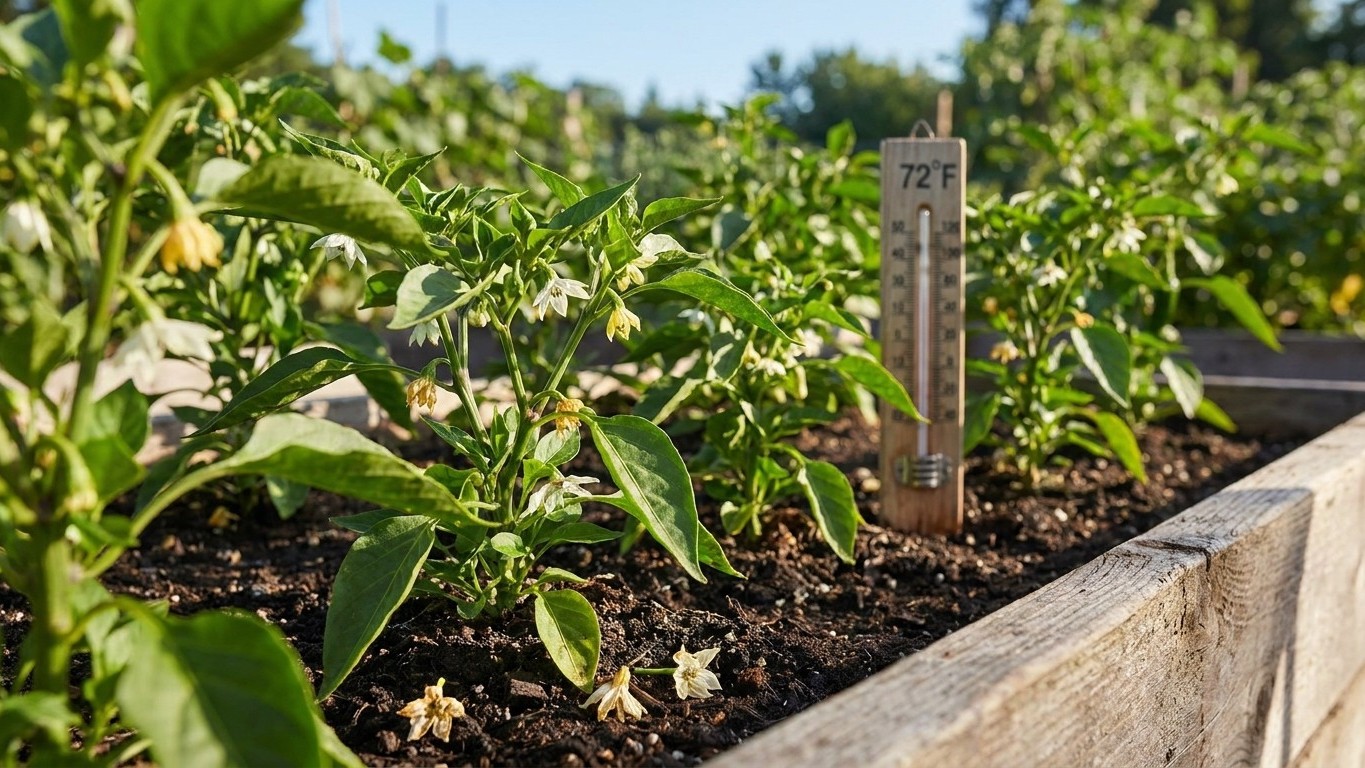

in New Brunswick, start pepper seed indoors somewhere between mid-March and the first week of April. That window comes from counting backward 8 to 10 weeks from a safe transplant date, and that transplant date itself depends on two things this climate doesn’t hand you for free: a frost that averages out May 23 but often runs later, and a soil temperature of 60 F that maritime ground is slow to reach. The details below show how to adjust for your own yard.
The short answer
Start with the heat side of the equation, because New Brunswick makes that part easy. At the Moncton reference station, the average number of days per year hitting 90 F or higher is 0.0, according to Environment and Climate Change Canada’s 1981-2010 climate normals. That’s not a rounding error. It means a New Brunswick pepper crop essentially never faces the kind of sustained heat that shuts down pollen viability in tomatoes and peppers alike. Growers in Texas or Kansas plan their whole season around dodging 90-plus afternoons. Here, that specific failure mode barely exists in an average year, though a one-off heat spell is still possible and won’t show up in a long-term normal.
The other end of the pepper fruit-set equation is nights below 55 F, and this is where New Brunswick growers actually need to pay attention. Peppers stop setting fruit reliably when nighttime temperatures drop under that mark, no matter how warm the days get. Utah State University Extension lists this as one of the two hard limits on fruit set, alongside the 90 F daytime ceiling. The problem for anyone gardening in this province is that this site does not carry summer night minimum data, and neither does the ECCC normals figure above, which measures daytime heat, not overnight lows.
That gap matters more here than it would in a warmer province. A maritime climate like New Brunswick’s often runs cooler overnight than inland areas at the same latitude, thanks to proximity to the Bay of Fundy and the Gulf of St. Lawrence moderating temperature swings. But moderation can cut both ways: it can mean fewer heat spikes, and it can also mean nights that stay stubbornly cool well into June. There’s no shortcut here. Track your own overnight lows through late spring and early summer using a simple min-max thermometer in the garden bed, and treat any stretch of nights under 55 F as a signal that fruit set will stall until it warms back up, whether or not the plants look healthy.
When to start seed here
Working backward from transplant to seed-starting date is arithmetic, not guesswork, but every input has to be adjusted to your own property. Here’s the sequence.
- Start with the frost mean, not a safe date. The Moncton station’s average last spring frost lands on May 23, per ECCC’s 1981-2010 climate normals. That’s a mean, which means in roughly one year out of two, frost actually arrives after that date. Treat May 23 as the midpoint of a risk window, not a line you can plant right up against.
- Build in a buffer for the years that run late. Because half of all years see frost after the mean date, a reasonable working target for transplant is early June rather than late May, especially if your property sits in a low spot, an inland valley, or anywhere north of the Moncton area where spring typically lags further behind.
- Wait for 60 F soil, not just frost-free air. Utah State University Extension is specific that peppers should go into the ground once soil temperature reaches 60 F, after the frost risk has passed. Coastal and river-valley soils in New Brunswick often warm slower than the air above them in spring, so soil temperature can lag the frost date by a week or more. Check with a soil thermometer at a 4-inch depth rather than trusting the calendar alone.
- Count back 8 to 10 weeks from your realistic transplant date. If you’re targeting the first week of June as a cushioned transplant date, 8 weeks back lands you in the first week of April, and 10 weeks back lands you in the third week of March. That gives a starting window running from roughly mid-March to early April.
- Adjust the window earlier or later based on your own site. A warm, sheltered, south-facing yard near the coast might reach 60 F soil and pass frost risk closer to the mean date, favoring the earlier end of the seed-starting window. A cooler inland or northern property should lean toward starting seed closer to late March or even into April, so the transplants aren’t sitting root-bound indoors waiting on cold ground.
None of this replaces watching your own conditions. The math gives you a starting range; your soil thermometer and a night-time low reading tell you when to actually move plants outside.
What goes wrong here
- Blossom drop from a cool night stretch. Because New Brunswick’s summer nights aren’t tracked on this site and can run cooler than gardeners expect from a maritime location, a run of nights under 55 F is the most likely cause of flowers dropping without setting fruit. The remedy isn’t more water or fertilizer, it’s patience: the plant will resume setting fruit once nights warm back up, so avoid the urge to pull the plant or overcorrect with nitrogen, which just pushes leafy growth instead of flowers.
- Blossom drop from an unusual hot spell. Even though New Brunswick averages zero days above 90 F, a short heat spike can still occur in some years. If daytime temperatures climb into that range even briefly during flowering, expect the same blossom drop as the cool-night version. Shade cloth over the row during the hottest afternoons of a heat spell can reduce the stress enough to keep some blossoms setting.
- Sunscald on exposed fruit. Where sun exposure is strong and foliage cover is thin, whether from pruning, wind damage, or a plant that never bushed out well, ripening peppers can develop pale, papery patches on the side facing the sun. Keeping foliage intact rather than over-pruning, and using light row cover or shade cloth during the sunniest stretch of midsummer, protects exposed fruit without cutting off airflow.
- Blossom-end rot on developing fruit. This shows up as a dark, sunken patch on the bottom of the pepper and traces back to inconsistent watering rather than a soil nutrient shortage in most home gardens. Uneven moisture, wet one week and dry the next, disrupts calcium movement into the fruit even when there’s enough calcium in the soil. Even, consistent watering on a set schedule, with mulch to buffer swings between rainy and dry stretches, is the practical fix.
Common questions
Can I transplant peppers in New Brunswick before the May 23 frost mean?
It’s risky. That date is an average, meaning frost arrives after it in roughly half of all years at the Moncton reference station. Transplanting ahead of that mean date without checking your own local forecast and soil temperature is a gamble that can cost you the whole planting to a late frost.
Does New Brunswick’s cool climate mean I never have to worry about heat stress in peppers?
The 0.0 average days above 90 F at Moncton suggests heat stress from daytime temperatures is rare here. But that figure is a long-term average, not a guarantee, and an unusual hot spell during flowering can still trigger blossom drop the same way it would in a hotter region.
How do I know when my soil has actually reached 60 F for transplanting?
Use a soil thermometer pushed to about 4 inches deep, checked in the morning before the sun has warmed the surface. Don’t rely on air temperature or the calendar alone, since soil in this maritime climate often lags behind air warming by a week or more in spring.
What should I do if my pepper plants stop flowering in early summer?
Check your overnight lows first, since this site doesn’t track summer night minimums for New Brunswick and a cool stretch under 55 F is a common, invisible cause of stalled flowering. If nights are warm and flowering still stalls, look next at watering consistency and recent heat spikes before assuming a soil or nutrient problem.