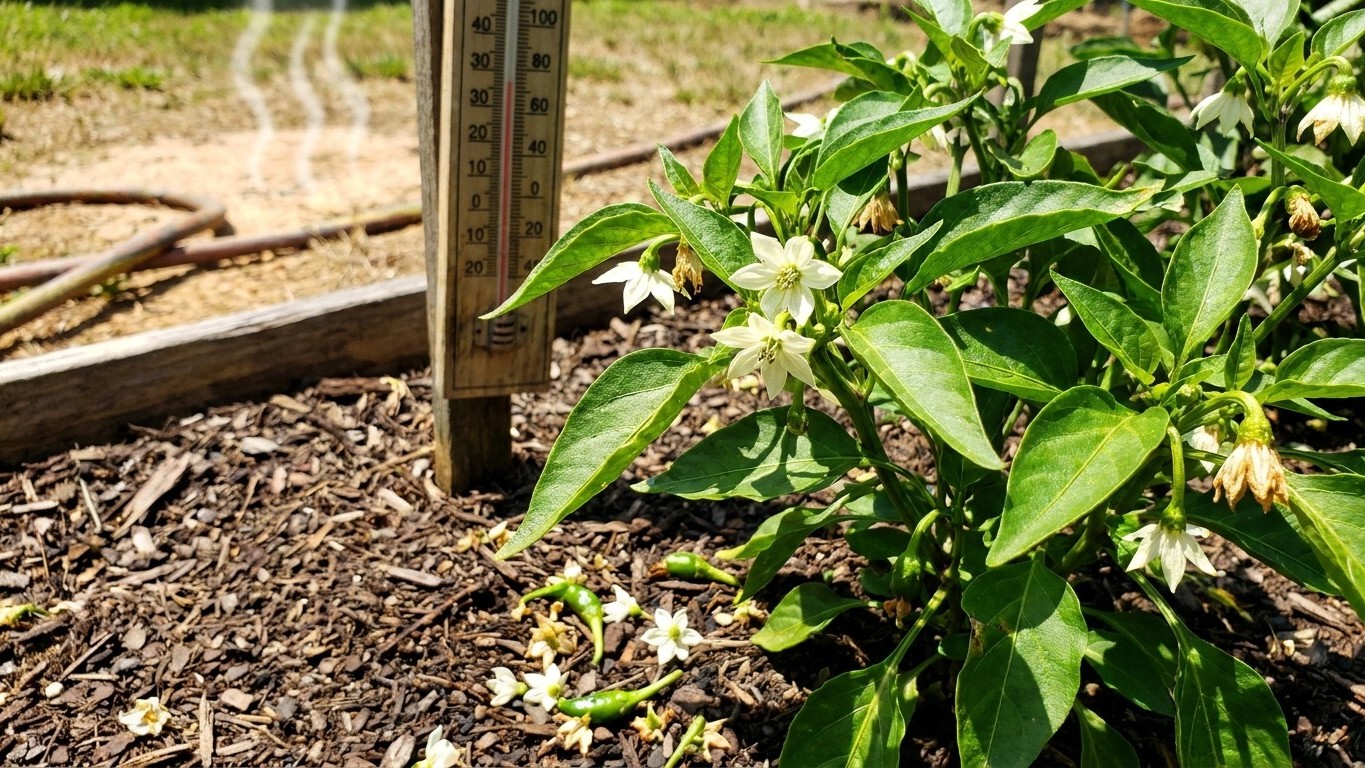

Peppers stop setting fruit in New Hampshire gardens for two opposite reasons, and both can show up in the same season. Hot spells push blossoms off the plant before pollination finishes, while cool nights slow pollen germination to a near-standstill. Manchester’s climate record puts the state at 10.9 days a year reaching 90°F or higher, which is the number that matters most for the heat-side failure. The cool-side threshold depends on your own nighttime lows, and that figure isn’t tracked here for New Hampshire specifically.
The short answer
Start with the heat number, because it’s the one this site can hand you directly. Manchester’s 1991-2020 climate normal shows 10.9 days a year at or above 90°F. That’s not a single heat wave, it’s an average spread across most summers, meaning a typical New Hampshire growing season sees somewhere around eleven days that hot, usually clustered in a run during July or early August rather than scattered evenly. Pepper flowers exposed to that kind of heat often abort before a fruit ever forms. Pollen becomes less viable, the plant redirects energy away from reproduction, and blossoms drop at the stem instead of swelling into peppers.
Why the cool end is harder to pin down
Pepper fruit set fails at both ends of the thermometer, not just the hot one. According to Utah State University Extension, nights below 55°F stop fruit set just as effectively as days above 90°F do, because cool temperatures at night interfere with pollen tube growth even when daytime conditions look perfect. This is the half of the story that trips up a lot of New Hampshire gardeners, because a stretch of chilly nights in late May or a cool snap tucked into August can quietly stall a plant that otherwise looks healthy.
The problem is that this site tracks days above 90°F for New Hampshire, but it does not carry summer night minima for the state. There’s no shortcut here: latitude doesn’t tell you what your yard does at 2 a.m. in June, and neither does the coldest month of the year. If your peppers are flowering heavily but not setting fruit, and the days haven’t been unusually hot, check your own overnight lows before blaming anything else. A cheap min-max thermometer left in the garden bed for a week will tell you more than any regional average.
| Failure point | Threshold | What Manchester’s record shows |
|---|---|---|
| Heat-side fruit drop | Days at or above 90°F | 10.9 days a year, on average |
| Cold-side fruit drop | Nights below 55°F | Not published on this site; monitor locally |
When to start seed here
Timing pepper seed indoors is arithmetic, and it works the same way in every county once you plug in your own numbers. Here’s how to build the schedule for a New Hampshire garden.
- Find your last spring frost window. For the Manchester reference station, NOAA’s 1991-2020 climate normals put the last spring frost between April 16 and April 27, based on the 32°F freeze probability band. Suburban and rural gardens typically see frost linger later than this, sometimes by one to two weeks, and even longer at higher elevations. Check your own county’s extension data or a few years of personal notes if you garden outside the immediate Manchester area.
- Wait for 60°F soil, not just a frost-free calendar date. Utah State University Extension recommends transplanting peppers only after both conditions are met: frost has passed and soil has warmed to 60°F. Cold soil stunts pepper roots even if the air feels warm, so a soil thermometer pushed a few inches into the bed is worth more than guessing from the calendar.
- Count back 8 to 10 weeks from your transplant date. If your target transplant window lands in early May because your local frost date and soil warm-up both cooperate, start seed indoors sometime in late February to early March. If your frost date runs closer to the later end of the April 16-27 range, or your soil takes longer to warm, push seed-starting back accordingly.
- Build in a buffer for a colder-than-average spring. Because rural and elevated sites often lag one to two weeks behind the reference station, gardeners outside the immediate Manchester area may want to start seed on the earlier side of that 8 to 10 week window, then simply hold transplants a bit longer indoors if the soil hasn’t caught up.
Redoing the math for your own county
The formula stays the same wherever you garden in New Hampshire: transplant date equals frost-free plus warm soil, and seed-starting date equals transplant date minus 8 to 10 weeks. Swap in your county’s frost record instead of Manchester’s if you’re gardening well outside the Merrimack Valley, and adjust for elevation if you’re up in the White Mountains foothills, where cold air pools and lingers longer than the valley floor.
What goes wrong here
New Hampshire’s climate creates a specific set of pepper problems, and most of them trace straight back to the temperature swings already covered above.
- Blossom drop during a hot spell. When a run of days pushes past 90°F, which happens on average close to 11 times a summer per Manchester’s climate normal, flowers can abort before fruit forms. There’s no fix for the heat itself, but light afternoon shade cloth over the row during the worst stretch, along with steady watering so plants aren’t also fighting drought stress, helps flowers hang on until temperatures ease.
- Blossom drop during a cool night. The same failure shows up in reverse when nights drop below 55°F, per Utah State University Extension, interfering with pollen tube growth even though the daytime looks fine. Since this site doesn’t track New Hampshire’s summer night minima, watch your own garden with a thermometer during late spring and any unseasonably cool August stretch, and consider row cover pulled over plants on nights that feel unusually chilly for the season.
- Sunscald on exposed fruit. Strong summer sun on peppers that have lost leaf cover, often from disease, wind damage, or overzealous pruning, can bleach and blister the fruit skin. Keeping foliage full through the growing season, and avoiding heavy pruning during the hottest weeks, keeps developing peppers shaded by their own leaves.
- Blossom-end rot on developing fruit. Uneven watering during a hot, dry stretch disrupts calcium uptake and leaves a sunken, leathery patch at the fruit’s blossom end. Consistent soil moisture, achieved with mulch and a regular watering schedule rather than deep soaking followed by dry spells, prevents most cases before they start.
Common questions
Can I fix blossom drop once it starts?
Not on flowers that have already fallen, but you can protect the next flush. If the cause is a heat spell above 90°F, shade cloth and steady irrigation help remaining buds set once temperatures ease. If nights have dropped below 55°F, row cover overnight can buy the plant a few warmer degrees until the cold snap passes.
Does a shorter growing season in New Hampshire limit which peppers I can grow?
Utah State University Extension names varieties suited to home gardens but does not publish heat ratings, days-to-maturity figures, or size comparisons for them, so no single variety can be recommended here as faster or more heat-tolerant based on that source. What matters more in New Hampshire is timing your transplant correctly around the April 16-27 frost window and 60°F soil mark, since that sets how much of the season your plants actually get to use.
How long after flowering should I expect fruit?
Fruit typically develops over roughly 35 to 45 days counted from flowering, not from the date you started seed or transplanted. That window matters most when you’re troubleshooting: if flowers set but nothing shows up weeks later, the problem happened after pollination, not before.
Should I bring peppers inside or cover them during a cold snap?
If nights are dipping below 55°F, which stalls fruit set according to Utah State University Extension, covering plants with row cover in the evening and removing it in the morning protects blossoms without blocking daytime pollination. Since New Hampshire’s summer night lows aren’t tracked on this site, checking a local thermometer during any unseasonable cool stretch is the only reliable way to know when to cover.