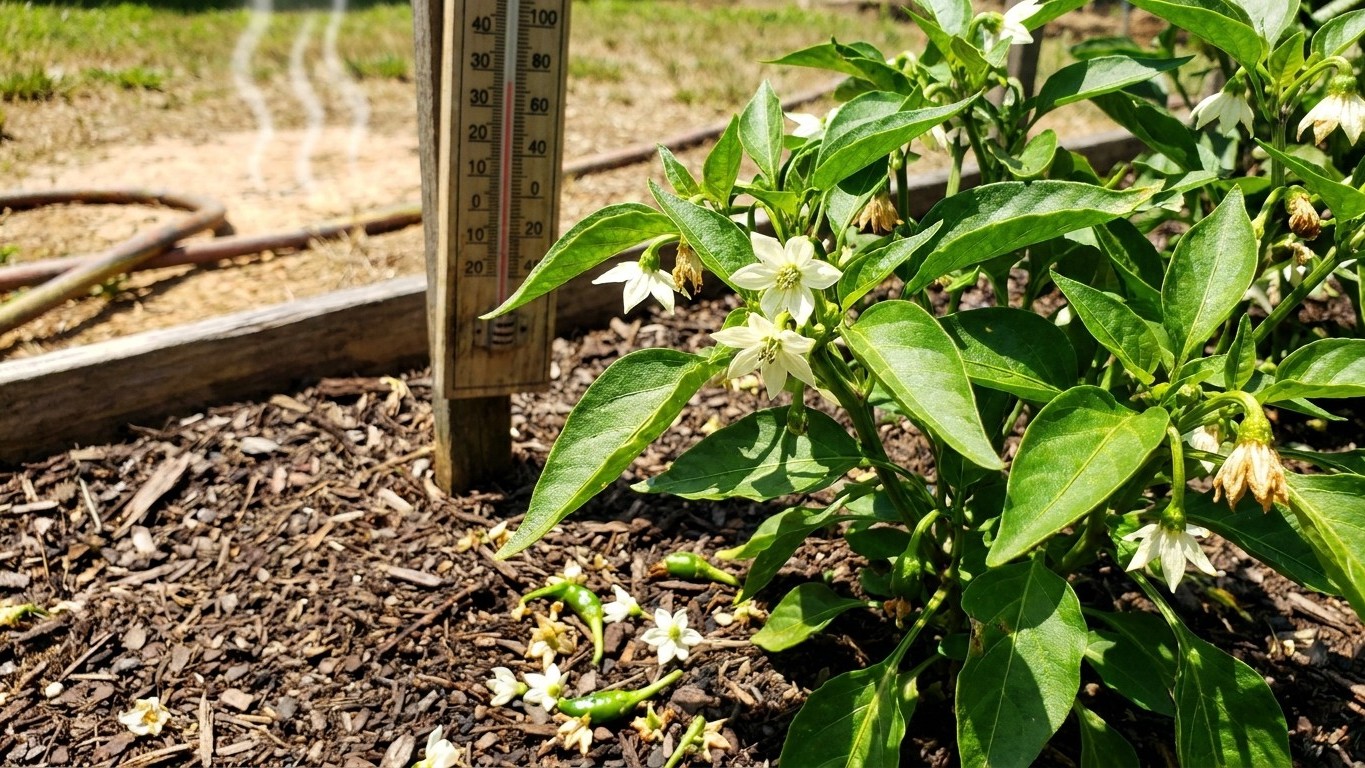

Peppers in Delaware often abort blossoms because of two separate stress points: extended heat above 90°F and any stretch of nights under 55°F. Wilmington’s climate averages 17.6 days a year at or above 90°F, enough to interrupt fruit set for at least two work weeks scattered through summer. Cool snaps do the same damage from the other direction. Getting fruit past the flower stage means timing transplants correctly, watching your own overnight lows, and adjusting expectations rather than chasing one quick fix.
The short answer
The hot end of the problem
The Wilmington reference station averages 17.6 days a year at or above 90°F, according to NOAA NCEI Climate Normals covering 1991-2020. That’s the benchmark for gauging summer heat load across the state, since Delaware’s small footprint means most gardens face a broadly similar pattern, though a paved suburban yard or an urban lot can run a few degrees hotter than open farmland. What matters for pepper flowers isn’t the annual total so much as how those days cluster. A run of five or six days above 90°F landing during peak flowering can turn pollen sterile and cause open blossoms to drop without ever setting fruit. Utah State University Extension puts it plainly: pepper fruit set fails at both ends, nights below 55°F or days above 90°F. Cross either line and the plant stops investing in reproduction, holding onto what fruit it already has or shedding blossoms outright.
Seventeen-and-a-half days spread across a whole season sounds manageable, but heat rarely spreads evenly. A single mid-summer heat dome can burn through a third of that annual count in one stretch, and if it lands during flowering, that’s the window that costs you fruit, not the season’s average high.
The cold end nobody checks
The cooler threshold gets missed constantly. Peppers stall with nights below 55°F just as surely as they do above 90°F, and that threshold can show up later in spring or earlier in fall than the calendar suggests. This site tracks daytime heat extremes by location, but it does not carry summer overnight low temperatures for Delaware. Don’t guess a nighttime low from where the state sits on a map or from how cold January feels. Summer overnight temperatures depend on topography, tree cover, distance from water, and low-lying terrain that traps cool air, none of which track cleanly with latitude. A garden near the Delaware Bay can run several degrees warmer overnight than one tucked into an inland hollow fifteen miles away. If blossoms are dropping and the days haven’t been particularly hot, put a min-max thermometer in the garden before assuming heat is the culprit. It might be the nights instead.
When to start seed here
The math behind pepper timing runs backward from two fixed points: your last frost and your soil temperature. Here’s how to work it out for your own property.
- Start with the reference frost window. The Wilmington airport station shows a 32°F freeze probability window of April 3 to April 14 for the last spring frost, based on NOAA NCEI 1991-2020 Climate Normals. Treat this as a reference point tied to that specific station, not a statewide guarantee.
- Adjust for your own ground. Suburban and rural gardens typically see their last frost later than an airport station reports, often by one to two weeks, and more at elevation or in low-lying frost pockets. If you garden outside Wilmington proper, push your working frost date later than the reference window and confirm it against your county extension office.
- Wait for 60°F soil, not just a frost-free calendar. Utah State University Extension is specific on this: transplant peppers after frost and once soil reaches 60°F. Air temperature can feel warm enough while the soil underneath is still too cold for root growth, so use an actual soil thermometer pushed a few inches down rather than trusting the forecast.
- Count back 8 to 10 weeks for indoor seed starting. Once you have a realistic transplant date, whether that’s tied to the reference window plus your own buffer, subtract 8 to 10 weeks. That’s your indoor sowing date. A gardener planning to transplant in the back half of the reference window, adjusted a week later for a cooler yard, would start seed roughly two months before that adjusted date.
- Recheck before you move plants outside. Frost date and seed-starting math get you in the right neighborhood, but the final call belongs to the soil thermometer on transplant day, not the calendar you used two months earlier.
What goes wrong here
The three most common failures
- Blossom drop. Triggered by either extreme, a run of days above 90°F or a stretch of nights below 55°F. Flowers open, then fall without setting fruit. Remedy: shade cloth over plants during forecasted heat spikes, floating row cover on unexpectedly cool nights, and skip high-nitrogen fertilizer during flowering since it pushes leafy growth instead of fruit set.
- Sunscald. Delaware summer sun combined with heat load above 90°F can scorch fruit that loses its leaf cover, whether from disease, over-pruning, or wind damage. Scalded patches turn pale, then leathery, then rot. Remedy: leave foliage intact rather than pruning heavily for airflow, and add light shade cloth over exposed rows during the hottest afternoon stretch.
- Blossom-end rot. A calcium uptake failure usually triggered by inconsistent watering through hot, dry spells rather than a true calcium shortage in the soil. Fruit develops a sunken, dark leathery patch on the bottom. Remedy: water on a consistent schedule instead of letting soil swing from dry to soaked, and mulch to hold moisture steady through the days when the thermometer climbs toward that 90°F mark.
Common questions
How many days does Delaware typically see above 90°F?
The Wilmington reference station averages 17.6 days a year at or above 90°F, per NOAA NCEI Climate Normals covering 1991-2020. That figure represents the reference station specifically; nearby paved or urban sites may run slightly warmer.
What soil temperature should peppers reach before transplanting?
Utah State University Extension recommends waiting until soil reaches 60°F and frost has passed, whichever comes later. Check with an actual soil thermometer rather than relying on air temperature alone.
Why do pepper blossoms drop without any heat wave in sight?
Fruit set fails at both temperature extremes, not just the hot one. A stretch of nights below 55°F can cause the same blossom drop as a run of 90°F days. This site does not track summer night minima for Delaware, so check your own garden with a min-max thermometer before ruling out a cold-night cause.
When is the last spring frost date for Delaware gardens?
The Wilmington airport station shows a 32°F freeze probability window of April 3 to April 14, based on NOAA NCEI 1991-2020 Climate Normals. Suburban and rural gardens away from that station often see frost linger one to two weeks longer, more at elevation, so confirm locally before transplanting.