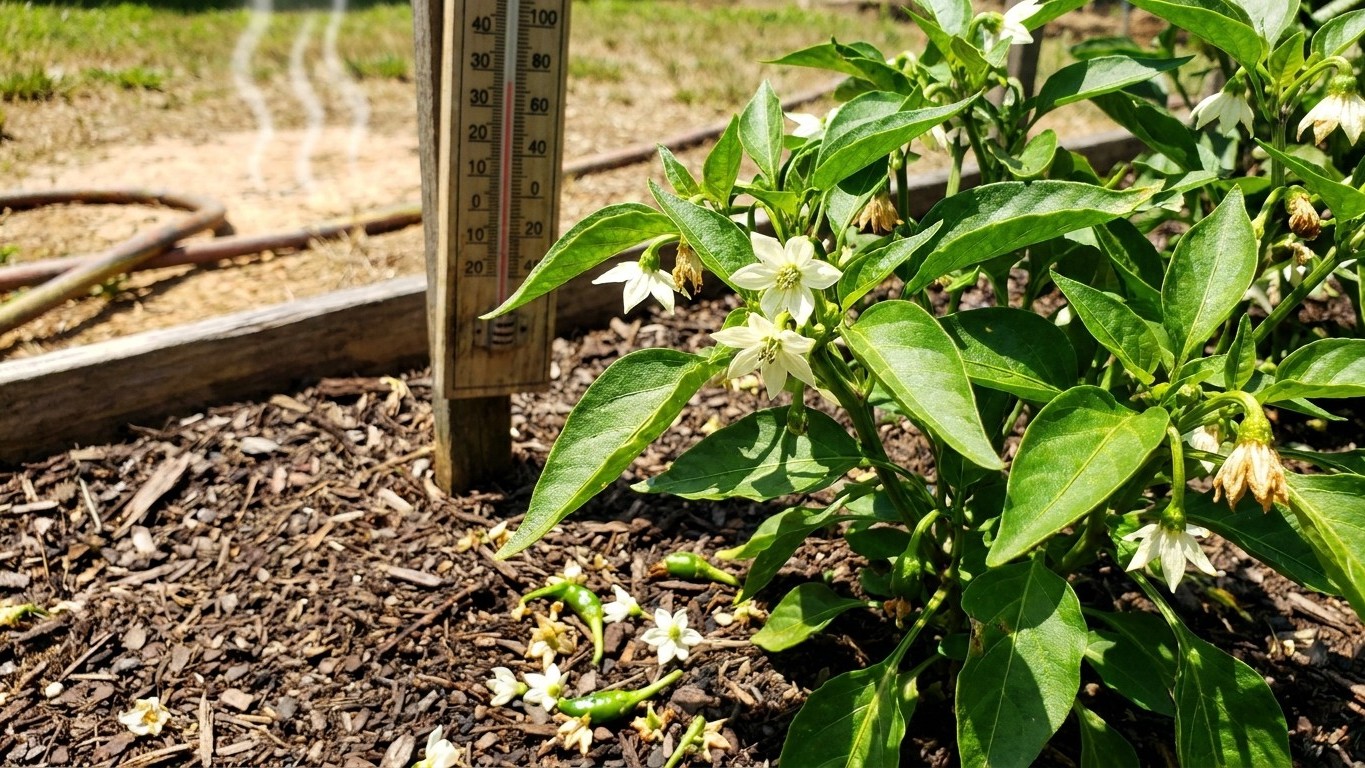

In New Brunswick, pepper plants almost never face the heat-stress side of fruit-set failure. But that’s only half the story: cold nights can shut down pollination just as fast, and this territory’s night-time lows aren’t published on this site. That gap matters more here than almost anywhere else in the cocon.
The short answer
Start with the number that actually describes this climate: the reference station at Moncton records 0.0 days a year at or above 90 F, according to Environment and Climate Change Canada’s Canadian Climate Normals for 1981-2010. That’s not a typo and not a rounding error. It means the hot-end failure mode that plagues pepper growers further south, where blossoms abort because daytime highs stay above 90 F for days on end, essentially does not happen in New Brunswick. If your peppers are dropping flowers here, heat stress from daytime highs is very unlikely to be the reason.
That’s the easy half of the equation. The harder half is the cold end, and it’s the one growers in this province tend to underestimate. Utah State University Extension is blunt about it: pepper fruit set fails at both ends, either when nights drop below 55 F or when days climb above 90 F. New Brunswick’s daytime numbers clear that bar with room to spare. Its night-time numbers are a different matter entirely, and this site does not carry summer night minima for this territory.
That’s not an oversight. Night-time lows are notoriously local. A river valley two miles from a ridge can run 8 to 10 degrees cooler after sunset, purely from cold air drainage. A backyard next to a paved driveway holds heat differently than one bordered by open field. None of that shows up in a provincial or even a station-level average, and it would be irresponsible to guess at it from Moncton’s coordinates or from how cold the province gets in January. Winter cold and a July night are two completely unrelated numbers, and latitude alone tells you nothing reliable about either.
What this means practically: track your own overnight lows through the pepper season, from bloom until harvest slows. A simple min-max thermometer left in the growing area for a week will tell you more than any regional average. If you’re seeing flowers open and drop without setting fruit, and daytime highs are nowhere near hot, check what happened to the thermometer overnight three to five days earlier. Pepper flowers respond to the night before, not the day of.
When to start seed here
The arithmetic for pepper timing has three fixed points, and once you have them for your own county, the math writes itself. Here’s how it works out using New Brunswick’s own numbers.
- Find your frost anchor. The Moncton station’s average last spring frost date is May 23, drawn from the 1981-2010 Canadian Climate Normals. That word “average” is doing real work: in one year out of two, frost actually arrives after May 23. Treat this as the midpoint of a window, not a line you can plant right up against. A grower who transplants on May 23 every single year will get burned in roughly half of them.
- Wait for 60 F soil, not just for the calendar. Utah State University Extension’s guidance for transplanting peppers is soil at 60 F, after frost risk has passed. Air temperature can feel like summer while soil eight inches down is still holding spring cold, especially in heavier or shaded ground. A basic soil thermometer, checked at the depth you’ll be planting, removes the guesswork.
- Count back 8 to 10 weeks for indoor sowing. If your realistic transplant date, factoring in both frost risk and soil warmth, lands in early June for a cautious New Brunswick garden, count back 8 to 10 weeks from that date to find your indoor seeding window. Early June minus 10 weeks lands in the last days of March; minus 8 weeks lands closer to early April. Growers who push their transplant date later, because they’re waiting out a slow soil warm-up or an unusually cold spring, should push their seeding date back to match, not leave transplants sitting leggy in trays.
- Redo the math for your own ground. A county with more open exposure, more elevation, or a history of late frosts should shift the whole sequence later. There’s no penalty for starting seed a week later than the average suggests; there’s a real penalty for transplanting into ground that isn’t warm enough or air that still has one more frost in it.
None of this arithmetic accounts for flowering-to-harvest time, which is a separate clock that only starts once the plant is already blooming. Utah State University Extension’s 35 to 45 day figure for peppers runs from flowering, not from sowing or transplanting, so don’t fold it into your seed-starting math. It only becomes relevant once you’re counting toward harvest, weeks after transplant.
What goes wrong here
Given New Brunswick’s daytime numbers, the failures growers actually run into locally tend to cluster around a few specific patterns. Here’s what tends to show up, and what to do about each one.
- Blossom drop from a cool night. Since New Brunswick almost never sees days above 90 F, a run of flowers falling without setting fruit is far more likely tied to nighttime lows dipping under 55 F than to any heat spell. Track your own overnight minimums through bloom, and if a cold snap lines up with dropped blossoms three to five days later, that’s your answer. Waiting out the cold snap and letting later flushes of bloom set fruit once nights warm is usually the only fix; there’s no product that overrides a cold night.
- Blossom drop from a rare hot spell. Even in a climate that averages 0.0 days above 90 F, an individual season can still throw an unusual hot stretch. If daytime highs spike hard for a few days during bloom, expect the same blossom-drop response heat causes anywhere else. Shade cloth over the row during the worst afternoon hours, and consistent watering so the plant isn’t fighting drought stress on top of heat, gives the next flush of flowers a better shot.
- Sunscald on exposed fruit. Once fruit is set, direct strong sun on a pepper that’s lost leaf cover, from pruning, wind damage, or disease dropping foliage, can scald the skin into a pale, papery patch. Keep the plant’s own canopy intact rather than stripping leaves for “more sun,” and stake or cage plants so wind doesn’t tear cover away from developing fruit.
- Blossom-end rot. This shows up as a dark, sunken patch on the fruit’s bottom end and traces back to inconsistent watering interrupting calcium uptake, not a soil calcium deficiency in most cases. Even, regular watering, especially through the weeks right after transplant when New Brunswick’s soil is still working its way up to that 60 F mark, does more to prevent it than any additive poured on after the fact.
Common questions
Does New Brunswick ever get hot enough to stop pepper fruit set?
Based on the Moncton reference station’s average of 0.0 days a year at or above 90 F, heat-driven fruit-set failure is very rare in this territory. It’s not impossible in an unusually hot individual season, but it isn’t the pattern to expect here, and it shouldn’t be the first thing you check when blossoms drop.
How do I know if my nights are too cold for peppers, since this site doesn’t cover that number?
Place a min-max thermometer in the growing area and check it through bloom. If overnight lows are running under 55 F, according to Utah State University Extension’s guidance, that’s cold enough to interrupt fruit set. There’s no substitute for measuring your own site; latitude and winter cold don’t predict a summer night.
Is May 23 a safe date to transplant peppers in New Brunswick?
No. May 23 is the average last spring frost date at the Moncton station for 1981-2010, which means frost arrives after that date in roughly half of all years. Treat it as the center of a risk window, confirm soil has reached 60 F, and lean later rather than earlier if your site runs cool.
When should I start pepper seeds indoors for a New Brunswick garden?
Count back 8 to 10 weeks from your realistic transplant date, the one set by both frost risk and 60 F soil, not the calendar alone. For a transplant target in early June, that puts indoor seeding somewhere in the last week of March through early April, depending on how cautious your local conditions call for.