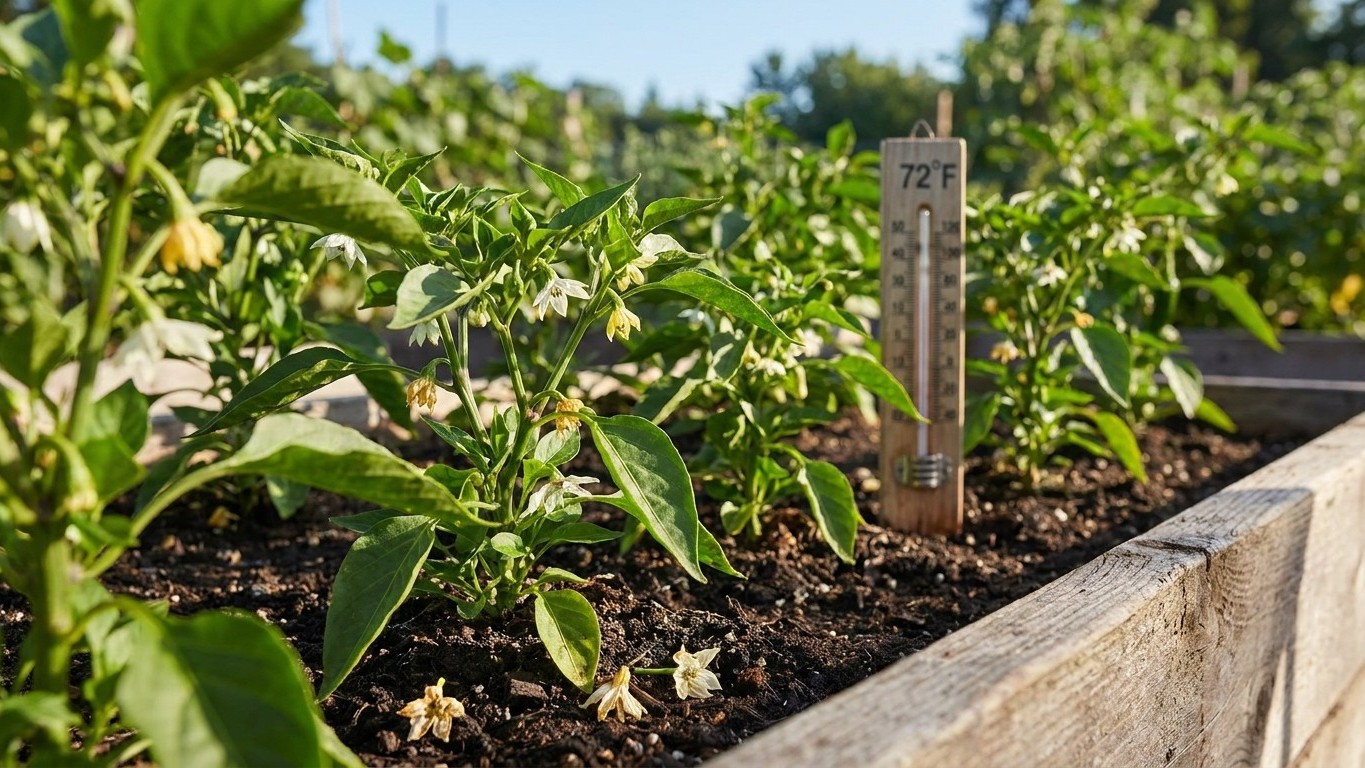

Start pepper seed indoors 8 to 10 weeks before you plan to set transplants outside. For most New Hampshire gardeners near the Manchester reference station, that lands seed-starting in mid-to-late February, since transplanting itself waits for frost to clear (April 16 to April 27 at that station) and for soil to warm past 60 F. Nights under 55 F and days over 90 F can still stall fruit set no matter when you sowed.
The short answer
Manchester’s climate record shows an average of 10.9 days a year at or above 90 F. That’s not a heat wave here and there. It’s close to two full weeks, spread across July and August, when pepper flowers can abort before they ever become fruit. Pepper plants don’t fail dramatically in that heat. They just quietly stop setting, dropping blossoms or letting pollen go sterile, and a gardener who isn’t watching the thermometer assumes the plant is simply “resting.”
Ten point nine days doesn’t sound like much until you map it against a pepper’s bloom window. If your plants hit peak flowering during the hottest stretch of summer, that’s when the damage lands hardest. Staggering transplant dates by a week or two across a few plants, or choosing a partly shaded spot for a couple of pots, spreads the risk instead of betting the whole crop on one flowering window landing in a cool stretch.
The other end of the failure range matters just as much, and this is where a lot of planning guides get lazy. Pepper fruit set also fails when nights drop below 55 F. Cool nights are common in New Hampshire well into late spring and can reappear in early fall, and they don’t announce themselves the way a 90-degree afternoon does.
Here’s the catch: this site tracks daytime heat extremes for New Hampshire, but it does not carry summer overnight low temperatures. That’s not a small gap. A valley garden a few miles from an official weather station can run several degrees cooler at night than the station’s own record, and no amount of guessing from latitude or from how cold January gets will tell you what your specific July and August nights look like. If you garden near a river bottom, in a low-lying yard, or at any elevation above the surrounding area, night chill is a real threat to fruit set even in a state that also produces those ten-plus days of 90-degree heat. Keep an eye on your own overnight readings during bloom. A basic min-max thermometer left outside near the pepper bed for a season will tell you more than any regional average can.
When to start seed here
The math behind a pepper start date isn’t complicated once you break it into steps. It works backward from the day you actually intend to put transplants in the ground, and every New Hampshire gardener can rerun this same sequence with their own county’s numbers.
- Find your local last frost window. The Manchester reference station’s 1991-2020 record puts the last spring freeze between April 16 and April 27. Suburban and rural gardens typically see frost linger later than that, sometimes by one to two weeks, and higher ground later still. Check your own town’s frost history rather than assuming the airport figure applies to your yard.
- Wait for soil, not just air. Peppers need soil around 60 F before transplant shock stops being a risk. Cold soil stunts root growth even if the air feels warm enough for a jacket-free afternoon. A simple soil thermometer pushed a few inches into the bed, checked over several mornings, beats guessing from the calendar.
- Set your transplant date at whichever comes later. If frost risk clears in late April but soil is still cold, wait for the soil. In much of New Hampshire that pushes real transplant dates into mid-to-late May.
- Count back 8 to 10 weeks from that transplant date. That’s the window Utah State University Extension gives for how long pepper seedlings need indoors before they’re ready to go out. Ten weeks before a mid-May transplant lands seed-starting in early March; eight weeks before a late May transplant lands it in early April. Splitting the difference, most gardeners here land somewhere in the mid-to-late February to early March range.
- Build in a buffer for slow germination. Pepper seed is notoriously unhurried, often taking one to three weeks just to sprout depending on soil temperature under the trays. Start on the early side of your calculated window rather than the late side.
Redo this arithmetic for your specific address, not for the state as a whole. A garden in the Connecticut River valley and one in the Lakes Region can differ by a week or more on both ends of the frost-free season, and that shift moves your seed-starting date right along with it.
What goes wrong here
- Blossom drop from a heat spike. A run of 90-degree days during flowering, part of that 10.9-day annual average, can cause flowers to drop before fruit forms. There’s no fixing the weather, but afternoon shade cloth over the bed during a forecasted hot stretch, along with steady soil moisture, keeps plants from adding drought stress on top of heat stress.
- Blossom drop from a cool night. Nights below 55 F have the same effect as extreme heat: flowers abort. Since this site doesn’t track summer night lows for New Hampshire, watch your own conditions, especially in low-lying or shaded yards where cold air pools overnight. Row cover pulled loosely over plants on a night that looks like it’ll dip into the 50s can make the difference for a bloom cycle.
- Sunscald on exposed fruit. Strong summer sun, especially during the same stretch that produces those 90-degree days, can scald fruit that’s lost leaf cover to disease, pruning, or wind damage. Peppers ripen better with a full canopy of leaves shielding them; avoid heavy pruning once fruit starts sizing up, and stake plants instead of stripping foliage to control sprawl.
- Blossom-end rot from uneven watering. This shows up as a sunken, leathery patch on the bottom of the fruit and traces back to inconsistent soil moisture interfering with calcium uptake, not a soil calcium shortage most gardeners actually have. Deep, even watering on a regular schedule, plus a layer of mulch to buffer soil moisture swings between rainy and dry stretches, is the fix that actually works.
Common questions
Can I start pepper seed earlier than 8 to 10 weeks to get a head start?
Starting much earlier usually backfires. Seedlings held indoors too long get root-bound, stretched, and stressed before they ever see the garden, and they often perform worse than seedlings started on schedule. Stick to the 8 to 10 week window Utah State University Extension recommends, counted back from your actual transplant date.
What if my soil hits 60 F before the last frost date passes?
Transplant only after both conditions are met. Frost can still kill young pepper plants even if the soil beneath them has warmed, so wait for the later of the two thresholds, not the earlier one.
Does New Hampshire’s 10.9 days above 90 F happen all at once or spread out?
The figure is a yearly average from the Manchester reference station’s 1991-2020 climate normals, not a description of a single heat wave. In practice it tends to arrive as scattered short stretches through July and August rather than one continuous block, which is part of why it’s easy to underestimate its effect on flowering.
How do I know if my garden runs colder at night than the official station data?
Set a min-max thermometer in the pepper bed and check it each morning through the bloom period. Yards in low spots, near water, or shaded by tree lines commonly run several degrees cooler overnight than a station reading taken from open, elevated ground, and that gap is exactly what this site’s data can’t capture for you.