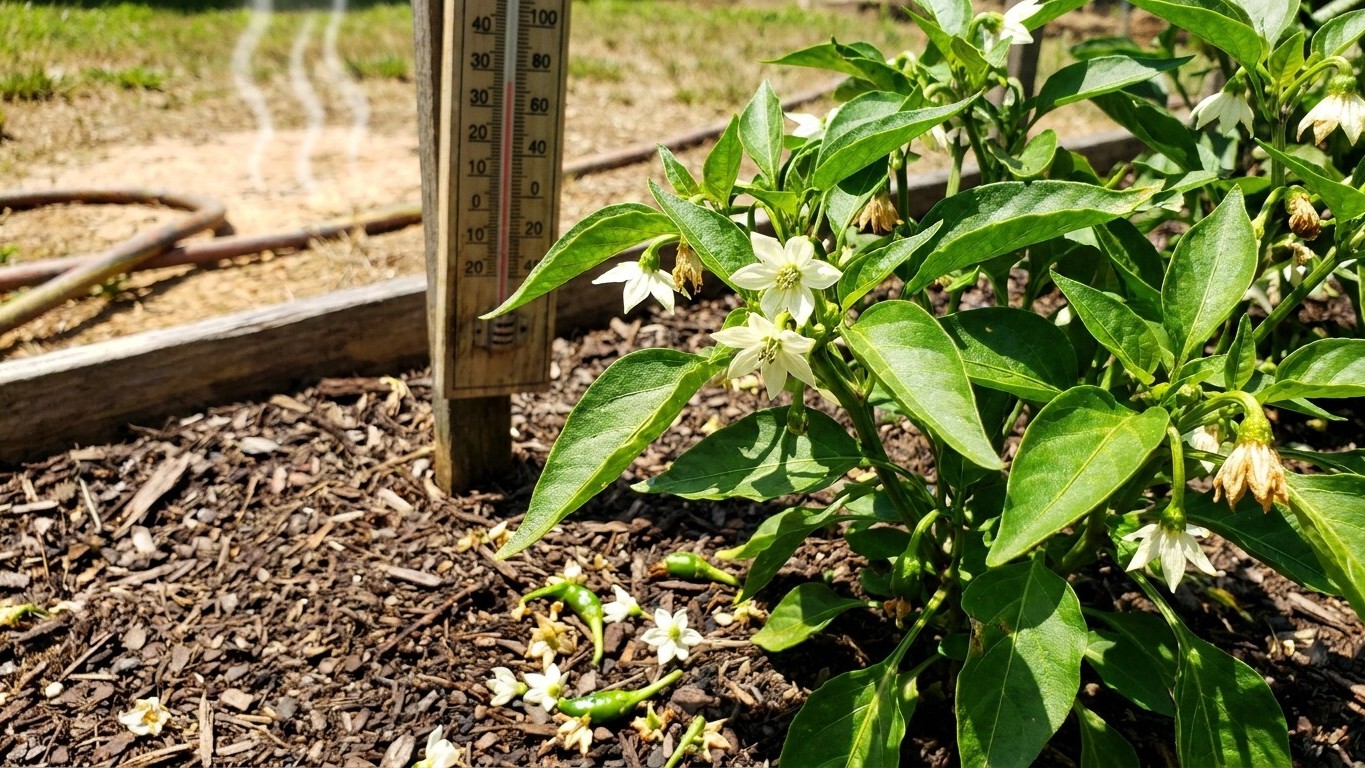

Peppers in Ontario usually stall for a cold reason, not a hot one. This province logs essentially zero days a year at or above 90 F at the reference station, so heat rarely shuts down flowering here. The more common culprit is a run of cool nights that hits pepper flowers before they ever set fruit, combined with starting seed too late or transplanting into soil that hasn’t warmed enough.
The short answer
Start with the number that matters most for heat stress: 0.0 days a year at or above 90 F, based on Environment and Climate Change Canada’s Canadian Climate Normals for 1981-2010 at the Toronto reference station. For a crop that stops setting fruit once daytime highs push past that mark, this is close to a non-issue across most of an Ontario growing season. Pepper flowers can abort when heat gets extreme, but that particular failure mode is rare here compared to warmer growing regions further south. If your peppers are dropping blossoms in Ontario, heat stress from daytime highs is the less likely explanation.
The other end of the range is where Ontario growers actually run into trouble. Pepper fruit set fails when nighttime lows drop below 55 F, according to Utah State University Extension, and that threshold has nothing to do with how hot the afternoon got. A string of chilly nights, even in July, can cause flowers to open and drop without ever forming a fruit, while the plant itself looks perfectly healthy otherwise. This is a distinct failure from heat stress, and it can happen in the same week that daytime highs feel comfortably warm.
This is also where the record here runs out. This site tracks days at or above 90 F by territory, but it does not carry summer night minima, and no reliable figure exists to substitute for it. A gardener in a low-lying field along a river valley can see nights ten degrees cooler than a gardener a few miles away on higher ground, and neither figure can be guessed from a map or from how far north the plot sits. Latitude alone won’t tell you what your July nights actually do. The only dependable approach is to watch your own overnight lows during flowering, using an outdoor min-max thermometer near the pepper bed itself, rather than relying on a nearby weather station or an assumption based on the region’s general climate.
Put together, the picture for Ontario looks like this: heat-driven fruit set failure is unlikely given how few days cross the 90 F line, but cool-night failure is a live risk that depends entirely on your specific site and the year’s weather pattern. Both ends can shut down fruit set even though they look nothing alike in the garden, and only one of them shows up in published climate data for this province.
When to start seed here
The timing question comes down to counting backward from two fixed points: when frost typically ends, and when the soil is actually warm enough to receive a pepper transplant. Here’s how that arithmetic works for Ontario.
- Start with the frost date. Environment and Climate Change Canada’s Canadian Climate Normals for 1981-2010, from the Toronto Lester B. Pearson International Airport station, put the average last spring frost at April 30. That’s a mean, not a guarantee. In one year out of two, frost arrives later than that date, so treat it as the midpoint of a window rather than a safe line to plant against.
- Wait for soil, not just air. Utah State University Extension advises transplanting peppers only after frost has passed and once the soil has reached 60 F. Air temperature can feel warm on a sunny April afternoon while the soil a few inches down is still cold from winter, so a soil thermometer pushed into the bed is worth more than a glance at the forecast.
- Expect soil warm-up to lag the frost date. Because the April 30 figure is only a mean and soil takes time to catch up to spring air temperatures, most Ontario gardeners find the 60 F soil mark falls somewhat after the average frost date, not on it. The gap varies by soil type, sun exposure, and whether the bed is mulched or bare, so there’s no single fixed number of days to add. Checking the soil directly removes the guesswork.
- Count back 8 to 10 weeks for indoor seed starting. Utah State University Extension recommends starting pepper seed indoors 8 to 10 weeks before that transplant date. If your soil typically hits 60 F in the latter half of May, for example, counting back 8 to 10 weeks lands seed-starting somewhere in mid to late March. Adjust the count using your own soil readings from past seasons rather than the frost date alone, since the frost date only marks one end of the calculation.
- Reconfirm with your own records each year. Because both the frost date and the soil warm-up are averages built from decades of data, any single year can run early or late. Gardeners who keep a simple log of first soil-thermometer readings each spring end up with a far more accurate personal transplant date than the regional normals can provide on their own.
What goes wrong here
- Blossom drop from a hot spell or a cool night. Pepper fruit set fails at both ends: nights below 55 F or days above 90 F cause flowers to open and fall without setting fruit. In Ontario the hot-end trigger is uncommon given the region’s low count of 90 F days, but a run of cool nights during flowering can still cause the same drop. The remedy is to watch overnight lows near the plants during bloom and, where a cold snap is forecast, cover plants overnight or delay heavy pruning that would expose more flowers to the chill.
- Sunscald where the sun is strong. Pepper fruit and stems can scald on the side facing direct afternoon sun, especially when foliage has been thinned or a plant loses leaves to wind or disease partway through the season. The remedy is to keep the plant’s natural leaf cover intact rather than pruning it back hard, and to use light shade cloth over exposed fruit during the sunniest stretch of midsummer afternoons.
- Blossom-end rot on developing fruit. This shows up as a sunken, darkened patch on the bottom of the pepper and traces back to uneven water delivery to the fruit rather than a soil nutrient shortage in most cases. The remedy is steady, even watering on a consistent schedule, along with a layer of mulch to keep soil moisture from swinging between soaked and bone-dry as the season’s weather changes.
Common questions
Why are my pepper plants flowering but not setting fruit in Ontario?
The most likely explanation is a run of nights below 55 F during flowering, since that threshold causes blossoms to drop before fruit forms. Given Ontario’s very low count of days at or above 90 F, heat stress is a less common cause here than in warmer regions, so checking your overnight lows near the plants during bloom is the first step.
Does Ontario get hot enough to stop pepper fruit set?
Rarely. The Toronto reference station averages 0.0 days a year at or above 90 F, based on Environment and Climate Change Canada’s 1981-2010 normals, which means the daytime-heat trigger for fruit set failure is uncommon across most of the province in a typical season.
When should I transplant peppers outdoors in Ontario?
Transplant only after frost has passed and once soil temperature has reached 60 F, per Utah State University Extension. The average last spring frost for the Toronto area is April 30, but that’s a mean date, not a safe one, so confirming soil temperature directly with a soil thermometer is the more reliable check.
How early should I start pepper seeds indoors for Ontario?
Utah State University Extension recommends starting seed 8 to 10 weeks before the outdoor transplant date, which itself depends on soil reaching 60 F after frost. Since Ontario’s average frost falls around April 30 and soil warm-up trails behind that, most local gardeners land on a March start, adjusted using their own soil readings from past seasons.