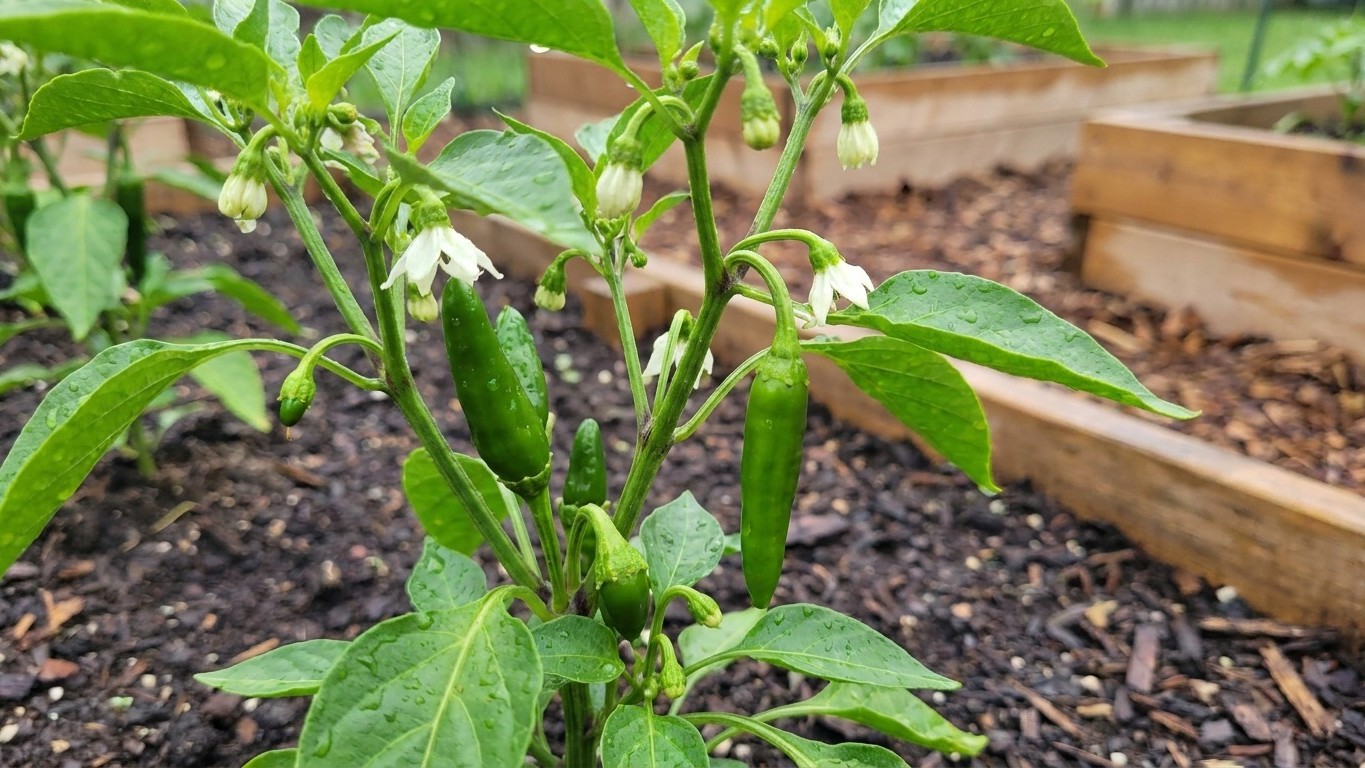

Ontario’s growing season delivers almost no days above 90°F, the heat threshold that shuts down pepper fruit set. That’s a real advantage over hotter regions. But heat is only half the equation. The other failure point, nights below 55°F, isn’t tracked at the provincial level here, so growers still need to watch their own thermometer through the shoulder weeks of the season. Timing the transplant right does more for a pepper harvest than the climate alone ever will.
The short answer

At the Toronto Lester B. Pearson reference station, Environment and Climate Change Canada’s 1981-2010 climate normals record an average of 0.0 days a year reaching 90°F or higher. For pepper growers, that number matters because Utah State University Extension identifies 90°F days as one of two thresholds that stop fruit set cold: pollen becomes less viable, flowers abort, and a plant that looked loaded with buds drops most of them within a day or two of a heat spike.
An average of zero days that hot means the hot-end failure that plagues gardeners in warmer states almost never shows up in a typical Ontario season. That’s the good news, and it’s worth sitting with for a moment, because a lot of pepper-growing advice written for hotter climates simply doesn’t apply here. Shade cloth to protect against scorching afternoons, staggered plantings to dodge a mid-summer heat dome, extra irrigation to offset transpiration losses on 95°F days: none of it is the priority in a region where 90°F afternoons are the exception, not the rule. The more useful question for local growers is which Pepper Varieties That Ripen in a Ontario Season actually make the most of the shorter, cooler window this climate provides.
But an average built from thirty years of data smooths over the outlier summer. A short heat spell that pushes a handful of afternoons past 90°F can still happen in any given year, even one where the seasonal average lands at zero, and a plant caught in that stretch will drop blossoms just as readily as one in a warmer state. Microclimates matter too. A pepper bed against a south-facing wall or a bed of black mulch in full sun can run several degrees hotter than the air temperature the reference station is measuring.
Then there’s the other end of the range, and it’s the one this climate actually needs to worry about. Utah State University Extension’s threshold for cold-side fruit-set failure is nights below 55°F. This site does not carry summer night minima for Ontario or any other territory, so there’s no published figure here to lean on. That’s not an oversight to gloss over, and it’s worth reading more on Why Peppers Fail to Set Fruit in Ontario to understand exactly what’s at stake. It means the reader has to track it directly, with a thermomWhen to Start Pepper Seed in Ontarioeter in the garden, rather than assume anything from the province’s latitude or from how cold the winters run. A location can sit at a given latitude and still see wildly different overnight lows depending on elevation, distance from Lake Ontario, and how open or sheltered the site is. Guessing is the wrong move here; measuring is the only one that works.
When to start seed here
Utah State University Extension’s rule for peppers is simple: start seed 8 to 10 weeks before transplanting, and don’t transplant until frost has passed and the soil has warmed to 60°F. Working backward from a real date turns that rule into a plan.
- Anchor the frost side of the equation. Environment and Climate Change Canada’s 1981-2010 climate normals put the average last spring frost at Toronto Lester B. Pearson International Airport (climate ID 6158733) at April 30. That’s a mean, not a guarantee. In one year out of two, frost arrives later than April 30, so treat the date as the midpoint of a window rather than a line you can plant right up against.
- Check the soil side separately. Air temperature and soil temperature don’t move together. A morning without frost doesn’t mean the soil four inches down has hit 60°F, particularly in clay ground, in a shaded bed, or in a spring that stayed cool and wet. A soil thermometer pushed into the planting bed is the only way to know for sure, and it’s worth checking for several consecutive days rather than trusting a single warm afternoon.
- Set a realistic transplant target. Because the frost date is a coin flip and soil warming often lags behind it, many Ontario gardeners aim a week or two past April 30 before setting pepper transplants outside, adjusting based on what the soil thermometer and the extended local forecast actually show that year.
- Count back 8 to 10 weeks from that target. Using April 30 as an illustration only, 8 weeks back lands on roughly March 5; 10 weeks back lands on roughly February 19. If the real transplant target shifts later to account for a slow spring, the seed-starting window shifts later by the same number of weeks.
- Redo the math for your own conditions. A station reading from Toronto’s airport doesn’t describe a garden two counties north, at higher elevation, or farther from the lake’s moderating effect. The arithmetic (frost date and 60°F soil, minus 8 to 10 weeks) stays the same; only the starting date changes.
What goes wrong here
- Blossom drop from either temperature extreme. Flowers can abort during a rare hot spell that pushes days above 90°F, or during a cool snap that drops nights below 55°F, and both produce the same frustrating result: a plant covered in flowers with almost nothing setting fruit. Since Ontario summers deliver very few 90°F days on average, the more common culprit here is likely the cool end. Keep a min-max thermometer in the bed through late spring and again in early fall, and hold off setting transplants out until nights are reliably staying above that mark.
- Sunscald where the sun is strong. Peppers that ripen without enough leaf cover, often after aggressive pruning, pest damage, or disease has thinned the foliage, can develop pale, blistered patches on the side facing direct sun. The fruit isn’t rotten, but the scalded tissue turns soft and often fails before it fully ripens. The fix is to leave enough foliage on the plant to shade the fruit naturally, avoid heavy pruning during the hottest stretch of summer, and use light shade cloth over exposed plants if a heat spell coincides with thin canopy cover.
- Blossom-end rot from uneven watering. A sunken, leathery brown or black spot at the blossom end of the fruit shows up when calcium can’t move consistently into developing peppers, usually because soil moisture swings between too dry and too wet. Mulching the bed to even out moisture, watering on a consistent schedule instead of letting the soil dry out between heavy soakings, and avoiding a big surge of nitrogen fertilizer all reduce how often it appears.
Checking this against your own county
Every figure above comes from a single reference station, Toronto Lester B. Pearson International Airport, and a province this size is not one climate. Growers farther north, at higher elevation, or well inland from Lake Ontario’s moderating effect should expect a later average frost date and a shorter frost-free window than the numbers used here.
For local frost records, soil temperature guidance, and pest and disease bulletins specific to a given county, the Ontario Ministry of Agriculture, Food and Rural Affairs is the right place to check: ontario.ca/page/agriculture-and-food. Cross-referencing a province-wide station reading against local guidance is the difference between a planting schedule that works on paper and one that actually holds up in a particular backyard.
Common questions
Do pepper plants need full sun in Ontario?
Yes. Peppers need as much direct sun as a bed can offer for reliable flowering and fruit set. Given how few 90°F days the province averages, sun exposure is far more likely to be the limiting factor here than excess heat.
Can peppers be transplanted before the last frost date if covered?
Frost protection like row cover can guard against a light frost, but it does nothing to warm the soil, and Utah State University Extension’s rule requires both conditions, no frost and 60°F soil, before transplanting. Covering plants doesn’t remove the need to check soil temperature separately.
Why are pepper flowers falling off even though nights aren’t unusually cold?
Check daytime highs first. A short stretch of days pushing past 90°F can trigger the same blossom drop as a cold night, even in a climate where such heat is rare on average. Also rule out water stress, since a plant that’s wilting from drought will shed flowers regardless of temperature.
Is there a published soil temperature guide for Ontario counties?
Not on this site. Soil temperature has to be measured directly with a soil thermometer at the planting site, since it depends on soil type, mulch, shading, and moisture in ways a single provincial reading can’t capture.