
In Prince Edward Island, the seed-starting math works backward from two outdoor benchmarks: the average last frost near May 16 and soil that has actually warmed to 60 F, which often trails that frost date here. Count back 8 to 10 weeks from whichever of those two lands later, and you land on a mid-to-late March start indoors. Charlottetown’s climate record shows almost no days hot enough to stall fruit set, so the real variable to watch on the Island is cold, not heat.
The short answer
Charlottetown’s official climate normals put the average number of days at or above 90 F at 0.0 a year. That figure comes from the 1981-2010 Canadian Climate Normals, and it tells you something specific: pepper plants on the Island almost never face the heat-driven blossom drop that shuts down fruit set farther south. Peppers stop setting fruit once daytime temperatures climb consistently past 90 F, according to Utah State University Extension, and Prince Edward Island’s summers simply don’t get there in a typical year. That’s one less thing to manage compared to a garden in a hotter province or state.
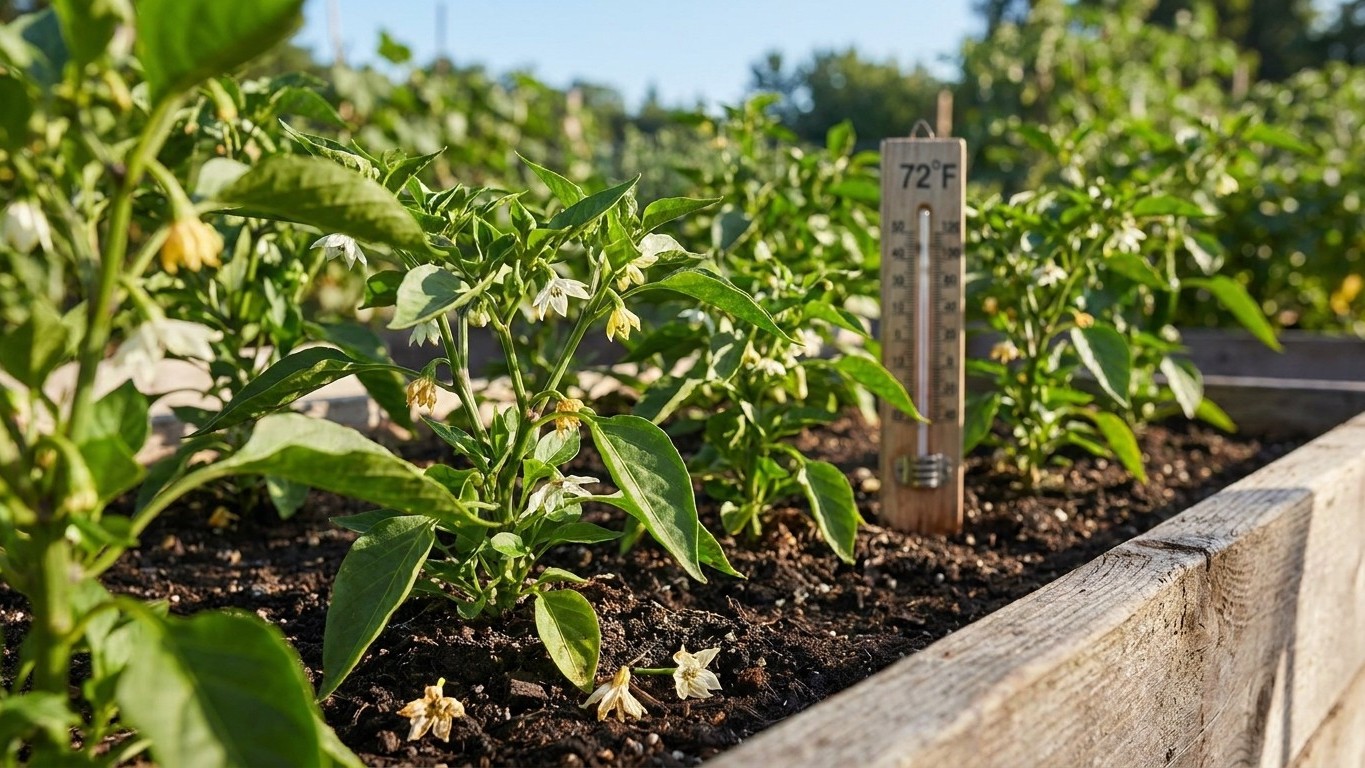
But fruit set fails at the other end too, and that’s the end that actually matters here. Pepper flowers drop when nights fall below 55 F, again per Utah State University Extension, and cool nights are a normal feature of an Island spring and early summer, especially near the coast or in low-lying inland spots where cold air settles. This site does not carry summer night-minimum data for Prince Edward Island, so there’s no local number to hand you here. That’s a real gap, and it means the responsibility shifts to you: track your own overnight lows with a simple min-max thermometer in the spot where you’ll actually plant, rather than assuming a date on a calendar guarantees warm nights.
The two thresholds don’t cancel each other out. A summer with zero days above 90 F is a summer where you won’t fight sunscald or heat-stalled flowers, but it’s also a summer where a late cold snap in June, or an early one in September, can still knock blossoms off the plant with no compensating benefit. Growers who treat “no extreme heat” as “no risk” are the ones who get caught by a 50 F night in the third week of June. The short version: heat is not your problem in Prince Edward Island pepper growing, and cold nights, tracked locally rather than assumed, are the one variable worth real attention.
When to start seed here
- Start with the frost date, but treat it as a midpoint, not a guarantee. The Charlottetown A station’s average last spring frost is May 16. That’s a mean drawn from the 1981-2010 record, which means in roughly half of all years, frost arrives after that date. Planning your transplant for exactly May 16 leaves you exposed in any year that runs even slightly cooler than average.
- Check soil temperature separately from air temperature. Utah State University Extension is specific that peppers should go outside once soil reaches 60 F, after frost risk has passed, not simply once the calendar clears the frost date. Cold Island soil, particularly in a spring that stays damp and overcast, can lag well behind air temperatures, so a warm afternoon doesn’t mean the root zone is ready.
- Pick whichever of those two dates lands later, and use that as your real transplant target. If your soil typically doesn’t hit 60 F until early June even though frost risk has cleared by mid-May, early June is your working date, not mid-May.
- Count back 8 to 10 weeks from that transplant target to find your seed-starting window. Utah State University Extension gives this as the standard indoor lead time for pepper transplants. Working from an early-June transplant target, that puts seed-starting in the last week of March to the first week of April; working from a mid-May target in a warmer microclimate, it moves earlier, into mid-to-late March.
- Adjust for your own property, not the province average. A sheltered, south-facing garden near Charlottetown may warm faster than the station average suggests. A low field or a spot near the water in a cooler district may run behind it. Redo the arithmetic with your own frost history and your own soil thermometer readings rather than applying one province-wide date.
What goes wrong here
- Blossom drop from a cool night. This is the failure most likely to hit an Island pepper crop. Utah State University Extension puts the threshold at nights below 55 F. Since this site doesn’t carry local night-minimum data, use a min-max thermometer at your planting site through late spring and early summer, and hold transplants back, or cover them, if overnight lows are still dipping below that mark.
- Blossom drop from a hot spell. Rare in a province with essentially zero days above 90 F on average, but not impossible in an unusually hot stretch. If daytime temperatures do spike, expect the same blossom loss described for the cold end. Shade cloth over the row during the hottest afternoons is the practical response.
- Sunscald on exposed fruit. Even where extreme heat is uncommon, direct strong sun on fruit that’s lost its leaf cover, from over-pruning or wind damage, can scald the skin. Keep the plant’s natural foliage canopy intact rather than stripping leaves to “let the sun in.”
- Blossom-end rot. This shows up as a dark, sunken patch on the bottom of the fruit and traces back to uneven watering disrupting calcium uptake, not to a soil calcium shortage in most gardens. Consistent watering, helped by a layer of mulch to even out soil moisture between rains, is the standard remedy.
Common questions
Can I just use May 16 as my transplant date every year?
No. That date is a long-term average from the Charlottetown A station, and averages by definition get beaten roughly half the time. Treat it as the center of a window, watch your local forecast as the date approaches, and be ready to hold transplants a week or two longer in a cool spring.
Does Prince Edward Island ever get too hot for peppers?
Rarely. The 1981-2010 normals show an average of 0.0 days a year at or above 90 F in Charlottetown, the threshold Utah State University Extension links to fruit-set failure on the hot end. Occasional hot spells can still happen, but heat stress isn’t a routine Island problem the way it is farther south.
What if my soil hasn’t reached 60 F by the average frost date?
Wait for the soil, not the calendar. Utah State University Extension ties the transplant date to soil reaching 60 F, after frost has passed, and cold Island soil can lag behind air temperature for weeks in a slow spring. A soil thermometer pushed a few inches into the bed gives a better answer than guessing from the air temperature alone.
How do I know if my nighttime lows are a problem, since this site doesn’t list them?
Set a min-max thermometer at the actual planting site and read it daily through late spring. Utah State University Extension’s 55 F threshold for blossom drop is the number to compare against. Since local night minimums for Prince Edward Island aren’t published on this site, your own reading in your own yard is the only reliable check.