
This page cannot hand you a verified list of carrot pests for Prince Edward Island, because the facts it carries hold none, and it will not fill the gap with guesses. What it can do is more useful than a name on a list: it shows how to date a problem from seeding day, how to separate insect damage from soil trouble, and where to take a sample. For the wider crop picture, see Growing Carrots in Prince Edward Island.
Which pests attack carrot in Prince Edward Island
The list, as this page holds it, is empty. The verified facts here name no pest species documented for the island and no service that documents them. So no insect is named below, and none will be. A pest list with no source behind it is exactly what sends gardeners after the wrong culprit.
That leaves the ground, which is documented. Agriculture and Agri-Food Canada, through the Canadian Soil Information Service, maps the island’s most common soil as a Podzol, the acid, leached kind that forms under conifers. It covers 33 percent of the mapped surface, followed by Gleysolic soils. The median surface pH is about 4.8, strongly acid. The texture is sandy, at 66 percent sand, 7 percent clay and 27 percent silt, with organic matter around 2.2 percent and imperfect drainage.
Why does soil belong in a pest section? Because carrots want deep, sandy, well-drained ground rich in organic matter, and where the ground falls short, the roots show it in ways that mimic insect work. Forked, stunted and misshapen roots are the classic case. That median describes the survey’s mapped agricultural land, not your bed. River bottoms, filled ground and scraped building lots can differ completely, so treat it as a starting point and never as your pH.
When you do get a pest list from a provincial or university source, sort it before you read it. Discard any species that feeds on trees, stored grain or another crop family, because a pest that never touches carrot foliage or roots has nothing to do with your row. A list that runs long is usually a list for the whole province and every crop, not for a carrot bed. Keep only the entries that name carrot, or the carrot family, as a host.
When each one shows up, and what it does first
Start counting from the day you seed. Carrots are sown in place, so there is no transplant date to count from, and the crop runs about 70 to 100 days from seeding to harvest. The frost-free window for the island is not published on this page. The sowing article, When to Sow Carrots in Prince Edward Island: Counting Back From the Last Frost, shows how to place seeding day against your own last frost.
Since no species is documented here, the calendar below follows the crop’s stages and what you would see at each one. You arrive with a symptom, so start there. Write the seeding date on a plant tag at the end of the row, because every diagnosis conversation begins with “how many days since seeding?”
Seedling stage
The first sign is a row with gaps. Before blaming an insect, look at what is left. Stems cut off at the soil line point to something feeding. Seed that never emerged, found by scratching gently at the gap, points to a dry or crusted seedbed. Sandy ground dries fast, so this second cause is common on the island’s typical soil.
Young foliage
Look for chewed leaf edges, curled or distorted tops and patches that wilt while neighboring plants stay firm. Damage that spreads from one end of the row suggests something moving in. Damage spread evenly across the whole bed suggests water, nutrients or pH.
Root sizing and harvest
Underground trouble stays hidden until you pull a root. Tunnels, scars or chewed patches are the sign to photograph and keep. Clemson Cooperative Extension gives a harvest window of about 65 to 75 days after planting, a South Carolina source, so use it as a general reference and let your own seed packet and the 70 to 100 day range guide you. Pulling a test carrot around the early end of that range shows you the roots before problems have had the full season.
Storage adds one more checkpoint. Clemson says bunched carrots, tops still on, keep about 10 to 14 days at 33 °F and high humidity. Soft or slimy spots that appear in storage are worth noting, because they belong to a different diagnosis than what you saw in the field.
Telling the damage apart from everything else
Most carrot problems that look like insect work turn out to be something else. Sandy, acid, imperfectly drained ground (the island’s typical profile) produces its own set of symptoms, and several of them pass for pest damage at a glance. The table sorts the common ones by what you see and what settles the question. It does not tell you what is in your garden. Only a sample taken to the extension office can do that.
| What you see | Other causes to rule out | What settles it |
|---|---|---|
| Gaps in the row after seeding | Dry or crusted seedbed; seed sown too deep | Scratch the bare spot. Ungerminated seed means no feeding damage; cut stems mean something ate them. |
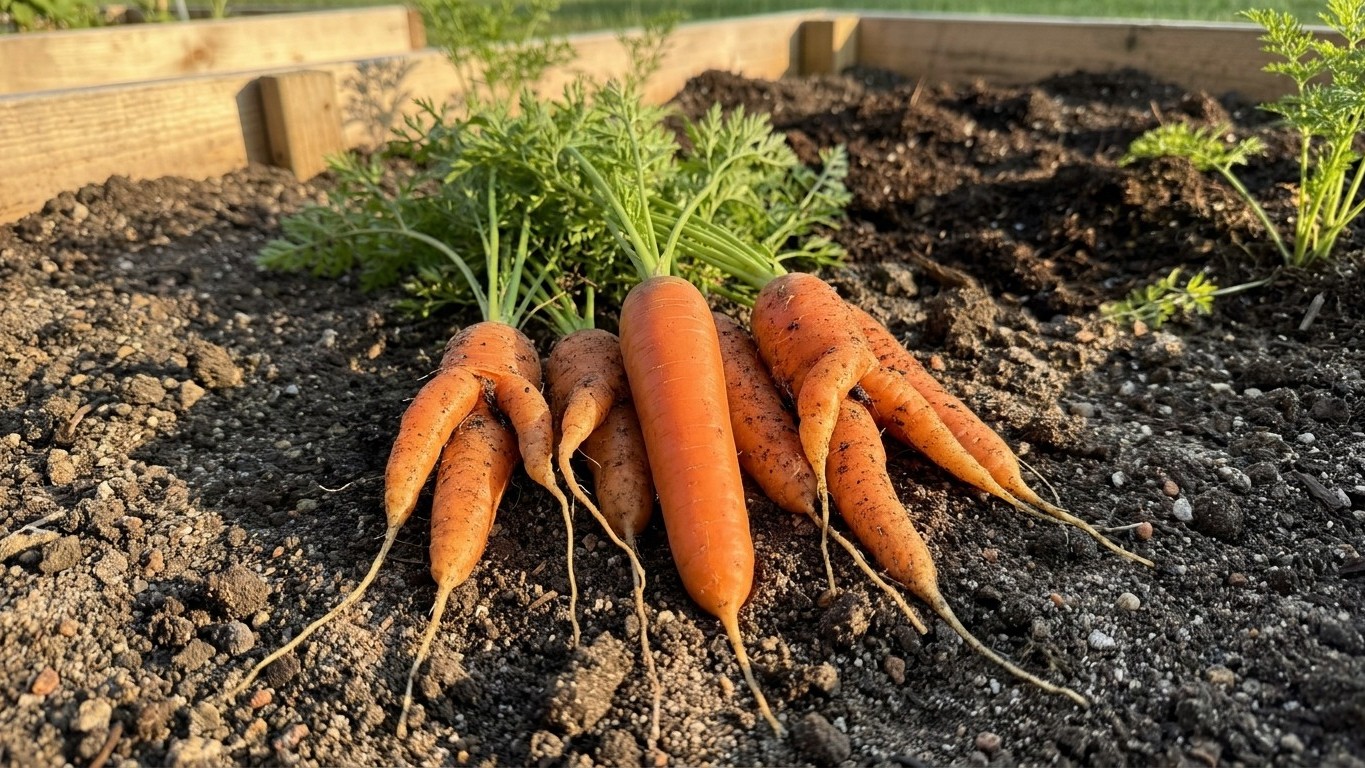
| Forked, stunted or twisted roots | Heavy or rocky soil, not insects | Look for chew marks or tunnels. A clean fork with smooth skin is a soil problem. See Will Carrots Fork in Prince Edward Island Soil? |
| Tops wilting through the day | Dry sandy soil; drought stress | Water the bed and check that evening. Tops that recover point to water, not pests. |
| Yellowed or off-color foliage across the whole bed | Nutrient shortage; strongly acid ground | A lab soil test for pH and nutrients. |
| Split or cracked roots | Uneven watering; mechanical damage from a fork or trowel | Look at the crack edges. A fresh, clean split near a tool mark is mechanical. |
| Tunnels, scars or chewed patches on the root | Possible insect feeding | Photograph, keep a sample, and take it to your extension office. |
| Dark spots or lesions on leaves or roots | Possible disease | Extension identification; a photo alone rarely settles it. |
The home test that settles the soil half of the table is a jar test for texture: fill a straight-sided jar about a third full of garden soil, top it with water, shake, and let it settle. Sand drops first, silt next, clay last, and the layers show your own proportions against the island’s median of 66 percent sand. Compare the layers with a lab pH reading, because texture alone will not tell you how acid the bed is.
What actually works here, and what is a waste of time
A physical barrier put down at the right moment beats a treatment applied after the fact. On a short northern season, the calendar does more than any product. Cover the row with a lightweight insect barrier fabric the day you seed, and keep the edges buried or weighted so nothing crawls under. The barrier only helps against pests that reach the crop from above, and only if it goes on before they arrive. Once damage shows, a cover placed over the row can trap the problem inside.
Beyond the barrier, four habits help. Sow into a bed that suits the crop, deep and loose, with plenty of compost, and double dig heavy patches. Keep the seedbed evenly moist through germination, which matters more than usual on sandy ground. Move carrots to a different bed each year so nothing that overwinters in the soil finds its host waiting. And pull a test root at the early end of the harvest window rather than leaving the crop in the ground to the last day.
What does not work is just as specific. Spraying on a guess wastes money and can harm what you cannot see, because a product chosen without a diagnosis may not touch the real cause. Treating forked roots as an insect problem sends you after the wrong cause, when the fix is a raised bed or deeper digging and not a different variety. Sowing thicker to outrun losses only crowds the roots. And storing carrots with their tops on turns a small field problem into a bigger one: leaves keep drawing moisture out of the root, so cut the tops first, and keep the roots at 33 °F, just above freezing, not in a 50 °F cellar where they sprout and soften quickly.
This site does not recommend pesticides. Whether anything is approved for home use on the island, and how it is applied, is a question for your extension service, which knows current local rules.
Where to check this for your own county
Go to the provincial agricultural extension office nearest you. The verified facts on this page name no specific pest-documenting service for the island, so rather than put a name to it here, look up the province’s agriculture department and ask for its home-garden or horticulture contact. That office can identify a sample, confirm which pests are active in your part of the island, and say which controls are currently permitted.
Local presence matters because pests vary inside a territory. What is documented across a whole province does not tell you what is in your garden, and two gardens a short drive apart can face different pressure. The soil varies as well. The island’s mapped profile is a median across agricultural land, with 542 mapped components behind it, and your bed may sit far from that middle.
Common questions
Can I tell an insect from a disease just by looking?
Not reliably. Chewed edges, tunnels and missing seedlings suggest feeding, while spots and lesions suggest disease, but many symptoms overlap. Take a photo and a sample to your extension office.
How long until carrots are ready after seeding?
Plan on about 70 to 100 days counted from seeding, since carrots are sown in place and never transplanted. Clemson Cooperative Extension gives about 65 to 75 days after planting for its own region.
How should I store carrots after harvest?
Cut the tops off first, because the leaves keep pulling moisture from the root. Then hold the roots at 33 °F with high humidity. Clemson Cooperative Extension says bunched carrots, tops still on, keep only about 10 to 14 days.
Is a forked carrot a sign of insects?
Usually not. Heavy or rocky soil is the usual cause of forking. Check the root for chew marks or tunnels, and read Will Carrots Fork in Prince Edward Island Soil? for the soil side.
Before the next sowing, run the jar test on your bed, send a sample for a pH reading, and write the seeding date on a tag, so that any photo you bring to the extension office arrives with a day count.