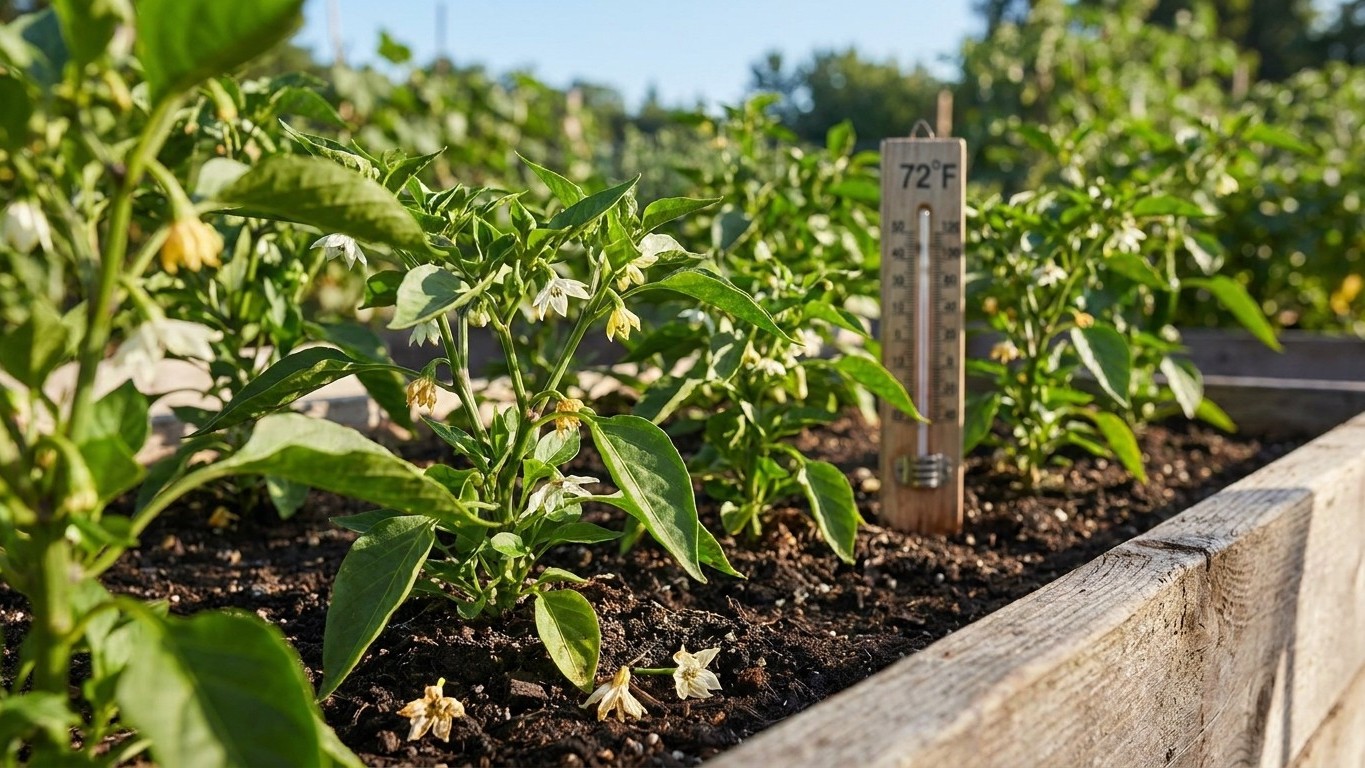

In most of Ontario, start pepper seed indoors about 8 to 10 weeks before your expected transplant date. With a mean last spring frost of April 30 at the Toronto Pearson reference station, that points to a seed-starting window running from mid-February through early March for gardeners near that station, earlier or later depending on how far your county sits from it.
The short answer
Toronto’s reference station records an average of 0.0 days a year at or above 90 F, according to Environment and Climate Change Canada’s 1981-2010 Climate Normals. That number matters more than it looks. Pepper fruit set collapses when daytime highs push past 90 F for stretches during flowering, as flowers drop instead of setting fruit. With essentially zero days reaching that threshold in a typical year, Ontario gardeners working near this station are not fighting the heat side of the fruit-set problem. Your plants are unlikely to shut down pollination because of scorching afternoons.
That’s one side of the equation. Pepper fruit set fails at the other end too, when nights drop below 55 F. A run of cool nights during flowering can abort blossoms just as surely as a heat wave can, and this is where the Ontario climate deserves real caution rather than reassurance.
This site does not carry summer night minima for any territory, Ontario included. The daytime heat count above comes from measured climate normals, but overnight low temperatures through June, July and August are not part of that dataset. That gap is not a small detail. A field two hours north of Toronto, or a low-lying valley prone to nighttime cold air drainage, can run consistently cooler after dark than the reference station even when daytime highs look identical on paper.
The practical takeaway is this: treat the 90 F count as good news for the heat side of fruit set, and treat the cool side as something you have to track yourself. Keep a simple min-max thermometer in your pepper bed through the flowering weeks, especially in late June and again in late August when night temperatures can dip. If you see repeated nights below 55 F during flowering, expect fewer fruit set even though the daytime numbers never looked threatening. Don’t assume that being farther north or south, or closer to a lake, tells you what your nights are doing. Only a thermometer in your own garden answers that.
When to start seed here
The math for seed starting is straightforward once you accept that the last frost date is a midpoint, not a guarantee. Here’s how to work it out for your own garden.
- Start with the mean last frost date. At the Toronto Lester B. Pearson station, Environment and Climate Change Canada’s 1981-2010 normals put that date at April 30. This is an average, which means in roughly half of all years frost arrives later than April 30. Treat it as the center of a window, not a safe line you can plant right up against.
- Add the soil temperature condition. Utah State University Extension advises transplanting peppers only after frost has passed and once soil has warmed to 60 F. Air temperature and soil temperature don’t move together in spring; soil lags behind, especially in clay-heavy ground or in a season with a wet, cold April. A frost-free calendar date means nothing to a pepper root sitting in 50 F soil. Check soil temperature directly with a probe thermometer a few inches down rather than guessing from the forecast.
- Set your transplant date from whichever condition comes later. If your soil typically warms to 60 F around the same time as your last frost risk fades, use that combined date as your transplant target. If soil lags well behind the frost date in your particular yard, wait for the soil, not the calendar.
- Count back 8 to 10 weeks from that transplant date. That span is the indoor growing time Utah State University Extension recommends for pepper transplants to reach a strong, plantable size. Working from an April 30 frost-date midpoint, that lands seed starting somewhere between mid-February and early March, depending on which end of the 8-to-10-week range you use and how much cushion you build in beyond April 30 itself.
- Adjust for your own county. A reference station reading is exactly that, a reference. Northern Ontario, upland districts and areas well inland from Lake Ontario’s moderating effect typically see later frost dates than Toronto Pearson. If your local frost risk historically runs one to two weeks behind the reference station, shift your whole seed-starting window back to match, rather than starting on the same date as a gardener closer to the lake.
None of this replaces watching your own conditions in real time. The arithmetic gives you a starting estimate; your soil thermometer and your own frost history should have the final word each year.
What goes wrong here
- Blossom drop from a cool snap. Even with virtually no days above 90 F to worry about, Ontario’s spring and late-summer nights can dip below the 55 F threshold that pepper flowers need to set fruit. A cold front moving through during flowering can knock blossoms off plants that otherwise look healthy. There’s no fix once flowers have dropped, but tracking overnight lows with a thermometer and delaying transplant until nights are more reliably mild reduces how often this happens. Row cover pulled over plants on forecasted cold nights can also buy a few critical degrees.
- Blossom drop from an unexpected hot spell. Although 90 F days are rare at the reference station, a short-lived heat spike can still occur in any given year, and peppers flowering during that stretch can drop blossoms just as they would from cold. Providing light afternoon shade cloth during an unusual heat spell, and keeping soil moisture consistent, helps plants hold onto flowers through a brief hot stretch.
- Sunscald on exposed fruit. Peppers that lose leaf cover to disease, pruning, or wind damage can develop sunscald, a pale, papery patch on fruit exposed to direct sun. This shows up even in a climate without extreme heat, because it’s about direct sun exposure on bare fruit, not just air temperature. Leaving the plant’s natural leaf canopy intact, and avoiding heavy pruning once fruit has set, keeps fruit shaded enough to avoid it.
- Blossom-end rot on developing fruit. This shows up as a sunken, dark patch on the bottom of the fruit and traces back to inconsistent watering, which disrupts calcium uptake, rather than a calcium shortage in the soil itself. Even in a climate with modest summer heat, uneven watering between dry stretches and heavy rain can trigger it. Mulching to hold consistent soil moisture and watering on a regular schedule rather than letting the bed dry out between waterings addresses the root cause.
Common questions
Can I start pepper seed earlier than 8 weeks before transplant to get a head start?
Starting much earlier than the 8-to-10-week window Utah State University Extension recommends tends to backfire. Seedlings held indoors too long become root-bound and stressed, and they often stall out or transplant poorly compared to a properly timed, younger transplant.
Is April 30 a safe date to transplant peppers outdoors in Ontario?
No. April 30 is the mean last frost date at the Toronto Pearson reference station, meaning frost arrives later than that in roughly half of all years historically. It’s a planning midpoint, not a guarantee, and peppers should also wait until soil reaches 60 F regardless of the calendar date.
Does Ontario’s low count of 90 F days mean I never need to worry about heat stress on peppers?
The 0.0 average days at or above 90 F at the reference station means extreme heat is rare in a typical year, but not impossible in any given season. A short hot spell during flowering can still cause blossom drop, so it’s worth watching the forecast during your plants’ flowering weeks rather than assuming heat is a non-issue.
Why doesn’t this site tell me the exact overnight low temperatures for my area?
Summer night minimum temperatures aren’t part of the climate dataset this site draws from for any territory. Night temperatures vary significantly with local terrain, elevation and distance from large bodies of water, so a reference-station average wouldn’t reliably describe conditions in your own garden. Tracking your own overnight lows with a simple thermometer during flowering season gives you a far more accurate picture than any regional estimate could.