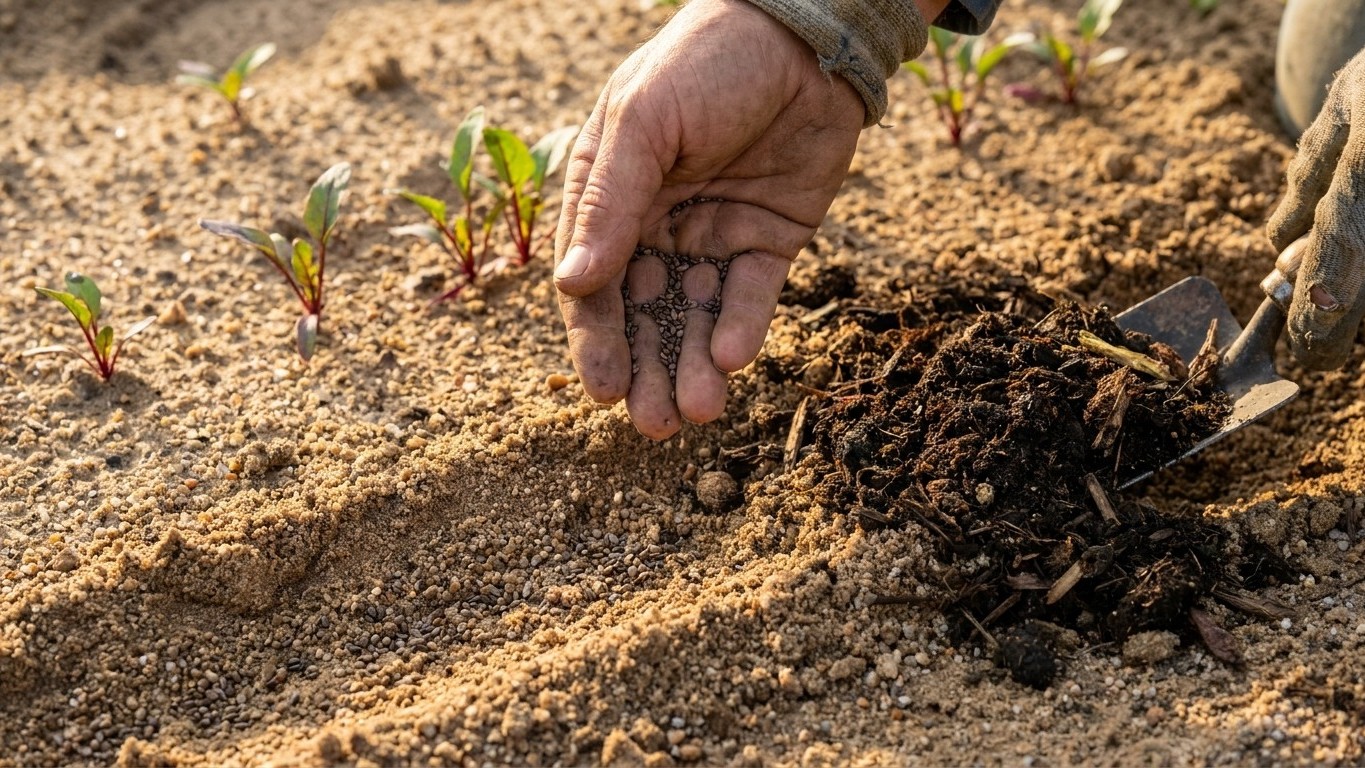

North Carolina’s most common ground, the Cecil series, is acid, sandy and short on organic matter, and the state’s Piedmont frost window closes between March 23 and April 5. Sow beets two to three weeks ahead of that date, expect fast-draining soil to dry out quickly, and treat the first six weeks after seeding as the stretch that decides whether the crop bolts before it ever builds a root. Understanding Beet Soil in North Carolina is the first step toward getting this timing right.
The short answer
The Cecil series is what the USDA’s State Soils program lists as representative of North Carolina’s ground, and it’s a soil built on a long geological clock. Classified as an Ultisol, it has been weathering and leaching for so long that its surface horizon has lost much of what a vegetable bed wants back: the representative values run 68 percent sand, 13 percent clay and 20 percent silt, with organic matter sitting around 0.8 percent and a surface pH near 5.5, slightly acid. It’s well drained, which sandy soils generally are, and that same speed works against a root crop that wants steady moisture more than fast runoff.
For a beet, that combination cuts two ways. Utah State University Extension notes beets want deep, sandy, well-drained soil rich in organic matter, and the Cecil series delivers on sand and drainage while falling well short on organic matter, at roughly a fraction of what a well-managed vegetable bed typically carries. The gap matters because organic matter is what holds moisture between rains in a sandy profile that otherwise sheds it fast. Compost, worked in at no more than 1 inch per 100 square feet per the same guidance, closes part of that gap without overdoing the amendment.
The heat side of the picture is harder to pin to a single number. The exact count of days Charlotte, the Piedmont reference city behind this state’s frost data, spends above 90 F in a typical year isn’t published in the sourced record behind this page. What is documented is the threshold that actually matters for the crop: heat above 85 F combined with water stress is what turns a beet root woody, according to Utah State University Extension. North Carolina’s Piedmont summers reliably push well past that mark for extended stretches once early summer sets in, which is exactly why the sowing window and the watering habit in the first six weeks, covered next, carry more weight here than the soil chemistry on its own.
None of this is a verdict on any one garden. North Carolina spans hundreds of mapped soil series, from river-bottom loams to mountain soils to coastal sands, and the Cecil series is simply the one USDA flags as representative of the state as a whole. Treat the figures above as a baseline reading of what Piedmont ground tends to do, not a substitute for testing the dirt actually under a shovel.
The six weeks that decide it here
Beets go into the ground two to three weeks ahead of the last frost, and for the Piedmont reference station behind this state’s data, that frost date falls between March 23 and April 5, per NOAA’s 1991-2020 climate normals for the 30 to 70 percent freeze-probability band. Count backward and the sowing window lands in early March, which means the six weeks that decide whether the crop bolts run straight through a North Carolina Piedmont spring known for swinging rather than settling: a cool, damp stretch followed by a dry, windy one, sometimes within the same week.
That swing is the problem. Utah State University Extension is specific that water stress in the first six weeks after sowing is what causes beets to bolt, sending the plant’s energy into a flower stalk instead of the root. A Piedmont spring that alternates a soaked week with a parched one produces exactly that stress pattern, especially over ground like the Cecil series described above, where 0.8 percent organic matter and 68 percent sand mean the topsoil dries out fast once a dry spell sets in. A bed that looked fine after a rainy week can be short on moisture again within a few days of sun and wind.
The practical fix sits in the watering habit, not the calendar. Consistent moisture through those first six weeks, checked by hand rather than assumed from the last rain, matters more than hitting the sowing date to the day. A gardener who sows a week later but keeps the bed evenly damp is often better off than one who sows on the earliest safe date and then lets the soil swing between soaked and dry.
None of this touches the second failure mode, the woodiness that shows up later from heat, which is tied to root maturity rather than the seedling stage. The two risks sit at opposite ends of the same crop’s life, and treating them as one problem solved by “keep it watered” misses that the fix for early bolting and the fix for late toughness aren’t the same fix.
What goes wrong here
- Bolting from spring water stress: the Cecil-type profile’s 0.8 percent organic matter and sandy texture mean the topsoil dries fast between rains, and Utah State University Extension ties that exact stress, in the first six weeks after sowing, directly to premature flowering. Check soil moisture by hand twice a week during that window, water before the topsoil fully dries, and mulch to slow evaporation.
- Woody roots from summer heat: a root left in the ground once temperatures push past 85 F while under any water stress turns fibrous, per the same source. Since beets are direct-sown, count the 60 to 80 day maturity window from the seeding date, not from any later transplant, and plan harvest before the hottest stretch of the Piedmont summer sets in.
- Nutrient-poor, acid ground: the Cecil series’ representative surface averages a pH near 5.5 and organic matter around 0.8 percent, both on the low side for a root crop that wants richer soil. A soil test beats guessing, and working in compost, at no more than 1 inch per 100 square feet, closes part of the gap.
- Fast drainage that reads as “enough water”: well-drained, sandy ground can look moist on the surface right after watering while the root zone dries out again within a day. Water deeply and less often rather than relying on a light daily sprinkle that never reaches the root zone.
Checking this against your own county
Every number on this page comes from a single representative soil series and a single Piedmont weather station, and neither one describes the whole state. The Blue Ridge mountains to the west run their last frost weeks later than the Charlotte-area date used here, and the coastal plain to the east typically clears its last freeze earlier. A soil map two counties over can carry an entirely different series, with a different sand-to-clay ratio, a different drainage class and a different starting pH.
The North Carolina Cooperative Extension Service, run through NC State, keeps county-level offices that can pull the actual soil survey for a specific address and give a local frost-date estimate rather than the statewide normals used above. A local extension agent can also run or interpret a soil test, the only reliable way to know whether a given bed sits closer to the acid, sandy Cecil profile or to something with more clay and organic matter already built in.
Common questions
How many days do beets take to mature in North Carolina?
Beets sown directly in North Carolina soil typically reach maturity in the 60 to 80 day range, counted from the day the seed goes into the ground, not from any later transplant date, since beets are a direct-sown crop that doesn’t move well once started. That window is why the sowing date, timed two to three weeks before the last frost, sets the pace for the whole season.
Can beets be transplanted instead of direct-sown in North Carolina?
Beets are grown as a direct-sown crop, not a transplant. The root starts developing from the seed in place, and disturbing that early root by moving a seedling tends to produce a forked or misshapen beet rather than a clean one, which is part of why garden centers rarely sell beet starts the way they sell tomato starts.
What does bolting look like, and can a bolted beet still be eaten?
Bolting is a beet sending up a tall flower stalk instead of building a root, triggered by water stress in the first six weeks after sowing. A bolted beet’s root is usually small, tough and often bitter, and while it isn’t unsafe to eat, most gardeners pull and compost it rather than serve it, since the plant has already redirected its energy away from the part meant to be harvested.
Does the Cecil soil series mean North Carolina soil is bad for beets?
Not necessarily. The Cecil series is acid, sandy and low in organic matter compared to what a root crop wants, but it’s also just the soil USDA flags as representative of the state, not a report card on any one yard. A soil test through the local extension office can show whether a garden sits closer to or further from that profile, and compost plus a pH check can correct most of the Cecil series’ shortfalls without much difficulty.