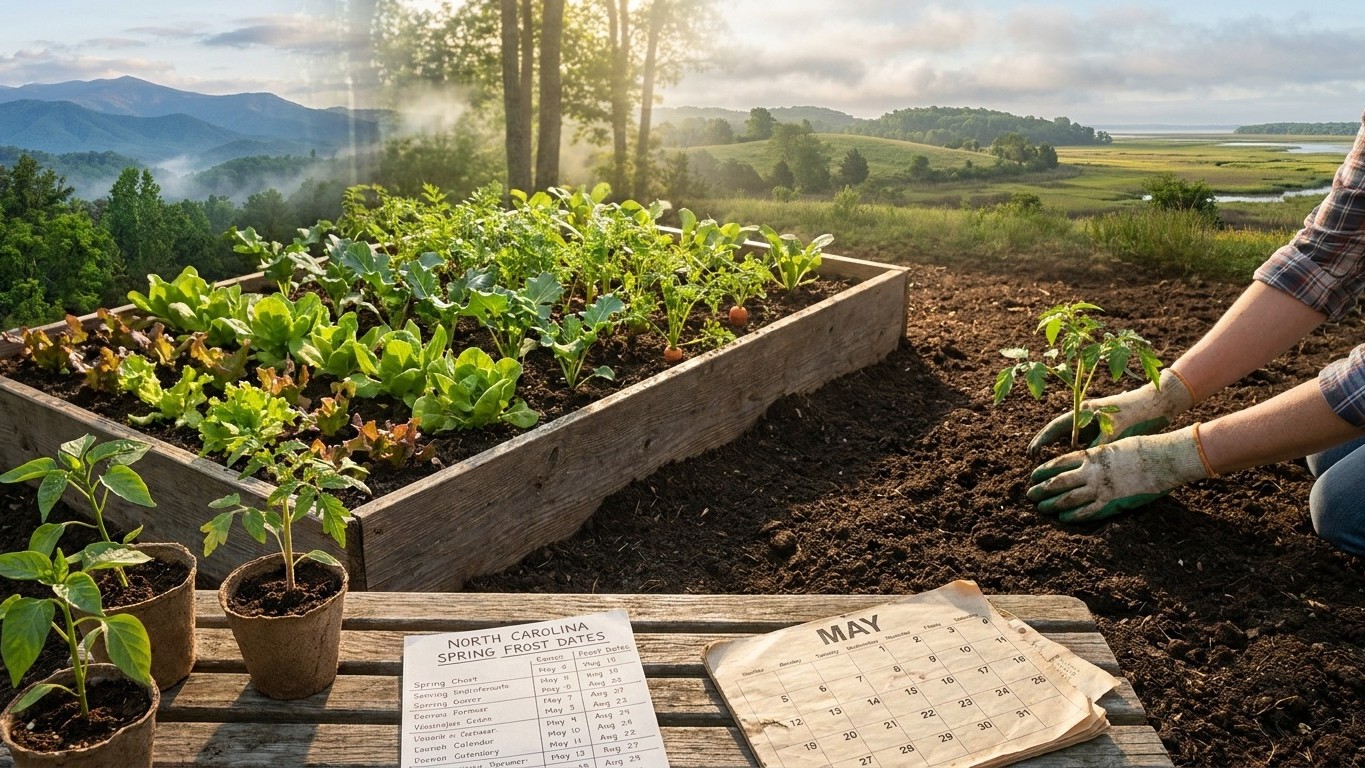

North Carolina’s growing season isn’t one thing. It runs from roughly 208 to 230 frost-free days depending on where you sit between the mountains and the coast, and that range decides more about what you can plant than any seed catalog will tell you.
How long your season really is

Start with three numbers. The USDA Plant Hardiness Zone Map (2023 edition, built on 1991-2020 normals) places North Carolina somewhere between zone 5b and zone 8b. The average last spring frost falls between March 23 and April 5. The average first fall frost lands between October 30 and November 8, a window that also helps explain When to Carve a Pumpkin in North Carolina so it lasts through the season’s cooler nights. Those three figures, read together, give you the one number that actually matters for planning: the length of your frost-free window.
Do the math from the widest reasonable spread and you land somewhere between about 208 and 230 days, depending on which end of each date range applies to your particular yard. That’s a long window by national standards, but it’s not infinite, and it’s not evenly distributed. A gardener working from the early end of that range, say a last frost in early April and a first frost in late October, has closer to 208 days to work with. That’s still generous, but it starts to rule things out. Extra-long-season crops, the kind that need 100-plus days just to reach maturity after a slow, tender start, stop being a sure thing and start being a bet you’re placing against the calendar, which is why timing matters so much for something like Growing Potatoes in North Carolina or Growing Pumpkins in North Carolina, while shorter-season, cool-tolerant crops like Growing Carrots in North Carolina, Growing Parsnips in North Carolina, Growing Beets in North Carolina, and Growing Spinach in North Carolina fit more comfortably even within the tighter end of that window.
Averages are not promises
Here’s the part that trips people up: those frost dates are averages, not guarantees. By definition, roughly half of all years bring a frost later than the “average” last frost date, and half bring one earlier than the “average” first frost date. Planting tender seedlings the week after the average last-frost date isn’t playing it safe. It’s playing the odds, and in any given year those odds can go the wrong way. Gardeners who push transplants out right at the average date, rather than a week or two after, are the ones replacing frost-killed tomato starts in late April more often than they’d like to admit.
The practical takeaway is simple: use the window to decide what’s feasible at all, then build in a buffer before you decide what’s safe to plant when.
What the summer does to a garden here
Heat isn’t automatically a gift to a garden, and Charlotte’s climate record makes that concrete. The reference station averages 35.0 days a year at or above 90F. That’s not a measure of how warm summer feels on average, it’s a measure of heat load, the kind that pushes plants past what they can tolerate rather than just what they enjoy.
Above roughly 90F, tomato blossoms drop instead of setting fruit, and the same stress can hit other fruiting crops like peppers, which is worth keeping in mind when Growing Peppers in North Carolina. Lettuce and other cool-season greens bolt, turning bitter and shooting up a flower stalk instead of staying tender. Spinach, peas, and most brassicas simply give up trying to produce anything worth harvesting once daytime highs sit in that range for stretches at a time. With 35 days a year hitting that mark, and plenty more hovering just under it, a big chunk of the growing calendar here isn’t friendly to anything but heat-tolerant crops.
That reshapes the whole shape of the gardening year. Instead of one long, uninterrupted stretch from last frost to first frost, most gardens here end up running on two separate windows: an early one before the heat locks in, and a second one once it breaks in late summer or early fall, with a slower, harder middle where only the most heat-tolerant plants keep producing. Cool-season crops get a real spring run and a real fall run, but not much of a summer one.
On the other end of the thermometer, the coldest month’s average daily minimum sits at 31.8F. That number, not the record low and not the monthly average, is what determines whether a marginal perennial or a tender shrub actually survives winter here. Sitting right around the freeze line, it’s a reminder that even a state with a long frost-free season still delivers real cold, just compressed into a shorter stretch than gardeners farther north deal with.
What tends to go wrong in North Carolina
NC State Extension’s Insect Management chapter names the pests that consistently show up in home gardens across the state, and a handful of them account for most of the damage reports.
- Striped cucumber beetle: shows up early, often on cucumber and squash seedlings right after emergence, chewing leaves and spreading bacterial wilt in the process.
- Japanese beetle: arrives in early summer and skeletonizes leaves on everything from roses to beans and grapes, working in visible clusters.
- Corn earworm / tomato fruitworm: the same insect under two names depending on the crop, active mid to late summer, boring directly into corn ears and tomato fruit.
- Brown marmorated stink bug and native stink bugs: build through summer and into fall, piercing fruiting vegetables and leaving the sunken, discolored spots that show up at harvest.
That’s four, not twenty, and that’s deliberate. A gardener who knows to watch for cucumber beetles the moment squash seedlings break ground, and to expect stink bug damage on tomatoes as the season stretches into September, is better equipped than one handed an exhaustive list of every insect that’s ever been photographed in the state. NC State’s own list runs longer, including cabbage loopers, imported cabbageworm, flea beetles, thrips, fall webworm, and hemlock woolly adelgid on ornamental hemlocks, and none of them are absent from the state just because they didn’t make this shortlist. What matters is timing and recognition, not memorizing a catalog, and no fixed spray schedule applies evenly across a state this size. Identification and timing belong to your county office, not a generic calendar.
Where to check before you plant
Everything above is a state-level average, and North Carolina is not a state where averages travel well. A hardiness range of 5b to 8b means the mountains in the west and the coastal plain in the east are, climatically, closer to different states than to each other. The frost dates and heat figures here come from a Piedmont reference station. The Blue Ridge Mountains run several weeks later into spring and earlier into fall than that station suggests, and the coastal plain runs the opposite direction, with an earlier spring and a longer, milder fall.
A planting calendar built around the state capital can be three weeks off in either direction once you’re at the edges of the state, which is long enough to lose a planting to frost or heat if you follow it blindly. The fix isn’t complicated: NC State Extension, the state’s land-grant extension service, publishes locally adjusted guidance, and your county extension office refines that further down to conditions specific to your soil and microclimate. This page is a starting point for understanding what North Carolina’s season allows in general. Your county office is where that general picture turns into a planting date you can actually trust.