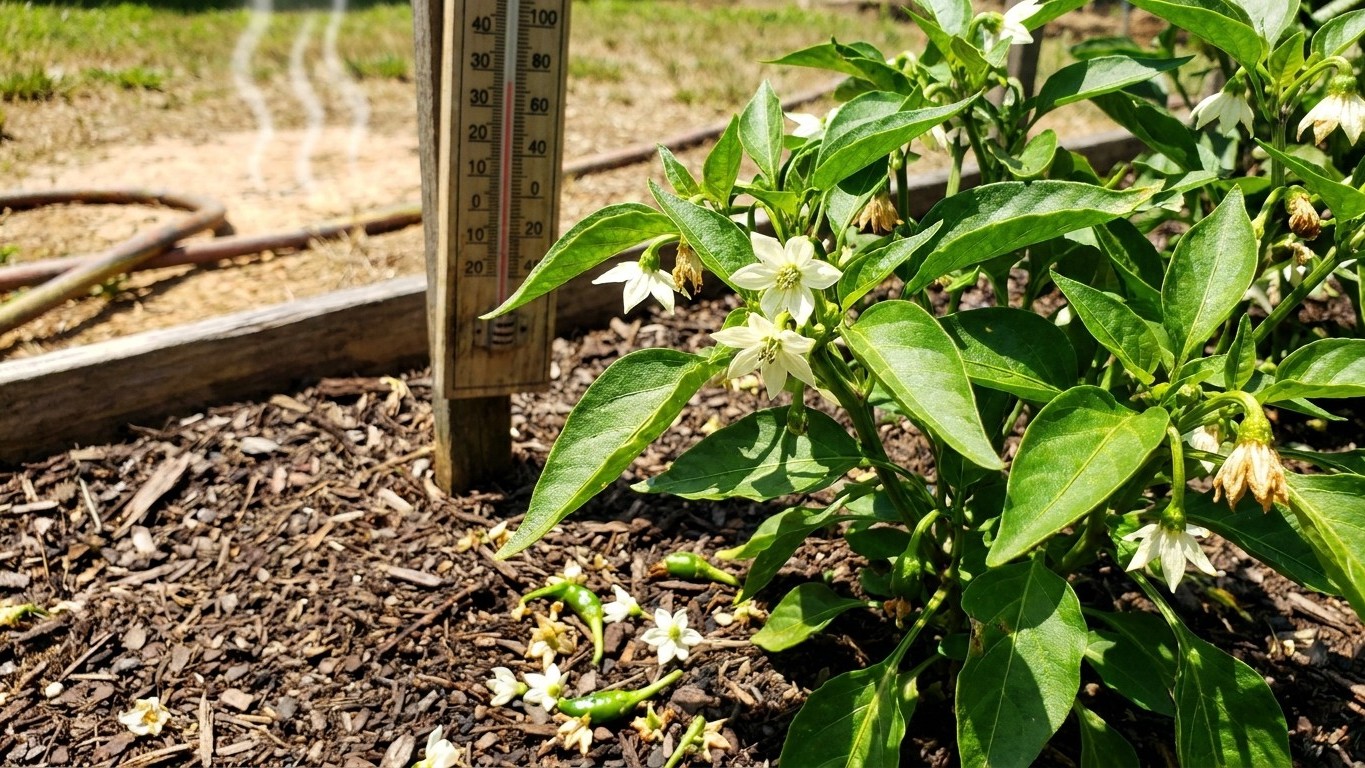

Michigan peppers stall out for one of two reasons: a stretch of nights too cool for pollen to work, or a run of days so hot the blossoms drop before they ever set fruit. Detroit-area data puts the state at 10.3 days a year of 90 F or hotter, enough to cause real damage during a bad July. The fix depends on which failure you’re seeing, and on watching your own thermometer rather than guessing from the calendar.
The short answer
Start with the heat side, because it’s the one this site can actually measure. The Detroit-area reference station logs an average of 10.3 days a year at or above 90 F, according to NOAA NCEI Climate Normals covering 1991-2020. That’s not a single miserable week, it’s scattered heat spikes, often in July and August, and each one is a window where pepper blossoms can abort before they ever become fruit. Ten days doesn’t sound like much against a whole growing season, but pepper flowers are picky. A 90-degree afternoon, especially paired with dry soil or wind, can push a plant to drop blossoms it set just days earlier.
Now the other end, and this is where most gardeners get tripped up. Pepper fruit set fails just as hard when nights fall below 55 F. Cool nights scramble pollen viability the same way heat does, just through a different mechanism, the flower opens, but nothing productive happens inside it. This matters more in Michigan than people assume, because a state with hot afternoon spikes can still deliver a run of chilly nights in the same week, particularly in low-lying gardens or anywhere near open water.
Here’s the catch: this site tracks days above 90 F by territory, but it does not carry summer night minima. There’s no reliable way to infer how cold your nights get from your latitude, your county’s name, or how cold your winters are. Those numbers don’t translate. A garden in a river valley can run 8 to 10 degrees cooler at night than one two miles away on higher ground, and nothing about “being in Michigan” tells you which one you’ve got. The only fix is to put a min-max thermometer in the garden and read it. If you’re seeing blossoms open and fall without ever swelling, and daytime highs aren’t cracking 90, check your nights before you blame anything else.
When to start seed here
Pepper seedlings need 8 to 10 weeks indoors before they go in the ground, and they shouldn’t go in the ground until two conditions are both met: the frost danger has passed, and the soil has warmed to 60 F. Work backward from your local frost date and you’ll get a seed-starting window that actually fits your county, rather than a generic date pulled off a seed packet.
- Find your last spring frost date. MSU Extension puts it around April 30 in the Detroit area, with early to mid May across most of the Lower Peninsula. Pick the date that matches your actual location, not the nearest big city if your garden sits somewhere colder.
- Add a buffer for soil warmth. Frost-free doesn’t mean the soil is at 60 F yet, cold ground lingers after the air warms, especially in clay soils common across much of the state. Most Michigan gardeners see soil hit that mark one to three weeks after the last frost, depending on how exposed the bed is and whether it’s mulched or bare.
- Count backward 8 to 10 weeks from your planned transplant date to find your indoor seed-starting date. If you’re transplanting in early June to be safe on soil temperature, for example, that puts seed-starting somewhere in late March to early April.
- Build in slack for a bad spring. If a cold snap pushes your transplant date back a week, your seedlings can usually hold under grow lights without much harm, but don’t start them so early that they’re leggy and root-bound by the time the soil finally cooperates.
Do this arithmetic yourself rather than trusting a fixed date, because “early May” and “mid May” are ten states, several counties, and real microclimate differences apart. A garden near Lake Michigan’s shoreline warms differently than one inland, and only your own soil thermometer settles the question.
What goes wrong here
Michigan’s swing between hot afternoons and cool nights sets up a specific, recognizable list of pepper problems. Each one has a distinct cause and a distinct fix, so it’s worth knowing which is which before reaching for a blanket remedy.
- Blossom drop from heat. On days pushing past 90 F, watch for flowers yellowing and falling within a day or two. Shade cloth over the plants during the worst afternoon hours, and deep, consistent watering in the morning, reduce the stress enough to keep some blossoms setting through a hot stretch.
- Blossom drop from cool nights. If flowers drop with no heat wave in sight, check your actual night readings rather than assuming, this site doesn’t carry that data for you, and neither does a general sense of “Michigan weather.” A floating row cover pulled over plants on chilly nights can buy a few critical degrees until the weather stabilizes.
- Sunscald. Strong summer sun on fruit that’s lost its leaf cover, often after storm damage or aggressive pruning, leaves pale, papery patches on the pepper skin. Keep foliage intact and avoid heavy pruning once fruit is forming; a light shade cloth during peak afternoon sun helps in an exposed bed.
- Blossom-end rot. Dark, sunken patches at the fruit’s bottom end come from inconsistent watering disrupting calcium uptake, not from a soil calcium shortage in most cases. Even, regular watering, not just more of it, is the fix, along with mulch to keep soil moisture steady between rains.
Common questions
Can I fix blossom drop once it starts?
You can’t save flowers that have already fallen, but you can protect the ones still forming. Shade cloth during heat spikes, row covers during cold nights, and steady watering reduce how many future blossoms you lose to the same stress.
Do all pepper varieties fail the same way in heat and cold?
Utah State University Extension names several pepper varieties suited to home gardens but doesn’t publish a heat tolerance rating, days-to-maturity figure, or size for any of them, so no variety can be promised as more forgiving here. Watching your own plants’ response to a given week is more reliable than picking by name.
How long after flowering should I expect fruit?
Utah State University Extension notes that fruit development runs 35 to 45 days from flowering, not from when you first transplanted or seeded. If your plants flowered during a hot or cold spell and set poorly, count that window from whichever flowering cycle actually succeeded.
Is 10.3 days of 90-plus heat really enough to matter?
It’s an average, not a hard cap, and hot years can bring more. Even scattered across a season, each of those days is a discrete risk window for blossom drop, and back-to-back hot days compound the stress rather than simply adding up.