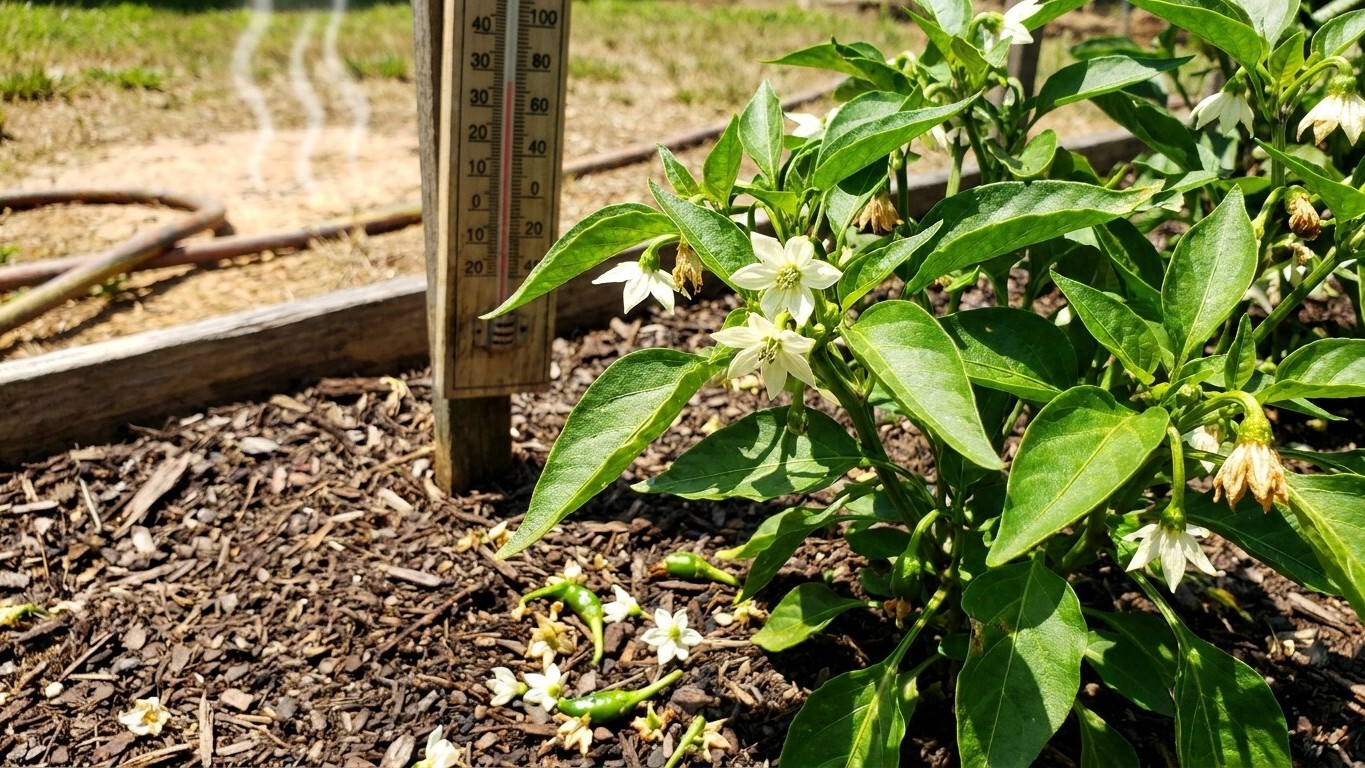

Peppers Fail to Set Fruit in Mississippi mainly because the growing season swings hard between two extremes: long stretches of 90°F-plus days that stall pollen viability, and cool nights early or late in the season that do the same thing from the other direction. Jackson averages 71.1 days a year at or above 90°F, which explains most of the state’s midsummer blossom drop and points to a planting-calendar fix most gardeners never make.
The short answer
Seventy-one days. That’s how many days a year the Jackson reference station spends at or above 90°F, based on the 1991-2020 NOAA climate normals. Spread that across a Mississippi summer and you get long, uninterrupted heat runs through July and into August, exactly the kind of stretch that pushes pepper plants past their fertility window. Above 90°F, pollen loses viability fast. Flowers still open, bees still visit, but fertilization doesn’t take, and the bloom drops off the plant a few days later without ever swelling into a fruit. Gardeners often blame the bees or the soil. The real culprit is usually the thermometer.
Seventy-one days a year is not a scattered handful of hot afternoons. It’s roughly ten weeks’ worth of heat load concentrated in the exact window when a spring-planted pepper crop should be flowering hardest. A plant that set fruit fine in June can go quiet for three or four weeks once July’s heat run settles in, then pick back up once temperatures ease in September. That pause isn’t a disease and it isn’t a nutrient problem. It’s the plant waiting out conditions it can’t fertilize through.
Now the other end, because pepper fruit set fails at both extremes, not just the hot one. Nights below 55°F cause the same kind of blossom failure, just through a different mechanism: cool night temperatures interfere with pollen development before the flower ever opens. This matters most at the shoulders of the season, right after transplant in a cool spring, and again as nights start dropping in fall. This site tracks the heat side of the equation (that 71.1-day count above) but does not carry summer overnight low data for Mississippi. There’s no way to responsibly hand you a number for how many nights in your area dip under 55°F, and guessing from latitude or from how cold January gets would be worse than no answer at all, since a river bottom, a hilltop and a low-lying yard three miles apart can post very different overnight lows on the same date.
The practical move: keep a min-max thermometer in the pepper bed itself, not just a general read on the weather app, especially in the first few weeks after transplant. If flowers are opening but nothing is sizing up, check both ends before assuming a fertilization problem is something else entirely.
When to start seed here
The seed-starting date for Mississippi peppers isn’t a fixed calendar day. It’s the result of working backward from two conditions that have to be true at transplant time, then counting off the indoor growing period peppers need before they’re ready to go in the ground.
- Start with the last spring frost window. At the Jackson reference station, the 1991-2020 NOAA climate normals put the last spring freeze (32°F) somewhere between March 6 and March 22, based on the 30-70% probability band. That’s a station reading from an airport weather site, not a guarantee for every yard in the state. Suburban and rural gardens commonly see their actual last frost run one to two weeks later than the airport figure, and low spots or higher elevations can lag further still. Check your own county extension office for a locally adjusted date before locking in a plan.
- Add the soil temperature test. Frost clearing isn’t enough on its own. Pepper transplants need soil at 60°F before they’ll settle in and grow instead of sulking. A cold snap can pass and the air can feel warm while six inches of soil is still sitting in the low 50s, particularly after a wet spring. A simple soil thermometer pushed a few inches down, checked over a couple of mornings, tells you more than the calendar does.
- Set your transplant date as the later of the two. If the frost-free date arrives before the soil hits 60°F, wait for the soil. If the soil warms early but frost risk is still on the table, wait for the frost window to close. Whichever condition lags is the one that sets your actual transplant date.
- Count backward 8 to 10 weeks for indoor sowing. Per Utah State University Extension, pepper transplants need 8 to 10 weeks of indoor growth before they’re ready for the garden. If your transplant target lands in early-to-mid April, for example, counting back 8 to 10 weeks puts your seed-starting date somewhere in early-to-mid February. Adjust the arithmetic to whatever your own transplant date turns out to be once you’ve confirmed frost and soil conditions locally.
One more figure worth keeping straight: once a pepper plant flowers, expect 35 to 45 days from that first bloom to a harvestable fruit, according to the same Utah State University Extension source. That window starts at flowering, not at the sowing date and not at transplant. It’s a separate clock from the seed-starting math above, and mixing the two up is a common way gardeners misjudge when a slow-looking plant is actually right on schedule.
What goes wrong here
- Blossom drop from a hot spell or a cool night. This is the headline failure in Mississippi’s climate, and it runs both directions. During a heat run at or above 90°F, pollen loses viability and open flowers drop without setting fruit; this is exactly the pattern the 71.1-day average points to. Early in the season, or during an unseasonable cool snap, nights below 55°F can cause the same blossom failure through poor pollen development. There’s no fix that overrides the weather, but light afternoon shade cloth during the worst heat runs and holding off on heavy nitrogen feeding (which pushes leafy growth over flowering) both help the plant ride out a rough stretch rather than shed every bloom it makes.
- Sunscald where the sun is strong. Mississippi’s long, intense summer sun can scald exposed fruit, especially on plants that have lost leaf cover to disease, pruning, or heat stress. The damage shows up as a flat, pale, papery patch on the side of the pepper facing the sun. Keeping the plant’s own foliage intact is the best protection; avoid heavy pruning during peak summer, and if a plant has thinned out, a loose shade cloth over the row during the hottest afternoons limits new damage on fruit already forming.
- Blossom-end rot on developing fruit. This shows up as a sunken, leathery brown-black spot on the blossom end of the pepper, not on the wall facing the sun. It’s tied to inconsistent water delivery to the fruit rather than a fixed calcium deficiency in the soil, and heat stress from those 90°F-plus stretches makes uneven watering more likely simply because plants pull moisture faster and soil dries out quicker. Even, regular watering, deep rather than frequent, and a layer of mulch to slow evaporation during the hottest weeks are the practical countermeasures.
Common questions
Why did my peppers flower but never fruit in July and August?
This is the classic pattern tied to Jackson’s 71.1 average annual days at or above 90°F. Once daytime highs run into that range for several days in a row, pollen viability drops and flowers open and drop without ever setting fruit. Production typically resumes once a cooler stretch breaks up the heat run.
Can I do anything to force fruit set during a heat wave?
Not directly, since the fertility problem is happening at the pollen level, not something a fertilizer or spray reliably fixes. Reducing heat stress on the plant (consistent watering, mulch, light afternoon shade during the worst stretches) helps it hold its blooms longer and resume setting fruit faster once temperatures ease, but it won’t force fertilization during the peak of a 90°F-plus run.
Is my frost date the same as Jackson’s March 6 to March 22 window?
Only if you’re close to the reference station itself. That window comes from an airport weather station under the NOAA 1991-2020 climate normals. Suburban and rural gardens in Mississippi commonly see their actual last frost run one to two weeks later, more at elevation or in low-lying spots, so check your county extension office for a locally adjusted estimate before setting a transplant date.
How do I know if cool nights, not heat, are causing my blossom drop?
Timing is the clue. Blossom drop tied to cool nights below 55°F tends to show up right after transplant in a cool spring or as nights start dropping in early fall, rather than during the peak of summer. Since this site doesn’t track summer night minimums for Mississippi, keep a min-max thermometer in the bed itself during those shoulder-season weeks rather than guessing from a general forecast.