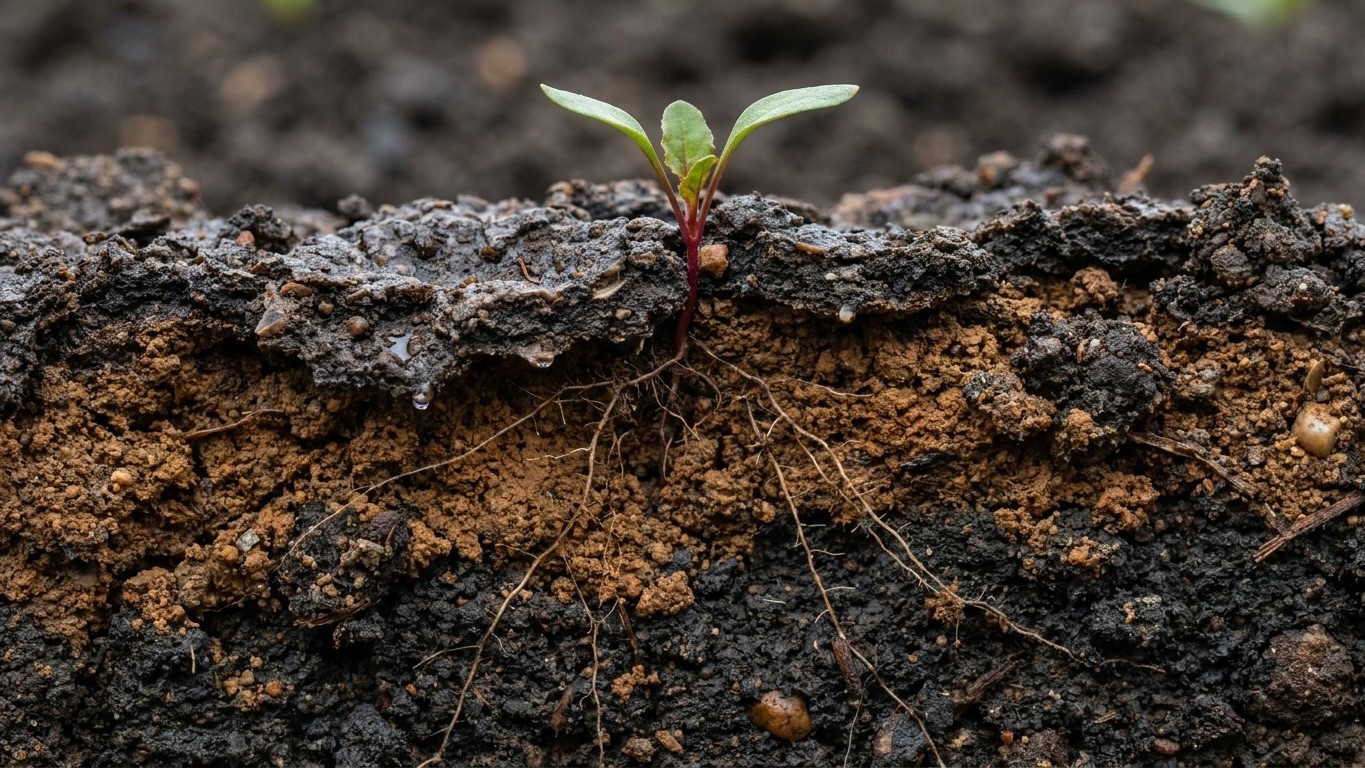

Arkansas’s state soil, the Stuttgart series, is a somewhat poorly drained silt loam sitting at a mildly acid pH. For a beet root pushing down through that profile, drainage and texture decide almost everything before a single true leaf shows. Sowing timing against the state’s last frost window matters just as much. This page lays out what that soil texture means for germination and root shape, why the first six weeks after sowing carry the real risk, and the specific failures gardeners here report most.
The short answer
Arkansas’s official state soil is the Stuttgart series, an Alfisol, the kind of forest soil that holds nutrients reasonably well without being especially rich. USDA soil survey data puts the surface horizon at 30 percent sand, 16 percent clay and 54 percent silt, a loam-to-silt texture, with organic matter around 1.8 percent and a surface pH near 5.6, slightly acid. Drainage class is listed as somewhat poorly drained.
For a beet, that combination is a mixed bag. Utah State University Extension is clear on what the crop wants: deep, sandy, well-drained ground loaded with organic matter. Stuttgart soil gives half that wish list. The silt fraction is generous, which helps hold moisture between waterings, but silt loam also crusts when it dries out on the surface, and a crusted cap can stop a beet seed cluster from pushing through cleanly. The somewhat poorly drained rating matters even more: it means water moves through slowly enough that a heavy spring rain can sit in the root zone for a stretch before it drains away, and a beet sitting in saturated soil is a beet at risk of rot or a misshapen, forked root rather than the smooth cylinder or globe the gardener planted for.
The organic matter figure, at 1.8 percent, is on the lean side of what beets prefer, which is one more argument for working in compost before sowing, at the rate Utah State University Extension names: no more than 1 inch of composted organic matter per 100 square feet. More than that, and the loose, high-organic bed can actually work against a beet by encouraging forked roots as they hit pockets of uneven density.
On heat, the record checked for this page does not carry a published count of days per year above 90 F for an Arkansas reference city, so that specific number isn’t given here. What is established is the mechanism: Utah State University Extension found that heat above 85 F combined with water stress makes the beet root turn woody and tough, a texture problem that has nothing to do with rot or bolting and everything to do with a plant pushed too hard by dry heat late in its growth. Arkansas summers reliably deliver stretches above that 85 F line, so the risk is real even without a specific day-count attached to it.
None of this describes every backyard in the state. Arkansas is mapped across hundreds of soil series, and a garden bed in the Ozark hill country, a river-bottom plot in the Delta, or a yard built on fill dirt behind a new subdivision can differ completely from the Stuttgart profile. Treat these numbers as a starting point for what the region’s ground tends to do, not a stand-in for a soil test on the actual bed the beets will grow in.
The six weeks that decide it here
Utah State University Extension is specific about the window that matters most for a beet: water stress in the first six weeks after sowing is what triggers premature flowering, the bolting failure that sends energy into a seed stalk instead of a root. Since beets are sown directly in place rather than transplanted, that six-week clock starts the day the seed goes into the ground, not weeks later when a seedling gets moved outdoors.
NOAA’s 1991-2020 climate normals put the last spring freeze for the reference station at between March 12 and March 28, the range covering the 30 to 70 percent probability band for a 32 F freeze. Home gardening guidance generally points to sowing beets two to three weeks ahead of that date, which lands the seed in the ground somewhere around late February to mid-March for most of the state, depending on how close a given location tracks to that reference window. Count six weeks forward from a sowing date in that stretch, and the critical bolting-risk period runs through the back half of winter into the first real stretch of spring, typically wrapping up sometime in April.
That timing places the make-or-break window inside a part of the Arkansas calendar known for swinging between extremes rather than settling into one steady pattern. A dry cold snap can be followed within days by a soaking system moving through, and a gardener who waters on a fixed schedule rather than watching the soil can easily let the bed dry out during a rainless stretch precisely when the beet is most sensitive to it. Given the Stuttgart series’s somewhat poorly drained rating and its silt-heavy texture, the more common problem in a wet spring is actually the opposite of drought: standing water in a bed with poor drainage can stress roots just as much as a dry spell, though it shows up as rot and stunted growth rather than bolting.
The practical takeaway is that the bolting risk here sits squarely in early-to-mid spring, tied directly to whichever six weeks follow the actual sowing date, not to a fixed calendar month. A gardener checking soil moisture by hand twice a week during that window, rather than relying on memory of the last watering, addresses the exact mechanism Utah State University Extension describes.
What goes wrong here
- Bolting from early water stress. A dry stretch in the first six weeks after sowing, common during the swings of an Arkansas spring, pushes the plant to flower instead of building a root. The remedy is checking soil moisture directly at the root zone twice a week through that window, since a silt loam surface can look dry while staying moist a few inches down, and watering before the topsoil fully dries rather than after it already has.
- Surface crusting blocking germination. The Stuttgart series’s silt-heavy texture, 54 percent silt against just 30 percent sand, forms a hard cap after it dries following a rain, which can trap beet seedlings before they break through. Keeping the top inch of the seedbed lightly moist until germination, and breaking up any crust that forms with a light hand rake, keeps the path open.
- Forked or misshapen roots from poor drainage. A somewhat poorly drained soil holds water in the root zone longer than a beet prefers, and roots that meet resistance or saturation split into forks rather than growing straight. Raised beds or mounded rows lift the root zone above the slower-draining subsoil and give the plant a cleaner path down.
- Woody roots from late-season heat stress. Once temperatures push past 85 F, any accompanying dryness turns the root tough and fibrous, a separate failure from bolting and one that shows up at harvest rather than mid-season. Mulching to hold soil moisture through the hottest stretch of summer, and harvesting on the earlier side of maturity, both blunt this.
- Nutrient lock-up from lean organic matter and acid pH. At 1.8 percent organic matter and a surface pH near 5.6, the soil offers only moderate fertility to start. Working in compost at the rate Utah State University Extension names, up to 1 inch per 100 square feet, before sowing addresses both the fertility gap and the acidity without overdoing the organic load, which can itself cause forking.
Common questions
Does the Stuttgart series mean my Arkansas garden soil is bad for beets?
Not necessarily. The Stuttgart series is the soil chosen to represent Arkansas overall, not a survey of every backyard. Its somewhat poorly drained rating and modest organic matter are real limits for beets, but a state spans hundreds of soil series, and a garden built on fill, river-bottom ground, or hill-country soil can behave very differently. A soil test of the actual bed is the only way to know what’s there.
How many days after sowing should I expect a beet root in Arkansas?
Utah State University Extension frames beet maturity from seeding rather than from a transplant date, since beets are sown directly in place. The specific day range for maturity isn’t part of the sourced figures on this page, but the six-week window that follows sowing is the period when water stress does the most damage, regardless of the exact harvest date that follows.
Is bolting the same problem as a woody root?
No, and treating them as one problem is a common mistake. Bolting comes from water stress in the first six weeks after sowing and sends the plant into premature flowering instead of root growth. Woodiness comes later, when heat above 85 F combines with dryness to toughen a root that’s already formed. They call for the same basic fix, consistent moisture, but at different points in the season.
What’s the ideal last-frost timing for sowing beets in Arkansas?
NOAA’s 1991-2020 climate normals put the last spring freeze for the reference station between March 12 and March 28. General guidance points to sowing beets two to three weeks before that date, which places seeding for much of the state somewhere in late winter to early spring, with the exact date shifting depending on how closely a given location tracks the reference station’s freeze pattern.