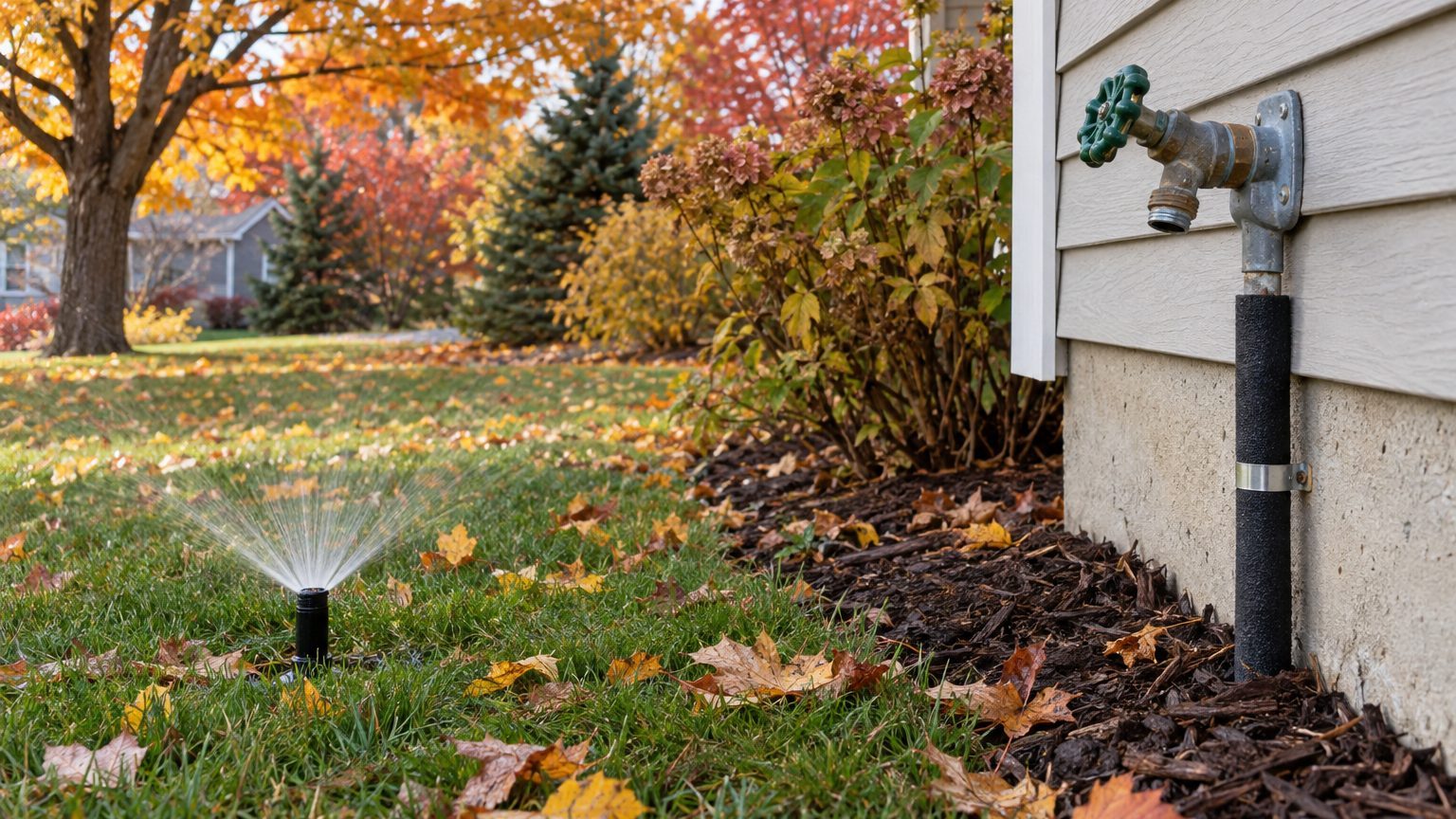

Most Arkansas homeowners should finish winterizing sprinklers and outdoor faucets by early November, and a bit sooner farther north and at higher elevations. That means hoses off, the interior shutoff closed, the outdoor tap drained, and sprinkler lines emptied before the first hard freeze. Winters here are short and mild compared with the Midwest, but cold arrives in snaps, and a single night below freezing can split an exposed pipe.
When to do it in Arkansas
Finish winterizing in the weeks before the first hard freeze, which at Little Rock falls between November 7 and November 20 (NOAA NCEI 1991-2020 Climate Normals, the 30 to 70 percent probability band for a 32F freeze). The working rule is before the first hard freeze, not after the first light one, so the target is ahead of the November 7 to November 20 window.
The light frost comes first. NWS Little Rock gives October 31 as the average fall date for 36F, the threshold gardeners use to decide when to cover tomatoes. For plumbing, a 36F night is a cue to start, because the hard freeze can follow soon after. Tender plants run on the 36F dates, and pipes run on the 32F ones.
Little Rock’s coldest month averages a nightly low of 30.9F (NOAA NCEI 1991-2020 Climate Normals). That sits barely under freezing, so most winter days are mild and long hard-freeze stretches are the exception. A full compressed-air blowout is often more than a well-drained system needs here, though it stays the safest choice for lines with low spots. What does matter is that nothing holding water sits exposed when a snap hits: hose bibs, the above-ground backflow assembly, and the pipes at the house wall.
Does the date change across Arkansas?
Yes, and the direction is consistent. Farther north and at higher elevation, the first fall freeze arrives ahead of Little Rock’s window, so the work moves earlier there. In the south it can wait a little longer, but a later average date does nothing for a given cold night. The USDA Plant Hardiness Zone Map (2023, built on 1991-2020 normals) places the state in 6b to 8a. That system rests on the average annual extreme minimum, so it says little about when to drain a pipe. Your county extension office and the local forecast fill in the dates for your town, and the other Arkansas guides cover seasonal timing around the state.
What order should the fall jobs go in?
Hoses and spigots take minutes, while sprinklers take an afternoon, so start the sprinkler work first. Give the lawn its last good watering, then shut down irrigation, and the sequence in Winterizing a Lawn fits around that. Once the system is drained, there is no reason to turn it back on until spring.
Sprinkler lines: drain or blow out
How does freezing damage sprinkler lines?
Water expands as it turns to ice. Inside a rigid pipe or a plastic valve body, that expansion has nowhere to go, so the pipe, fitting, or valve splits. The break usually sits where water collects: low spots in a line, the bottom of a valve, the fittings at each head, and the backflow preventer that rises above ground near the house. Nothing looks wrong until spring, when the system is pressurized and the split starts leaking or spraying.
Sprinkler pipe runs shallow compared with the main water line, so it sees the cold sooner. Because winter lows here hover near freezing rather than far below it, the damage tends to come from a quick, hard night rather than a long deep freeze. Even a short event can crack a valve that is holding water.
Manual drain, automatic drain, or blowout: which fits Arkansas?
A manual drain uses valves at the low points of the system. You shut off the supply, open the drains, and let gravity empty the lines. It costs nothing but time, and it works only when the system was built with those drain points in the right places.
An automatic drain valve opens by itself when line pressure drops after the water is shut off, letting each section empty. It is convenient, but water can stay in spots the valves do not reach, such as a sag in the pipe or the valve manifold.
A compressed-air blowout pushes water out of each zone, one zone at a time, through the heads. It clears nearly everything, including the low spots that gravity leaves behind. It also carries risk. Too much air pressure can damage heads and plastic fittings, and running air through a zone with no water left can overheat parts. Go zone by zone, stop when the heads spit only mist, and never exceed what the system is rated for.
Given winters that are cold but short, a system built with working manual or automatic drains and a properly shut-off supply is often reasonable here. Pair it with a drained backflow preventer. If you do not know whether your system drains fully, or the yard has low spots and long runs, a blowout is the safer bet. Close the supply to the system first, then drain or blow out the lines before the November 7 to November 20 freeze window.
When is a professional the sensible choice?
Call a professional if you do not own or cannot size a compressor, if the system has no drain valves, or if you are unsure where the backflow assembly shuts off. Irrigation companies do blowouts as a routine fall service. Call before the forecast turns, since a cold snap sends everyone looking for the same appointment at once. If the system has drip zones or a valve box with a tangle of pipe, a pro will also know which parts need extra attention.
Outdoor faucets and hoses
The faucet work is simple and takes a few minutes per spigot. Disconnect every hose, splitter, and timer or sprayer from the spigot and drain the hose before you coil it. Close the interior shutoff valve that feeds the outdoor tap, usually found in a basement, crawl space, or utility room. Then open the outdoor tap fully and leave it open so the water between the two valves can drain out. Do this before the November 7 to November 20 window, and again on any early cold forecast if you have skipped a spigot.
That is the whole job. Anything beyond turning valves is a plumber’s work. If the faucet keeps dripping after the interior valve is closed, if there is no interior shutoff, or if you find a leak or wet insulation at the wall, stop and call a plumber. Do not try to cut, solder, or replace parts on a cold weekend.
Why does a frost-free faucet still fail with a hose attached?
A frost-free faucet has a long stem that puts the valve seat well inside the heated part of the wall. The barrel slopes slightly downward so the water between the seat and the outlet can run out when the faucet is shut off. Attach a hose, and that water cannot drain. The hose holds a column of water against the open end, the barrel stays full, and a freeze splits the pipe behind the wall. The break usually shows up in spring, when the first turn of the handle sends water into the wall or basement instead of out the spout.
So remove hoses even from frost-free spigots. Details about these fixtures, including how to tell if yours is truly frost-free, are in Frost-Free Outdoor Taps. A more general walkthrough for older spigots without a shutoff is in Winterizing Outdoor Faucets Before the First Freeze. A foam cover over a spigot can slow heat loss, but it does not replace draining it.
What goes wrong here
The most common failure in Arkansas is the early cold snap. The first 32F freeze can land at the early edge of the November 7 to November 20 window, or ahead of it, and the system still holds water because the job was waiting on a weekend. In spring it shows up as cracked fittings, a head that sprays sideways, or a zone that will not hold pressure. Prevention is simple: finish in late October, and set the date before the forecast sets it for you. If a cold night is already coming, shut the supply, open the drain valves, and wrap or cover the backflow assembly as a stopgap.
The forgotten hose is the second. One spigot around the side of the house gets missed, a hose stays on, and a frost-free faucet traps water in its barrel. In spring you may see a steady drip inside the wall, a wet ceiling in a basement, or water spraying from behind the faucet plate. Walk the house once before the first cold forecast, checking each spigot, including the one at the garage or the back porch. If a pipe has already frozen, the steps in Frozen Pipes explain what to do and when to call for help.
The third is the valve box that floods. Valve boxes sit in the ground and collect rain, runoff, and debris. If the valves inside hold water into a hard freeze, they can crack, and in spring a zone may refuse to shut off or leak at the box. Drain the valves, clear mud and leaves from the box, and make sure the lid sits firmly. A box that stays full after a rain needs a better outlet. Putting a reminder on the calendar for the last week of October is the cheapest protection against all three problems. Also set the controller to its rain or off mode instead of unplugging it, which keeps your schedule.
Common questions
Can I winterize my sprinkler system in October?
Yes, once you are done watering for the season. Late October is within the working window and leaves margin before the November 7 to November 20 range at Little Rock. If the lawn still needs a drink during a dry fall, wait a week or two, and plan to finish before the forecast shows a 32F night.
How late is too late to winterize in Arkansas?
Once the November 7 to November 20 window opens at Little Rock, risk rises every day, and it opens earlier farther north and at higher elevation. A mild fall can let you slide, but one cold night ends the margin. If you are past that window, drain right away rather than waiting for a calmer weekend.
Do frost-free spigots need winterizing?
They need less, but they still need attention. Disconnect the hose, and close the interior shutoff if there is one, so the barrel can drain on its own. A hose left attached traps water in the barrel and can split the pipe in the wall.
Is Little Rock’s first freeze date true for the whole state?
No. It is a reference point. The state runs from USDA zones 6b to 8a on the 2023 map, and colder parts see a first freeze before Little Rock’s window while milder parts see it after. The 36F light-frost date of October 31 from NWS Little Rock is the one tender plants follow, and pipes are better judged by the 32F dates.