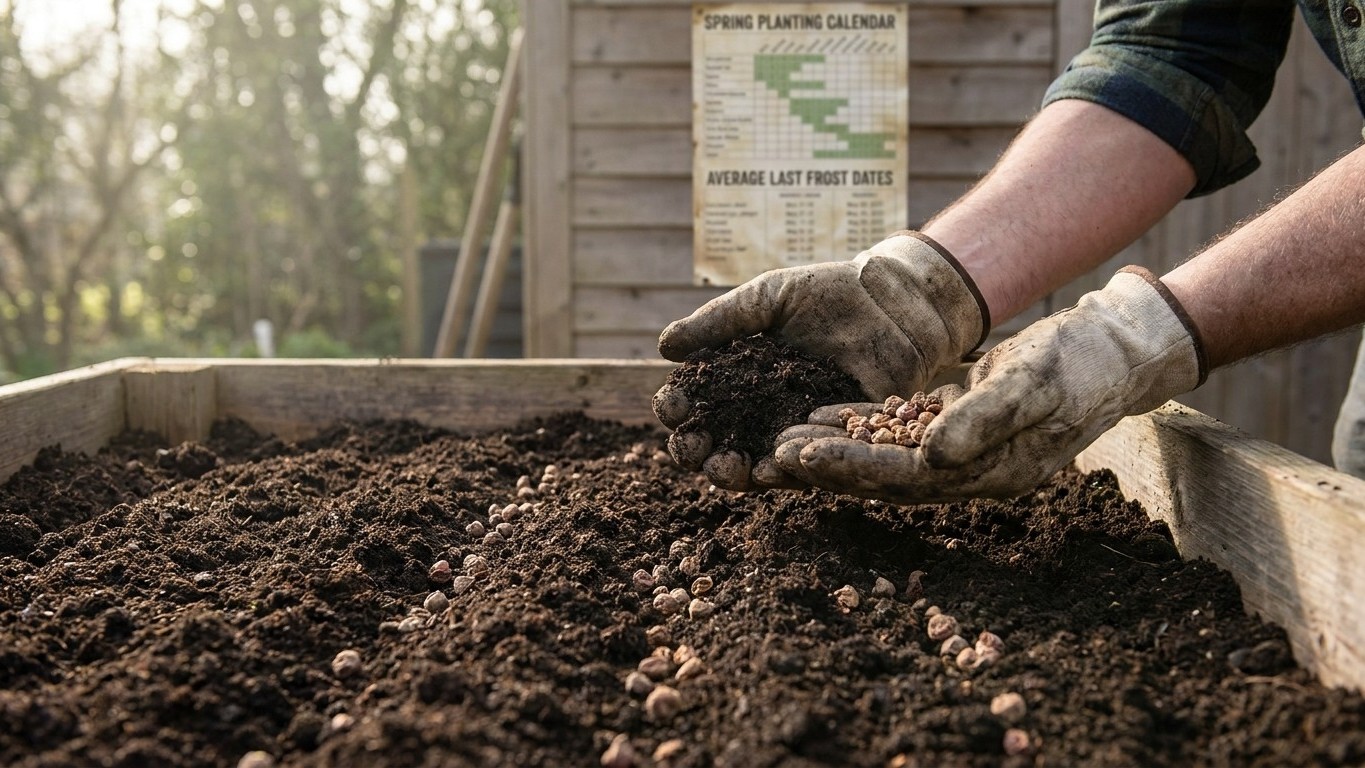

Sow beets in Arkansas two to three weeks before the last spring frost, which lands somewhere between March 12 and March 28 across the state. That puts most seed in the ground from late February through mid-March, early enough to get roots sizing up before summer heat turns them tough and fibrous.
The short answer
Arkansas’s official state soil, the Stuttgart series, tells you a lot about what a beet seed is dealing with the moment it goes into the ground. It’s an Alfisol, a forest-derived soil of moderate fertility that holds onto nutrients reasonably well. The surface runs slightly acid, around pH 5.6, and texturally it’s a loam-to-silt mix: about 30 percent sand, 16 percent clay, and 54 percent silt. Organic matter sits around 1.8 percent, and drainage is classed as somewhat poorly drained.
Beets want the opposite of a heavy, slow-draining profile. Utah State University Extension describes the ideal beet bed as deep, sandy, and well-drained, built up with organic matter but not overloaded (no more than 1 inch of composted material per 100 square feet). A soil that’s 54 percent silt and only 30 percent sand, sitting in the somewhat-poorly-drained class, leans the wrong direction on both counts. Silt-heavy surfaces crust after rain, which makes it harder for a beet’s small seed to push through, and a soil that drains slowly holds water at the surface longer than a beet’s forked taproot appreciates.
The organic matter number matters too. At 1.8 percent, the Stuttgart series sits well below what a beet bed benefits from, which is exactly why the Utah State guidance calls for working in compost before seeding rather than after.
Heat is the other half of the equation. Utah State’s research is specific here: once temperatures climb past 85 F and the plant is also short on water, the root turns woody. Arkansas summers push past that threshold for long stretches, which is the whole reason the sowing window sits so early in the year. A beet planted too late isn’t racing the calendar so much as racing the thermometer.
None of this describes any one garden exactly. Arkansas spans hundreds of mapped soil series, and a yard in the Ozark hill country, a river-bottom plot in the Delta, or a lot where a builder scraped and filled the topsoil will all behave differently than the Stuttgart series does on paper. Treat these numbers as a starting point for what the region’s ground tends to do, then confirm your own bed with a soil test before you decide how much to amend.
The six weeks that decide it here
Timing a beet sowing two to three weeks ahead of the last frost means the first six weeks of that plant’s life fall in a fairly predictable slice of the Arkansas calendar, roughly late February through mid-April depending on where in the state you garden. That six-week stretch is the one Utah State flags as the danger zone for bolting: if the young plant runs short on water during this early window, it responds by throwing a flower stalk instead of building a root.
Arkansas spring is not a gentle, steady ramp. It’s a season known for swinging hard between soaking fronts and dry, windy stretches, sometimes within the same week. That volatility is exactly what makes the first six weeks after sowing the riskiest part of growing beets here. A week of heavy rain followed by ten dry, breezy days is common enough in an Arkansas March or April, and on a somewhat poorly drained, silt-heavy surface like the Stuttgart series, that pattern can mean a crusted, waterlogged surface one week and a parched one the next, with the beet seedling absorbing the stress of both.
This is worth separating clearly from the heat problem, because the two failures come from different causes and hit at different points in the season. Bolting is an early-season event, triggered by water stress in roughly the first six weeks, whatever the temperature happens to be. Woodiness is a later-season event, triggered by heat above 85 F combined with water stress, and it shows up as the root itself, not as a flower stalk. A gardener who waters faithfully in June but let the bed dry out in March can still end up with bolted plants. One doesn’t fix the other.
Practically, that means the six weeks right after sowing deserve closer attention to soil moisture than almost any other stretch of the beet’s life in an Arkansas garden. Checking the bed a couple of times a week during dry spells in that window matters more than watering diligently later, once the plant has already decided whether to bolt.
What goes wrong here
- Crusted, uneven germination. With surface silt content around 54 percent, a hard rain followed by sun can seal the top of the bed into a crust that a small beet seed struggles to break through. Keep the seedbed loose at sowing depth, cover lightly, and water with a gentle spray rather than a heavy stream until seedlings are up.
- Bolting from a dry snap in the first six weeks. Arkansas spring’s habit of swinging from wet to dry means a bed can dry out fast right when beet plants are most sensitive to water stress. Check soil moisture through that early window and water before the surface goes bone-dry, rather than after seedlings already show stress.
- Woody roots from a late sowing. Beets sown after the recommended window run into extended stretches above 85 F while they’re still bulking up, and heat paired with any water shortage turns the root fibrous. Aim for the two-to-three-week-before-last-frost window so most of the root’s growth happens before the hottest stretches arrive.
- Slow drainage holding water at the root zone. The somewhat-poorly-drained rating on soils like the Stuttgart series means water can sit longer than a beet’s taproot likes, especially in low spots. Raised beds or mounded rows give the root somewhere to grow down into rather than sideways through standing moisture.
- Low native fertility limiting root size. Organic matter around 1.8 percent is thinner than beets prefer. Work in compost ahead of sowing, capped at roughly 1 inch per 100 square feet per Utah State’s guidance, rather than trying to correct it mid-season with heavier applications.
Common questions
What is the best week to sow beets in Arkansas?
Based on the state’s last-frost window of March 12 to March 28, aim for sowing roughly two to three weeks ahead of whichever of those dates applies closest to your location, which generally lands seed in the ground from late February through mid-March.
Can I sow beets in fall in Arkansas?
This page covers the spring sowing window tied to the last frost date; fall timing works on a different calendar tied to the first frost and isn’t addressed by the figures here.
Do beets need full sun in Arkansas heat?
Sun exposure isn’t covered by the sourced figures on this page. What is established is that beets need consistent moisture in their first six weeks to avoid bolting, and that heat above 85 F combined with water stress causes woody roots regardless of light levels.
How do I keep beets from bolting in Arkansas gardens?
Bolting is tied specifically to water stress in the first six weeks after sowing, according to Utah State University Extension. Given how much Arkansas spring swings between wet and dry stretches, checking soil moisture through that early window, rather than waiting until plants look stressed, is the most direct way to head it off.