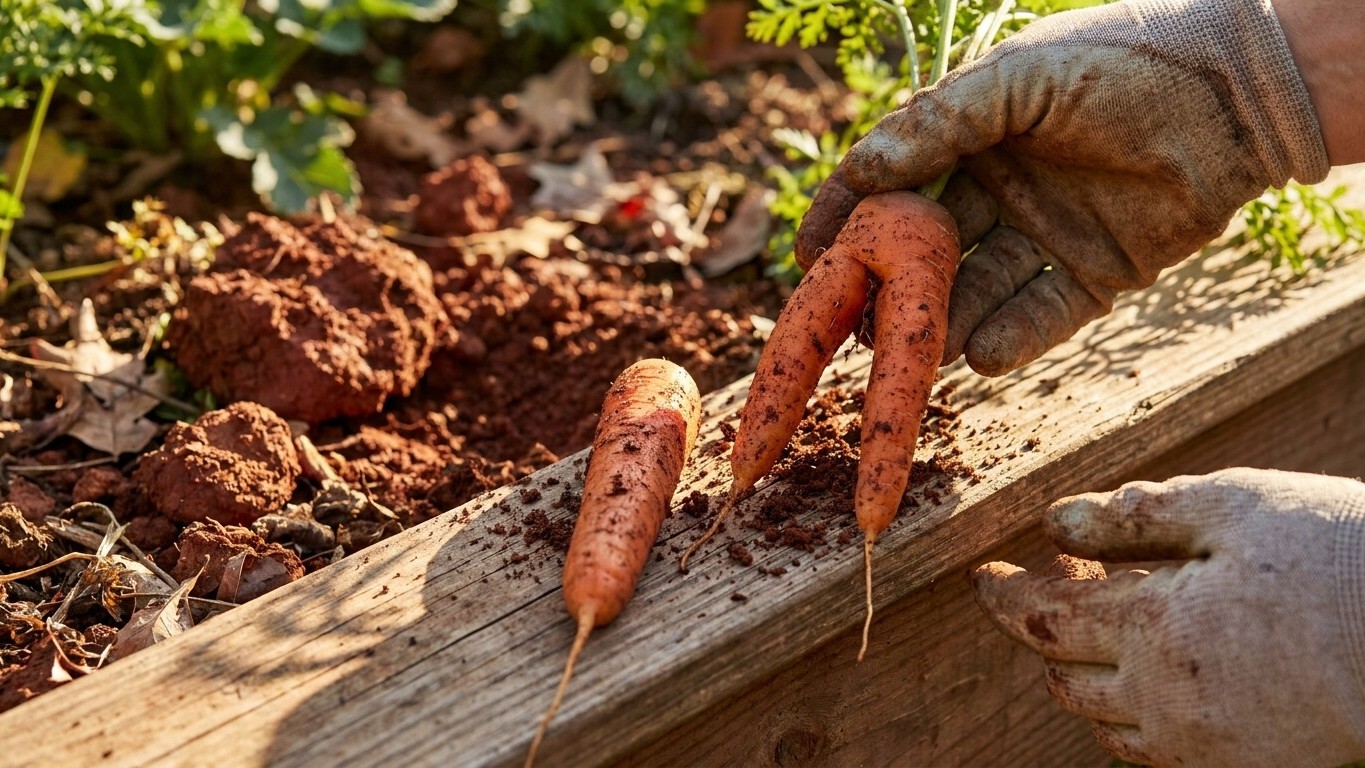

A carrot growing in ground that matches Delaware’s official state soil, the Greenwich series, has good odds of coming up straight. That soil runs closer to loam than clay and drains well. But state soil is a label, not a guarantee for any one backyard, and the fix for forking isn’t a different variety of seed. It’s compost, depth, and knowing what’s actually under your feet.
The short answer
Delaware’s lawmakers named the Greenwich series the official state soil, and USDA NRCS keeps the numbers on record. It’s an Ultisol, an old, heavily weathered and leached soil type, naturally acid and short on nutrients even where it looks fine on the surface. The surface horizon runs about 48 percent sand, 9 percent clay and 43 percent silt, which lands it in the loam-to-silt-loam range rather than heavy clay. Organic matter sits around 1.7 percent. Drainage class: well drained.
Texture says low risk, organic matter says don’t skip the compost
Utah State University Extension is blunt about what makes a carrot fork: heavy or rocky soil forces the taproot to split as it hunts for the path of least resistance, and heavy soil needs plenty of compost and double digging before carrots go in. With clay content at only 9 percent, the Greenwich series doesn’t fit the description of heavy soil. That’s the good news for anyone gardening in ground that matches this profile: fork risk from texture alone is low, and carrots have a reasonable shot at growing long and straight without double digging.
The organic matter figure is the catch. At roughly 1.7 percent, the native surface is on the lean side, and Utah State’s guidance calls for soil “rich in organic matter,” not just loose and sandy. A bed that’s never had compost worked into it can still produce stubby or misshapen roots even where clay is low, simply because the soil runs out of the loose, fertile depth carrots want to push through. The practical answer: if your soil resembles the Greenwich series, skip the double digging that heavy clay would demand, but don’t skip the compost.
None of this is a diagnosis for your specific plot. Delaware spans hundreds of mapped soil series, and the Greenwich series describes what represents the state as a whole, not what’s sitting under a particular raised bed, a filled lot, or a yard near a river bottom. It’s a starting point for what the region’s ground tends to do, not a stand-in for a soil test on your own ground.
The test that settles it in your own garden
State soil data can only tell you what’s typical. Your bed might match it closely, or it might be nothing like it if a builder scraped and refilled the lot, or if you’re gardening near a creek where silt has piled up for generations. A short hands-on check answers the question the state record can’t.
Steps to run before you sow
- Dig a hole at least a foot deep in the exact spot you plan to sow carrots. They need that much clear depth to grow straight, so this is the test that matters most.
- Note what stopped the shovel. Easy digging the whole way down is a good sign. Hitting a rock layer, old buried debris, or a dense hardpan partway down tells you exactly where a root will hit resistance and start to fork.
- Take a handful of moist soil from the bottom of the hole and rub it between your fingers. Gritty and loose reads sandy. Silky and floury reads silt. If it rolls into a ribbon between your thumb and finger without falling apart, that’s clay, and clay is what pushes carrots to split.
- Fill the hole with water and watch what happens over the following hours. Water that disappears steadily is a sign of decent drainage. Water that sits and stares back at you well into the next day points to a heavier, tighter profile than the surface may suggest.
- Weigh what you found against what carrots actually need: deep, loose, well-drained soil with organic matter worked through it, per Utah State University Extension. Rock, hardpan, standing water, or a clay ribbon at any point in that top foot means a raised bed or double digging will do more for you than switching seed packets ever could.
What goes wrong here
Matching the state soil’s numbers on paper doesn’t mean every carrot bed sails through the season without trouble. A few failures show up again and again, and each one has a fix that doesn’t involve starting over.
- Forking in compacted or backfilled ground. Even where native soil runs light on clay, foot traffic, construction fill, or years of walking the same garden path can pack a bed down into something far denser than the surface texture implies. Double digging or building a raised bed with a loose, compost-rich mix routes around the problem entirely.
- Poor germination during a hot spell. Carrot seed is slow to sprout under the best conditions, and a stretch of hot, dry weather can crust and dry out the top inch of soil before the seedlings ever break through. Keeping that top layer consistently moist with light, frequent watering, or laying a thin mulch or shade cloth over the row until germination, keeps the seed from drying out mid-process.
- Splitting from uneven watering. A carrot that goes dry for a stretch and then gets hit with a heavy soak swells too fast and cracks along its length. Steady, even watering through the growing season, backed by a layer of mulch to slow evaporation, keeps growth even instead of stop-and-start.
- Stunted roots from thin organic matter. With native organic matter around 1.7 percent, a bed that’s never had compost added can run out of fertility right when the root is sizing up. Working compost into the soil before sowing, exactly as Utah State University Extension recommends for carrots, gives the root the depth of rich, loose ground it needs the whole season through.
Common questions
Is Delaware’s soil naturally acidic?
The Greenwich series, Delaware’s official state soil, carries a surface pH of about 6.0, which reads as slightly acid, according to USDA NRCS records. That’s a representative figure for the state soil’s surface horizon, not a measurement of your bed. A soil test is the only way to know your own number.
How deep should the soil be for carrots to grow straight?
Utah State University Extension calls for deep, sandy, well-drained soil rich in organic matter, without putting a specific inch count on it. The one-foot check described above is a practical way to confirm there’s enough clear, loose depth before you sow.
Does adding compost really stop forking?
For heavy soil, Utah State University Extension is direct: it needs plenty of compost along with double digging. Compost loosens dense ground and adds the organic matter carrots need, which matters even in soil like the Greenwich series where clay is already low but native organic matter runs thin.
How long does it take to grow carrots from seed?
That harvest-date figure isn’t part of the soil data on this page, so it won’t be repeated here without a source. What’s worth remembering is that carrots are sown directly in the ground and never transplanted, so any days-to-harvest count starts from the seeding date, not from a transplant date.