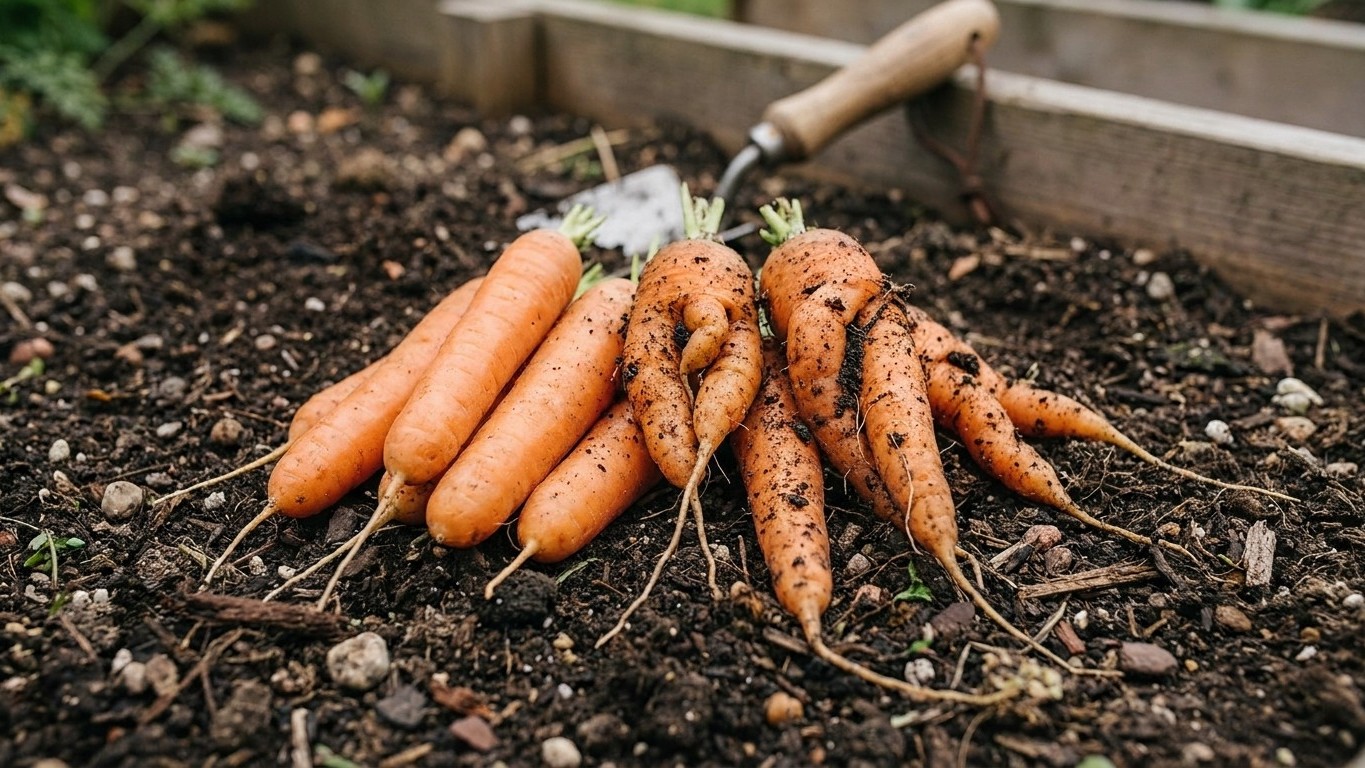

Delaware’s official state soil, the Greenwich series, runs well drained and only mildly acid, which sounds encouraging for carrots. But the real question isn’t what the state soil does on paper, it’s what forks a root in heavy clay and what fixes it. Compost, double digging or a raised bed answer that, depending on how much clay actually sits under your rows. Here’s the arithmetic, the soil numbers, and the test that settles it at home.
The short answer
Delaware’s state soil is the Greenwich series, an Ultisol, one of the old, heavily weathered and leached soil orders common across the coastal plain. Its surface layer runs 48 percent sand, 9 percent clay and 43 percent silt, a texture close to a loam, and it drains well rather than sitting wet. Surface pH averages about 6.0, slightly acid, with organic matter around 1.7 percent, both figures drawn from the USDA NRCS Soil Survey Geographic Database for the surface horizon of the series’ major mapped components.
Carrots want deep, sandy, well-drained soil rich in organic matter, according to Utah State University Extension. Held against the Greenwich numbers, low clay and good drainage read as decent news: this ground shouldn’t clamp down on a taproot the way a heavy clay loam does. Clay content matters more than sand content here, because clay is what compacts, holds water against a growing root, and forces the root to split around a stone or a hard layer instead of pushing straight down. At 9 percent clay, the state soil sits on the sandy, forgiving side of that equation. Organic matter at 1.7 percent, though, is on the low side for a vegetable bed, so compost still earns its keep, loosening what’s already loose and feeding a crop that pulls nutrients from a narrow band of soil around the root.
None of this is a diagnosis of the ground under your own boots. Delaware spans hundreds of mapped soil series, and the Greenwich profile describes a representative sample, not the bed behind your house. Fill dirt from a builder, a low spot near a stream, or a yard that’s been compacted gravel for years can carry far more clay, far worse drainage and a different pH than the figures above. Treat the Greenwich numbers as a regional tendency, sandy and well drained more often than not, and settle the real question with a spade in your own dirt.
The test that settles it in your own garden
The state soil map can’t tell you what sits twelve inches down in your own carrot bed. Only digging can. Set aside some time with a spade and a garden hose before you buy seed, and work through these steps in order.
- Dig a hole at least a foot deep where you plan to sow. A shovel that stops on rock, hardpan or heavy clay before reaching that depth tells you carrots will hit the same wall and fork or stub out short.
- Look at what comes out. Note the depth where color or texture changes, and pick out any stones, gravel or construction debris. Straight roots need an obstacle-free column of loose ground; a scattering of pebbles a few inches down will split more than one root that season.
- Feel the texture between your fingers. Wet a handful and rub it. Soil that turns into a smooth, sticky ribbon holds a lot of clay and will need work. Soil that falls apart gritty and loose leans sandy, closer to what the crop wants. Silt sits in between, feeling smooth but not sticky, and doesn’t ribbon the way clay does.
- Watch how water drains. Fill the same hole with water and note how long it takes to disappear. Water that lingers well after a normal rain has passed points to a compacted or clay-heavy layer underneath, the kind of ground that keeps roots wet, encourages splitting and rot, and calls for a raised bed rather than an amended patch of native soil.
Run through all four and you’ll know more about your own carrot bed than any state-level soil survey can tell you. A garden that fails the depth or drainage test isn’t a lost cause, it’s an argument for raised beds, which sidestep the question of what’s underneath entirely.
When to sow here
Carrot seed goes straight into the ground, never started indoors and moved outside as a seedling, so every date below counts from the day seed hits soil, not from a transplant. Delaware’s last spring frost, based on the 30-year NOAA NCEI Climate Normals for the reference weather station used in that dataset, falls between April 3 and April 14. That window anchors everything else.
- Check soil temperature first. Carrot seed needs ground at least 40 degrees Fahrenheit to germinate at all. A soil thermometer pushed a couple of inches into the bed on a still morning tells you more than the calendar does.
- Count back two to three weeks from your local last frost date. Against Delaware’s April 3 to April 14 window, that arithmetic lands sowing somewhere in the second half of March to the very start of April, earlier where the ground warms fast, later where it’s shaded or heavy and slow to shed winter’s cold.
- Aim for the 55 to 65 degree range for germination. That’s where carrot seed sprouts best; colder soil slows the process to a crawl, and seed can sit dormant for weeks without breaking the surface.
- Treat the frost date as a station average, not a promise. The dates above come from a single reference weather station. Gardens further inland, at higher ground, or sitting in a low spot that pools cold air typically see their last frost land one to two weeks later than the station record, which pushes the safe sowing window back by the same margin.
None of this replaces watching your own soil and your own thermometer. The frost date sets the outer edge of the calculation; soil temperature decides whether seed sown on that date actually sprouts.
What goes wrong here
- Forking in heavy or compacted ground. Wherever a garden strays from the sandy, well-drained texture of the state soil into denser clay, roots meet resistance and split around it instead of growing straight. Utah State University Extension names heavy or rocky soil as the direct cause of forked roots, and its fix is direct too: work in plenty of compost and double dig the bed before sowing, breaking up the compacted layer a single pass with a shovel would leave in place. Where clay runs deep, a raised bed filled with loose, amended soil sidesteps the problem instead of fighting it every season.
- Poor germination during a hot spell. Carrot seed germinates best between 55 and 65 degrees Fahrenheit. A run of unseasonably warm days can push topsoil well past that range, especially in a sunny, exposed bed, and germination rates drop even though the seed itself is perfectly viable. A layer of mulch or shade cloth over the row during a heat spike keeps the top inch of soil closer to the range seed actually wants, and watering in the cool of the morning helps more than a midday soak.
- Splitting from uneven watering. A root that grows through a dry stretch, then gets hit with heavy rain or a deep soak, tends to crack along its length as the interior swells faster than the outer skin can stretch. Even, regular watering avoids the swing between drought and flood that causes it, and mulch helps the soil hold moisture between waterings instead of drying out completely and then flooding.
Each of these traces back to the same two variables: how much clay sits under the row, and how steady the soil’s temperature and moisture stay through the weeks it takes seed to become a root worth pulling.
Checking this against your own county
Everything above works from a single mapped soil series and a single weather station, a useful starting point but no substitute for local knowledge. The University of Delaware Cooperative Extension keeps county-level guidance, soil testing services and planting calendars built around Delaware’s actual range of ground, from sandier soils near the coast to heavier ground further inland. Their office can also point you toward a soil test that returns an actual pH and nutrient reading for your bed, rather than a state series average.
A call or a visit to their site is worth more than another paragraph of state-wide figures. Find their programs and contact information at the University of Delaware Cooperative Extension.
Common questions
Can I grow carrots in Delaware’s clay soil?
Yes, but not straight from the ground. Heavy or rocky soil is the direct cause of forked roots, so a clay-heavy bed needs plenty of compost worked in and double digging, or a raised bed filled with loose, amended soil.
What’s the best time to plant carrots in Delaware?
Sow two to three weeks before your local last frost date, once soil reaches at least 40 degrees Fahrenheit. Against the state’s April 3 to April 14 last-frost window, that lands roughly in the second half of March to early April, adjusted for your own soil’s warming pace.
Why do my carrots come out forked?
Forking traces to heavy, compacted or rocky soil that resists a straight-growing taproot. Digging a foot-deep test hole and checking for stones or a dense layer will usually reveal the cause.
Does Delaware’s state soil match my garden?
Probably not exactly. The Greenwich series describes a representative sample across the state, not any single yard. Dig, feel the texture and check drainage in your own bed rather than relying on the state figures alone.