
Delaware gardeners count back from their local last-frost date and add the days carrots need to mature from seed, since carrots go straight into the ground and are never transplanted. This piece won’t hand you one statewide frost date because that number shifts by county and by year. What it will do is show you how the state’s own ground behaves, how to check your own bed against it, and what actually goes wrong when the timing or the soil is off.
The short answer
Delaware’s official state soil is the Greenwich series, an Ultisol, the kind of old, heavily weathered and leached ground common across the Mid-Atlantic coastal plain. The surface horizon runs 48 percent sand, 9 percent clay and 43 percent silt, a loam-to-silt mix with organic matter around 1.7 percent and a surface pH near 6.0, slightly on the acid side. It’s classed as well drained.
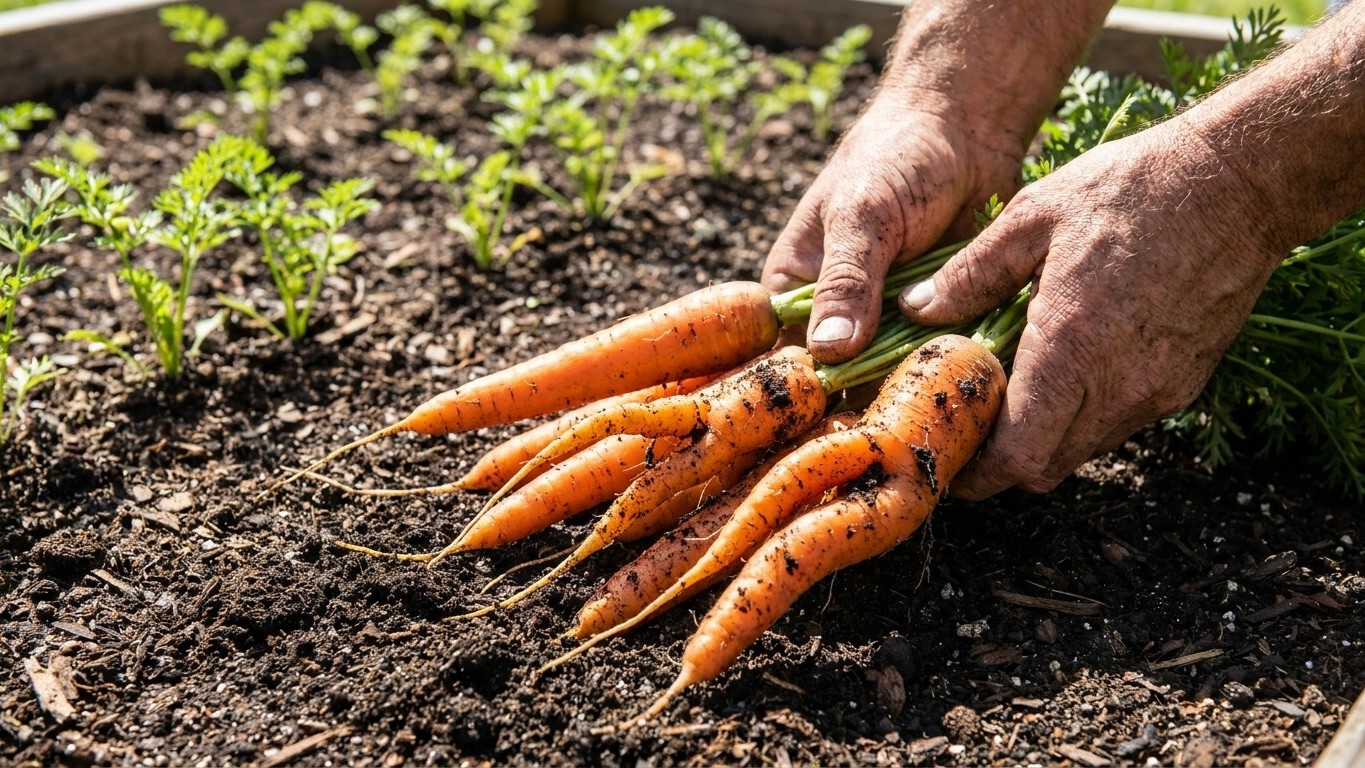
That combination is, on paper, decent news for carrots. Utah State University Extension is blunt about what ruins a carrot root: heavy or rocky ground makes it fork, splitting into two or three legs instead of growing down as one clean taproot. Greenwich series ground, with clay sitting under 10 percent and sand making up nearly half the profile, leans toward the loose, well-drained texture carrots actually want. A gardener working straight Greenwich-type soil, with no hardpan and no compaction from heavy equipment, has less forking to fight than someone on a dense clay flat.
That’s the state’s answer, not your yard’s. Delaware maps out to hundreds of individual soil series, and no single one of them describes what’s actually under your carrot bed. A subdivision built on scraped and filled ground, a low spot near a ditch, a yard with fifty years of construction debris under the topsoil, any of these can sit nowhere near the Greenwich profile even a mile from where it’s mapped. Coastal flats trend sandier and looser. Inland pockets and anywhere a builder compacted subsoil during grading can run heavier in clay than the state figures suggest, and that’s exactly the ground where carrots fork.
If your soil turns out heavier than this, the fix Utah State lays out isn’t a different variety of carrot. It’s more compost worked into the bed and double digging to loosen the profile a full spade’s depth down, or skipping the fight altogether by building a raised bed filled with a loose, sandy mix. Either approach gets you back to something closer to what Greenwich-type ground already offers naturally: loose, deep, well-drained soil a taproot can push through without hitting resistance and splitting.
The test that settles it in your own garden
The state soil profile is a starting point, not a diagnosis of your particular bed. The only way to know what you’re actually planting into is to dig, look, feel and watch. None of this needs a lab.
- Dig a hole where the carrots will go. Go down at least a full shovel’s depth. Note where the soil changes color or gets noticeably harder to dig, since that’s often where a compacted layer or clay pan starts, and that’s the depth a carrot root will hit before it’s forced to fork or stop.
- Check for stones and debris as you dig. Rock and rubble in the top foot of soil do the same thing a clay pan does: they deflect the taproot sideways or split it. A handful of pebbles here and there is normal; a bed full of construction gravel or buried rock is not carrot ground without clearing it first.
- Feel the texture between your fingers. Grab a moist handful and squeeze. Soil that falls apart and feels grainy leans sandy, like the sand-heavy Greenwich profile. Soil that squeezes into a slick, sticky ribbon and holds its shape is heavier in clay, and that’s the soil most likely to produce forked, misshapen roots.
- Watch how water moves through it. After a rain, or after you water the bed yourself, come back and see how the surface looks. Ground that stays soggy and puddled long after everything around it has dried out is telling you drainage is poor, the same condition that pushes gardeners toward raised beds for carrots.
- Compare what you found to the Greenwich numbers. If your soil crumbles loose, drains fast and shows little rock, you’re working with something close to what Delaware’s state soil profile describes, and straight carrots are realistic. If it’s sticky, slow to drain or full of stones, plan on compost, double digging or a raised bed before you plant.
What goes wrong here
- Forking in heavy ground. Clay-heavy or compacted soil, or a bed full of stones, splits the taproot into multiple legs instead of one straight carrot. Utah State University Extension’s remedy is direct: work in plenty of compost and double dig the bed to loosen it a full spade’s depth, or build a raised bed with a looser mix if the native ground won’t cooperate.
- Poor germination during a hot spell. Carrot seed is small, slow to sprout, and sits near the surface where it dries out fast once summer heat sets in. A dry crust on top of the bed during germination week can mean a thin, patchy row instead of a full stand. Keeping the surface consistently damp until seedlings show, with a light layer of mulch or a daily check with the hose, is what gets seed through that window.
- Splitting from uneven water. Once roots are sizing up, a stretch of drought followed by a heavy soak can crack a carrot right open. The root grows fast when water finally shows up after being starved, and the skin can’t keep pace with the swelling core. A steady watering rhythm, rather than feast-or-famine watering, keeps roots growing at one even rate instead of stalling and then surging.
Common questions
Does this page give an exact last-frost date for my part of Delaware?
No. Frost timing varies enough by county, and by year, that a single statewide number wouldn’t actually help you plant on the right week. This page focuses on soil, since that’s the piece of the timing puzzle that’s stable and checkable in your own yard.
Do carrots need to be started indoors and transplanted?
No. Carrots are sown directly where they’ll grow. Their taproot doesn’t transplant well, so there’s no transplant date to work from, and every bit of timing runs from the day the seed goes into the ground.
How long from sowing to harvest should I expect?
Utah State University Extension puts carrots at 70 to 100 days from seeding to maturity, depending on conditions. That count starts the day seed goes into the soil, not from any later stage.
My soil test shows more clay than the Greenwich series figures on this page. What now?
Treat your own test result, not the state profile, as the number that matters. Heavier clay than the 9 percent Greenwich figure means a higher risk of forked roots, and the fix is the same one Utah State University Extension recommends for any heavy ground: work in compost, double dig the bed, or switch to a raised bed filled with a looser mix.