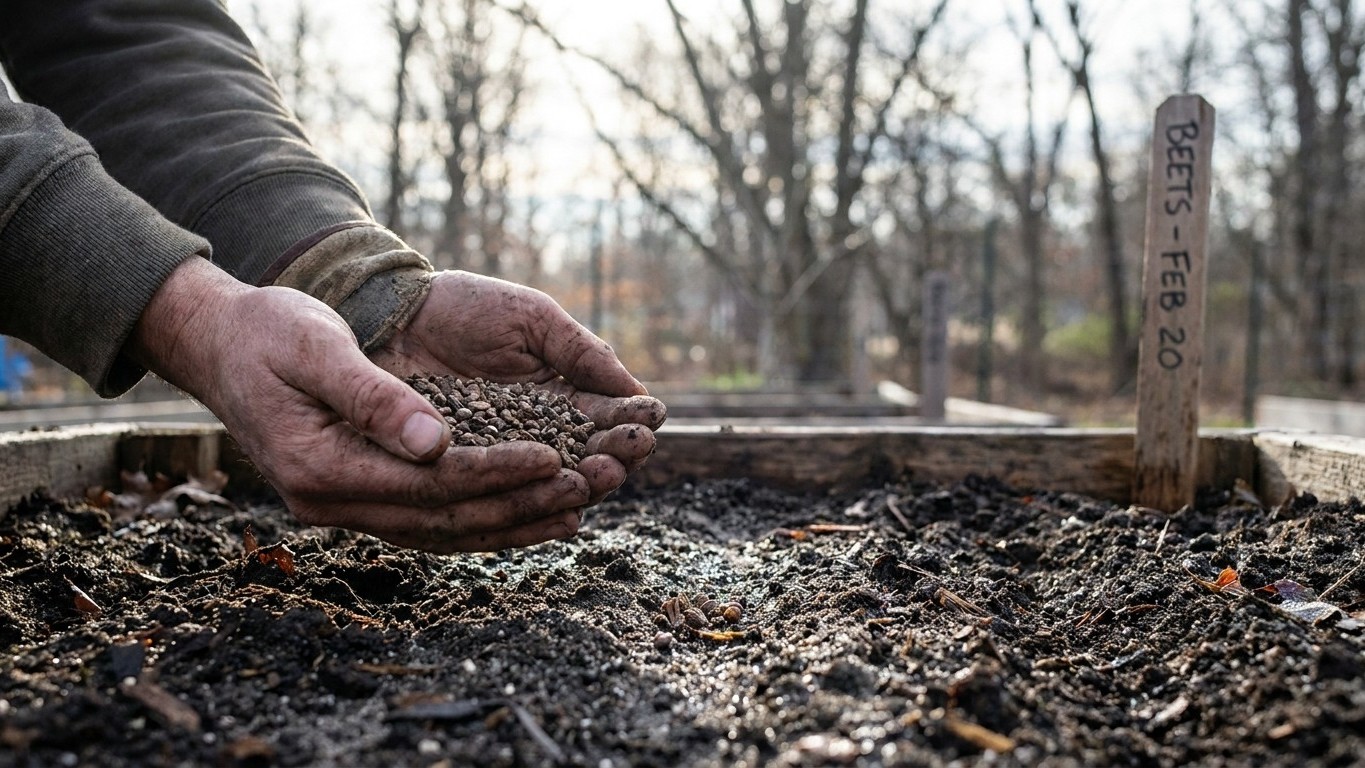

In central Indiana, direct-seed beets outdoors from about March 19 to April 7, two to three weeks ahead of the region’s last spring frost window of April 9 to April 21. Push a second sowing through midsummer for a fall crop, timed so the root fills out before the hottest run of the season sets in. South of Indianapolis, that window typically opens roughly two weeks earlier; the northern third of the state usually needs to wait a little longer.
The short answer
What the Miami series soil means for a beet bed
The soil USDA lists as representative of Indiana is the Miami series, an Alfisol, which is a forest soil of moderate fertility that holds nutrients reasonably well. Its surface horizon runs about 30 percent sand, 20 percent clay and 49 percent silt, a loam to silt loam texture, with a surface pH near 6.5 (slightly acid) and organic matter around 2.0 percent. Drainage is rated moderately well drained, not the free-draining sandy loam that Utah State University Extension describes as ideal for beets. That gap matters. Beets want deep, sandy, well-drained ground rich in organic matter, and a silt-heavy soil like the Miami series can seal at the surface after a hard rain, slowing the drainage a young beet root depends on. A gardener working this kind of ground does well to work in compost, capped at roughly 1 inch per 100 square feet per USU’s guidance, and to raise the bed a few inches if water tends to sit after storms. The pH itself sits close to what beets tolerate without amendment.
Where heat enters the picture
The exact count of days the state crosses 90 F in a given year isn’t part of the record cited for this page, so no specific number belongs here. What is documented is the threshold that matters for the crop: USU Extension flags 85 F combined with water stress as the point where a beet root turns woody. Indiana summers routinely run stretches well past that mark, which is the practical reason spring sowing gets pushed early and a fall crop gets timed to mature after the worst of the heat has broken, rather than during it.
None of this replaces a soil test. Indiana spans hundreds of mapped soil series, and the Miami series is a statewide reference point, not a description of any one backyard. River bottoms run sandier and drain faster; hill country and any lot a builder has cut, filled or compacted can behave nothing like the numbers above. Use this as a starting point for what the region’s ground tends to do, then check your own bed.
The six weeks that decide it here
What a typical Indiana spring does to a seedbed
Sowing two to three weeks before the last frost date means the first six weeks of a beet’s life fall in a fairly predictable stretch of the calendar: mid-March through early May in central Indiana, shifted earlier or later depending on where in the state a garden sits. That stretch is the one where Indiana spring tends to swing hardest, cold snaps followed by warm spells, heavy rain followed by dry stretches that can crust the surface of a silt-heavy bed like the Miami series described above. That swing is exactly the condition USU Extension warns against: water stress in the first six weeks after seeding is what pushes beets toward premature flowering, a failure that shows up later as a plant that bolts to seed instead of building a root.
The frost math behind the sowing date
The published last-frost window for the Indianapolis station runs April 9 to April 21, based on NOAA’s 1991-2020 climate normals. That’s a 30 to 70 percent probability band, not a hard line, and there remains roughly a 10 percent chance of a 32 F event after that window closes. A gardener sowing at the early edge of the recommended two-to-three-week lead, meaning mid-to-late March, is sowing into a season that still carries some frost risk on the calendar, which argues for keeping row cover on hand rather than assuming the risk is zero once seed goes in. Beet seedlings tolerate a light frost better than the seed-to-root stretch tolerates drying out, so the six-week bolting risk in Indiana sits less with cold and more with the dry spells that show up between spring rain systems.
What goes wrong here
Where the failures start
- Crusted surface after a heavy spring rain. The Miami series’ silt-heavy texture (49 percent silt) can cap over and block emerging seedlings. Break the crust gently with a rake tine right after a storm, and mix compost into the top few inches before sowing so the surface holds together less tightly.
- Bolting from a dry week in the first six weeks. A stretch without rain right after seeding is the direct trigger USU Extension names for premature flowering. Water on a set schedule through that window rather than waiting for the soil to look dry, since a silt loam can look moist on top while drying out below.
- Woody roots from a late, hot sowing. A sowing pushed into late spring can mature right as temperatures clear 85 F, and heat paired with any water stress toughens the root. Move the main sowing earlier in the recommended window, or shift a warm-season planting to the fall slot instead.
- Standing water after storms. “Moderately well drained” means water lingers longer than beets prefer after a hard rain. Raised rows or beds a few inches above grade give the excess somewhere to go besides the root zone.
- Overdoing the compost. More organic matter isn’t automatically better; USU Extension caps additions at roughly 1 inch per 100 square feet, since heavier applications can throw off the balance a beet root wants.
Common questions
Can beets go in the ground before the last frost date?
Yes, that’s the standard approach. Sowing two to three weeks ahead of the last frost is the timing basis for this page’s window, since beet seed and young seedlings handle a light frost better than they handle a dry spell during the first six weeks of growth.
Does southern Indiana follow the same calendar as Indianapolis?
No. Indianapolis is the reference station for the April 9 to April 21 frost window used here, but southern Indiana typically runs earlier in spring and later in fall by two weeks or more, and the northern part of the state runs later in spring. Adjust the sowing window in the same direction.
How do I know if my own soil matches the Miami series described above?
You don’t, without testing it. The Miami series is the soil USDA lists as representative of the state as a whole, drawn from surface-horizon data across 627 mapped components, not a measurement of any particular garden. A soil test through a local extension office is the only way to know your actual sand, silt, clay and organic matter numbers.
Is bolting the same problem as a woody root?
No, and treating them the same is a common mistake. Bolting comes from water stress in the first six weeks after seeding, before the plant has built much root at all. Woodiness comes later, when heat above 85 F combines with water stress on a root that’s already forming. The fix for one (steady early watering) doesn’t automatically solve the other (earlier sowing or a fall planting to dodge peak heat).