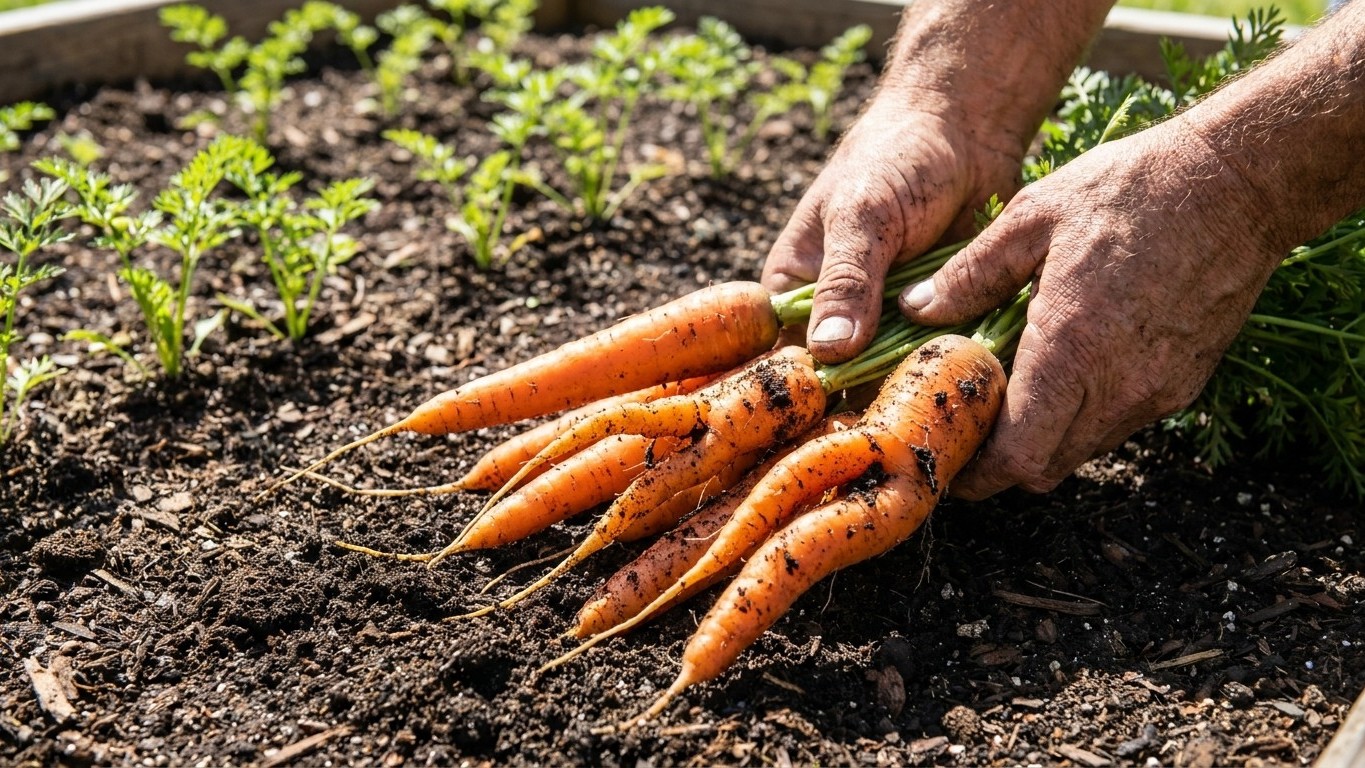

Carrots in Kentucky are sown directly into the ground, counted backward from your local last spring frost, since the crop is never transplanted. But that calendar math only tells half the story. What’s under your boots decides whether the root grows straight or forks, and Kentucky’s official state soil, a well-drained silt loam called the Crider series, is a useful starting point for guessing what that ground might do.
The short answer
Kentucky’s official state soil is the Crider series, a silt loam formally recognized under state law in 1990 through the USDA NRCS State Soils program. Sampled at the surface, it runs about 5 percent sand, 19 percent clay and 76 percent silt, with organic matter around 3.0 percent and a surface pH near 6.2, slightly on the acid side. It’s classified as an Alfisol, a forest-derived soil that holds nutrients reasonably well and drains freely rather than staying soggy.
For a carrot, that profile is a mixed bag. Utah State University Extension notes that carrots want deep, sandy, well-drained soil loaded with organic matter, and that heavy or rocky ground makes the taproot fork instead of growing straight down. Crider soil clears the drainage requirement without any help. Its clay content, at 19 percent, isn’t the sticky, root-stopping clay of a river-bottom field, but it’s also nowhere near the loose sand carrots prefer. Left alone, a bed of straight Crider silt loam will likely grow a usable carrot, just not the long, unblemished one you’d pull from a raised bed of sand-amended compost.
| Trait | Ideal carrot soil | Crider series (KY state soil) |
|---|---|---|
| Texture | Sandy, loose | Silt loam: 76% silt, 19% clay, 5% sand |
| Drainage | Well drained | Well drained |
| Organic matter | Rich, high | About 3.0 percent |
| Forking risk | Low | Moderate without amendment |
The fix, per Extension guidance, is the same one recommended for any heavier-than-ideal ground: work in a generous amount of compost and double dig the bed, breaking up compaction well below the depth a spade normally reaches so the root can push down without hitting resistance. If digging that deep isn’t practical, a raised bed filled with a lighter, sand-amended mix sidesteps the problem entirely, since you control the texture from day one instead of fighting what’s already there.
None of this settles what’s happening in your own yard, though. Kentucky spans hundreds of mapped soil series, from river-bottom silt to hillside clay to whatever a builder graded and filled behind a new subdivision. The Crider series describes the surface horizon of one representative soil; it says nothing about the ground fifteen feet from your back door. Treat it as a hint about regional tendencies, not a substitute for a shovel test.
The test that settles it in your own garden
A state soil designation is a snapshot of the whole state, not a report card on your vegetable bed. The only way to know what carrots will actually grow into is to check it yourself, and it takes less time than reading a soil survey.
- Dig a hole where the carrots will go. Go down at least a foot with a spade or garden fork, since that’s roughly the depth a full-size carrot root needs to travel without hitting an obstruction.
- Look at what comes out. Note the depth before you hit a hardpan, a rock layer, or a clear change in color that signals a different layer underneath. Pull out any stones, roots, or buried debris you find, because carrots fork around anything solid in their path.
- Feel the texture between your fingers. Grab a moist handful and rub it. Sand feels gritty and falls apart. Clay feels sticky, smears easily, and holds a ribbon shape when squeezed. Silt feels smooth, almost like flour, and sits between the two. Most garden soil is some blend of all three.
- Watch how water moves through it. Fill the hole with water and time how long it takes to disappear. Water that drains quickly points to sandy, fast-moving ground. Water that sits for hours points to clay-heavy soil that will need amending, or a raised bed, before carrots go in.
Run this test in more than one spot if your yard has any variation at all. A soil survey boundary can cut straight through a suburban lot and put two different series on either side of the driveway. Twenty minutes with a shovel tells you more about your carrots’ prospects than any map, because a map describes the county and a shovel describes your bed.
What goes wrong here
The soil and climate combination across Kentucky produces a handful of predictable carrot failures, and most of them trace back to either texture or watering habits rather than the seed itself.
- Forking in heavy ground. Where clay content runs higher than the state soil’s 19 percent, or where a hardpan sits close to the surface, the taproot hits resistance and splits into two or more legs instead of growing straight. Work in compost and double dig the bed, or start over in a raised bed filled with a lighter mix.
- Poor germination in a hot spell. Carrot seed is slow to sprout under the best conditions, and a stretch of hot, dry weather right after sowing can dry out the thin surface layer before the seed ever germinates. Keep the top inch of soil consistently moist with light, frequent watering, and a thin mulch or board laid over the row can help hold that moisture until seedlings emerge.
- Splitting from uneven watering. Once roots are established, a long dry stretch followed by a heavy soaking makes the carrot swell too fast and crack along its length. A steady watering schedule, rather than alternating drought and deluge, keeps growth even.
Common questions
Do I need to transplant carrot seedlings?
No. Carrots are sown directly into the ground where they’ll grow to maturity. The taproot doesn’t tolerate the disturbance of transplanting, so all timing, including counting back from your last frost, runs from the seeding date rather than any transplant date.
How many days does it take carrots to mature from seed?
Most carrot varieties run 70 to 100 days from seeding to harvest, according to Utah State University Extension. That range spans quicker-maturing types and longer-season ones, and it’s always counted from the day seed goes into the ground.
Is the Crider series the only soil in Kentucky?
No. It’s the soil Kentucky lawmakers designated the official state soil in 1990, chosen because it’s widespread and representative, not because every acre matches it. The state has hundreds of mapped soil series, and river bottoms, hillsides, and graded urban lots can all differ sharply from the Crider profile.
Will adding sand fix a heavy garden bed?
Not on its own. Utah State University Extension points to compost and double digging as the fix for heavy soil, not sand stirred into clay, since the wrong ratio of the two can set up like poorly mixed concrete. A raised bed filled with a purpose-built, lighter mix avoids that risk entirely.