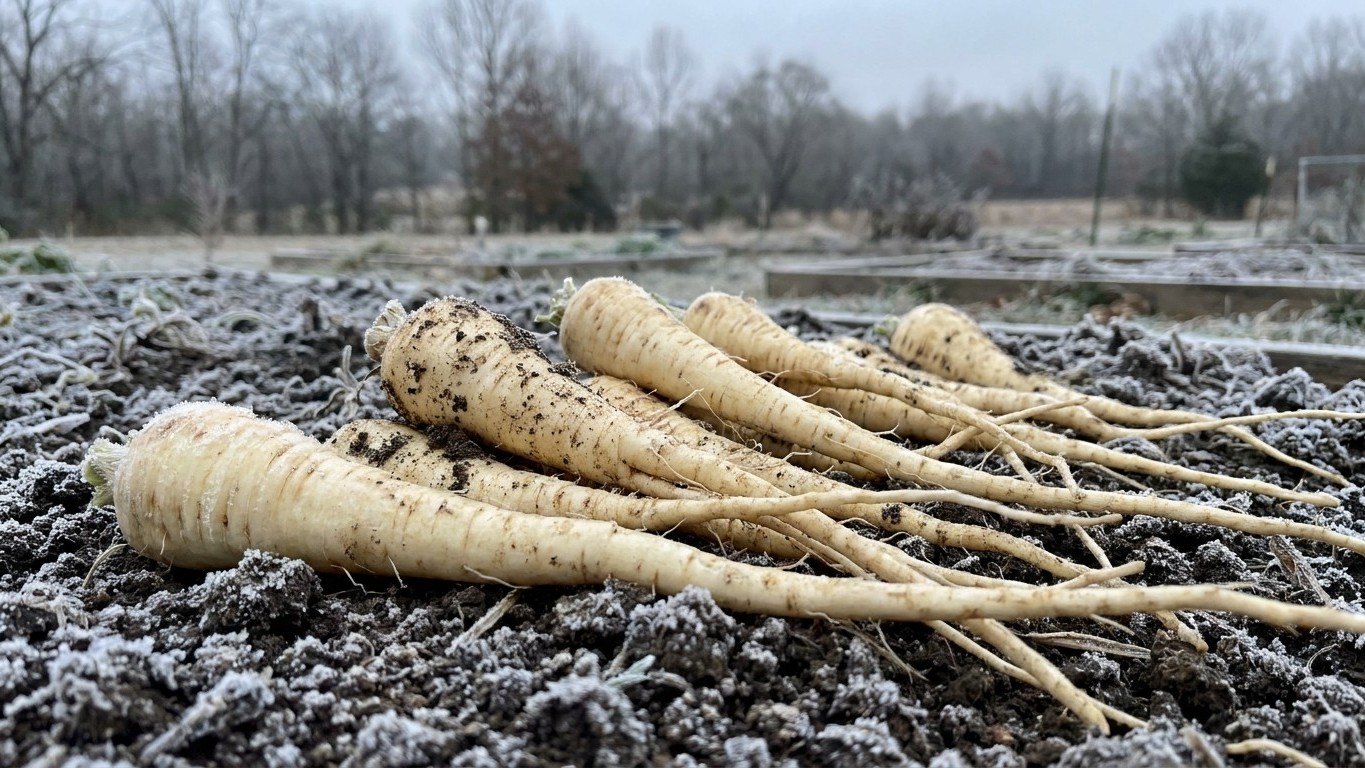

Indiana’s winters run cold enough, and its growing season stretches long enough, that parsnips sown directly in spring will not only reach full size but sweeten properly by the time they’re dug in late fall. The state isn’t a marginal case here. The specifics on timing, soil, and one real handling hazard follow below.
The short answer
Does Indiana hand a parsnip enough genuinely frosty weeks before it comes out of the ground? That’s the question that decides everything else here, because a parsnip doesn’t sweeten just because it survived winter. It sweetens because cold repeatedly hits the root and converts stored starch into sugar.
Indianapolis, the reference station for statewide climate normals, posts a mean minimum temperature of 20.9°F for its coldest month, according to NOAA NCEI’s 1991-2020 Climate Normals. That figure isn’t a record low pulled from one brutal night. It’s the average low across the entire coldest month, which means nights well below freezing are the routine, not the exception, across most of the state.
That kind of sustained, repeated cold is exactly what parsnips need. A single light frost barely nudges the starch-to-sugar conversion along. Weeks of it, night after night, do the job Utah State University Extension describes: cool, frosty weather turning a starchy, flat-tasting root into one with real sweetness. Indiana’s coldest-month average sits well within the range that delivers this, and it does so as a matter of course most winters, not as a lucky exception.
So the answer for growers here is straightforward: a parsnip left in the ground through Indiana’s cold season, dug after several hard frosts rather than before the first one, will sweeten. A mean minimum nearly 11 degrees below freezing is a different climate entirely from a place that dips to freezing on its worst nights and calls that winter. Where growers go wrong isn’t the state’s climate, it’s the calendar. Pulling parsnips before frost has had time to work, or harvesting everything in a warm October flush before the cold sets in, gives you a fine-looking, fully mature root that simply hasn’t converted yet. The plant did its job. The timing didn’t let it finish. Waiting for real cold, not rushing the harvest ahead of it, is what separates a sweet Indiana parsnip from a merely edible one.
Does the season fit?
Parsnips need 100 to 120 days from seeding, sown 2 to 3 weeks before the last frost, according to Utah State University Extension. Here’s how that arithmetic plays out against Indiana’s own frost calendar.
- Start with the last spring frost. Indianapolis’s 1991-2020 average, per NOAA NCEI, places it between April 9 and April 21.
- Move back 2 to 3 weeks from that date to find the sowing window: seed goes into the ground somewhere between roughly March 19 and April 7, depending on where in that frost range your county falls.
- Add germination time. Parsnip seed is slow, taking 14 to 21 days to show a row of seedlings, so resist the urge to re-sow if nothing’s up after the first week or ten days.
- Count 100 to 120 days from the sowing date itself, not from germination, to reach maturity. That lands the earliest roots around late June to mid-July, and the latest around late July to early August.
- Compare that maturity window against the first fall frost, which for Indianapolis runs October 21 to October 30 per the same NOAA NCEI normals. There’s a gap of roughly three months between a root that’s technically mature and the arrival of real cold.
- Use that gap on purpose. Rather than harvesting at the maturity mark, leave the roots in the ground through the gap and into the frosty weeks that follow first frost, since that stretch is what builds the sweetness.
Put together, Indiana’s season fits comfortably, with room to spare rather than a tight squeeze. Southern Indiana runs earlier in spring and later in fall than the Indianapolis reference by a fortnight or more, which only widens the window further south. Purdue notes roughly a 10% chance of a freeze event even after the published spring date, so anything set out on the early edge of the sowing window should have some kind of covering on hand.
What goes wrong here
- Forked roots in heavy or stony ground. Indiana’s clay-heavy soils, common across much of the state, split a taproot around any obstruction it hits. Utah State University Extension calls for deep sandy soil and says heavy soil must be double dug. If double digging isn’t practical, a raised bed filled with loose, stone-free soil at least a foot deep solves the same problem.
- Forked roots from overwatering. This is a separate cause from heavy soil, not the same problem in different words. Too much water encourages side roots to branch off in search of air pockets. Water consistently and moderately rather than soaking heavily on a schedule, and make sure the bed drains rather than holding standing moisture.
- A season that runs out. Indiana’s frost window leaves generous margin, but a late sowing, cold soil delaying germination past the usual 14 to 21 days, or a slow spring can still eat into that margin. Sow as early as the soil can be worked; parsnip seed tolerates cool ground and doesn’t need to wait for warmth the way tomatoes do.
- A winter too mild to sweeten. Indiana’s coldest-month average runs well below freezing most years, but any single winter can run milder than the average, or a grower can simply dig too early in a warm fall spell. The remedy is patience: wait for several nights of hard frost before harvesting, rather than pulling roots on the calendar alone.
Handling parsnips deserves its own caution, and it’s one most garden pages skip entirely. North Carolina Extension Gardener Plant Toolbox states it plainly: “All parts of this plant contain furocoumarins which can make skin sensitive to light causing burns so be sure to wear gloves, long sleeves and long pants when dealing with it.” That’s the root, the foliage, the stems, all of it, not just the leafy tops.
The mechanism is what makes this surprising. Furocoumarins on their own don’t burn skin. The burn needs sap on the skin plus sunlight hitting that same skin; one without the other does nothing. That’s why the injury shows up on a bright day of harvest or of pulling tops, why it often doesn’t appear until hours after the exposure, and why the meaningful protection is gloves, long sleeves, and long pants worn while handling the plant, not washing up afterward once the sap has already been on skin in the sun. Once that combination has happened, there’s no rinsing it back out.
Checking this against your own county
Every figure above traces back to Indianapolis as the reference station. Indiana stretches roughly 275 miles north to south, and a county near the Michigan line doesn’t share a frost calendar with one near the Ohio River. Southern counties see spring frost end earlier and fall frost arrive later than the Indianapolis dates by two weeks or more.
For county-specific frost dates, soil guidance, and any local notes on parsnip varieties that do well in your particular ground, contact your local office through Purdue Extension at extension.purdue.edu. They can pin down where your property actually sits relative to the statewide averages used here.
Common questions
Why does parsnip need to be sown directly instead of started indoors and transplanted?
Parsnip grows a single long taproot from the start, and disturbing that root during a transplant tends to cause forking or stunting. Sowing the seed where it will grow avoids the disturbance entirely.
Nothing has sprouted after a week. Should I re-sow?
Not yet. Parsnip seed germinates slowly, taking 14 to 21 days under normal conditions. Keep the bed consistently moist and give it the full window before assuming the seed failed.
What soil works best for parsnips in Indiana’s clay-heavy ground?
Utah State University Extension recommends deep sandy soil for straight roots, and says heavy soil must be double dug to loosen it enough for the taproot to grow down cleanly rather than forking around resistance.
Are parsnip greens or roots dangerous just to handle, even if I’m not eating them raw?
Yes, all parts of the plant carry furocoumarins that sensitize skin to sunlight, per NC State Extension. The risk applies to handling and harvesting, not just eating, so gloves, long sleeves, and long pants are the protection, worn while working with the plant rather than applied after the fact.