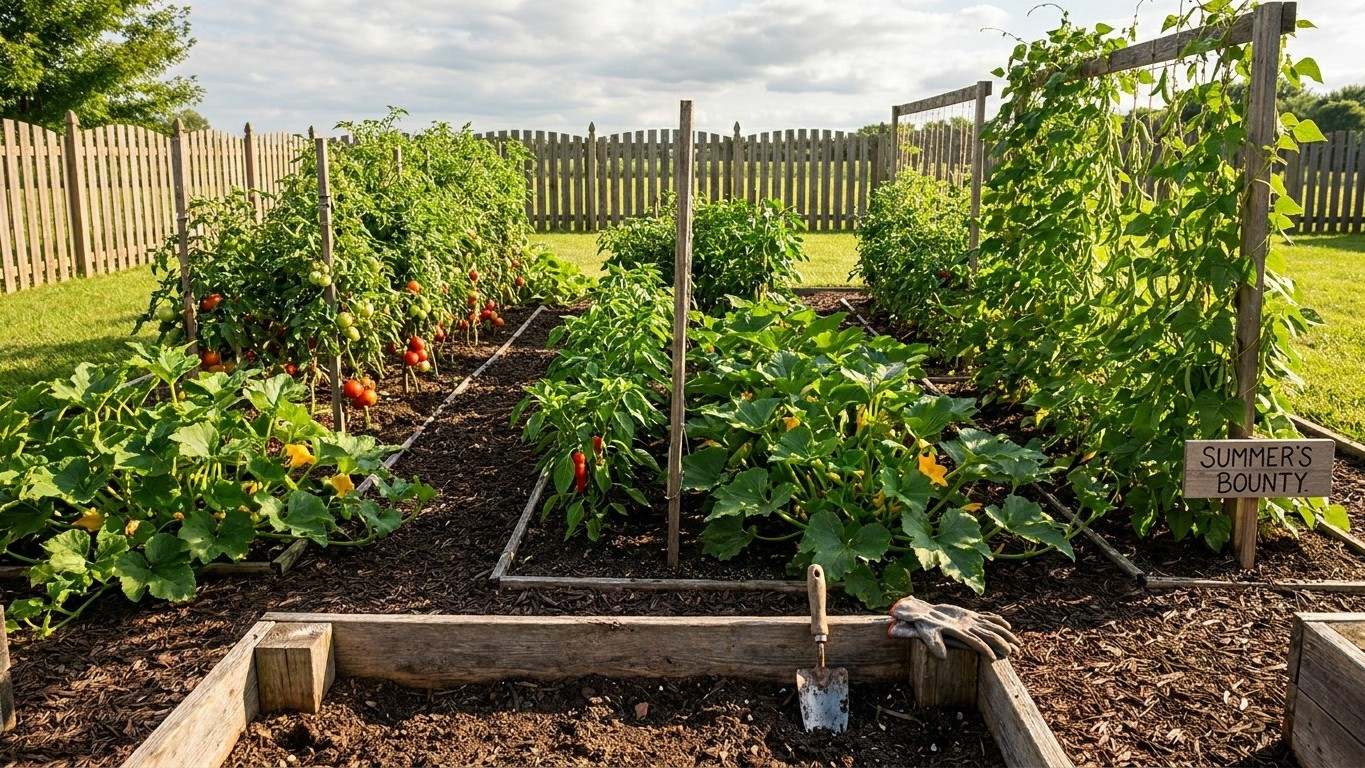

Indiana gardening runs on a frost-free window of roughly five months, bookended by an April thaw and an October freeze that arrive on their own schedule, not yours. The state’s USDA hardiness zone spans 5b to 7a, which tells you what survives winter but nothing about how long you actually have to grow. Here’s what the numbers allow, and what they quietly rule out.
How long your season really is

Start with the USDA Plant Hardiness Zone Map: Indiana sits across a 5b-7a range, a spread wide enough that a plant thriving in the southern counties can freeze out up in the north. That range comes from one variable only, the average annual extreme minimum temperature, so it tells you what perennials might survive winter, not what you can grow in a season.
For the growing window itself, the numbers that matter come from the Indianapolis reference station: an average last spring frost between April 9 and April 21, and an average first fall frost between October 21 and October 30. Subtract one from the other and you land on a frost-free season of about six months at the earliest read, closer to five if you take the later spring date and the earlier fall date as your planning range.
That’s the number that decides everything. A five-to-six-month window is enough for the staples: tomatoes, peppers, beans, squash, most of what fills a backyard plot — see Growing Peppers in Indiana for how to make the most of that window with one of the state’s most reliable crops, or Growing Potatoes in Indiana for a cool-season crop that fits comfortably within it, and it leaves plenty of room for a fast, forgiving root crop like the one covered in Growing Carrots in Indiana, another quick-turnaround root vegetable detailed in Growing Beets in Indiana, a summer favorite that fits neatly inside that same stretch as covered in Growing Sweet Corn in Indiana, or even a perennial that outlasts a single season entirely, as explained in Growing Asparagus in Indiana. It is not enough, or barely enough, for crops that need a long, uninterrupted stretch to size up properly — a root vegetable like the one covered in Growing Parsnips in Indiana falls squarely into that borderline category, needing nearly every week of frost-free time the season offers.pted stretch of warmth with no margin for error, things like certain long-season melons or crops that need 100-plus frost-free days just to reach maturity before you’ve even accounted for a slow start — a timing challenge covered in detail in Growing Pumpkins in Indiana. If a seed packet lists a days-to-maturity number that runs close to your full frost-free window, you’re not planting a sure thing. You’re planting a bet that the season runs long and the first frost runs late — the same frost timing that determines When to Carve a Pumpkin in Indiana if you’re growing them for fall display.
And here’s the part gardeners routinely misread: these are averages, not guarantees. Purdue Extension flags this directly, noting there’s still roughly a 10% chance of a 32F freeze event after the published spring frost date. Half of all years, by the basic math of an average, run colder or shorter than the number on the page. Treat the early edge of the spring window as a date to have row cover ready, not a date to plant tender crops with confidence. The frost date is a planning tool. It is not a promise the weather has agreed to keep.
What the summer does to a garden here
Indianapolis averages 14.6 days a year at 90F or above. That’s not a huge number on paper, but it’s the wrong way to read it: those are the days a garden actually feels stress, not the days that define the summer’s character. Heat load doesn’t average out gently across a season. It arrives in clusters, usually mid-July through August, and does specific, predictable damage when it hits.
Above roughly 90F, tomato plants stop setting fruit. The flowers drop, pollen goes sterile, and a plant can look lush and green while producing nothing for two or three weeks straight. Lettuce and other cool-season greens bolt, running to seed and turning bitter, in that same stretch. This isn’t a matter of watering more or shading better. It’s a temperature threshold that cool-season and heat-sensitive crops simply cannot work around.
The practical result is that Indiana gardens don’t run as one long uninterrupted growing arc. They run as two productive shoulders, a spring-into-early-summer stretch and a late-summer-into-fall stretch, with a dead middle where the heat days cluster and certain crops just idle or fail to set fruit. Gardeners who plant lettuce once in April and expect a second good harvest in July are usually disappointed. The move is a second sowing timed for that cooling shoulder in September, after the heat load breaks, rather than fighting the mid-summer stretch directly.
On the other end, the coldest month’s average daily minimum runs 20.9F at the reference station. That figure, not the record low and not a monthly average, is what determines whether a perennial planted here actually survives winter. It’s a useful gut-check against the hardiness zone map: a plant rated for zone 6 needs to tolerate lows colder than 20.9F on an ordinary night in the coldest month, not just survive a single unusual cold snap.
What tends to go wrong in Indiana
Purdue Extension’s home garden entomology guidance points to a specific short list of pests that actually show up in Indiana vegetable plots, and it’s worth naming them rather than treating every possible insect as equally likely. The Colorado potato beetle arrives early, feeding on potato and related foliage from spring onward, and Purdue notes something gardeners should know before reaching for a bottle: many populations in Indiana are already resistant to most homeowner insecticides, which changes how the problem needs to be managed rather than just sprayed.
Cucumber beetles, both striped and spotted, and squash bugs and squash vine borers show up together as the vine-crop trouble of the season, typically as plants start to flower and set fruit in early-to-mid summer. Squash vine borer damage is easy to misdiagnose: a healthy-looking squash plant wilts and dies seemingly overnight, and the cause is usually already inside the stem by the time symptoms show. Seedcorn maggot is an earlier-season problem, attacking seeds and seedlings right after planting in cool, wet soil, which is part of why a slow, cold spring can hurt germination beyond just the temperature itself.
Cabbage loopers chew ragged holes in cole crop leaves through summer, the Mexican bean beetle shows up on beans specifically in southern and central Indiana (Purdue notes it’s not a statewide pest), and the asparagus beetle and brown marmorated stink bug round out the list Purdue flags as the ones home gardeners actually encounter. None of this is a spray calendar, and it shouldn’t become one here. It’s a heads-up on what to watch for and when, so damage gets identified early instead of mistaken for something else. A county extension office can confirm what you’re looking at.
Where to check before you plant
Every figure above is a state-level average, built from a single reference station in Indianapolis. That’s useful as a baseline, but Indiana runs across several degrees of latitude and a hardiness zone range from 5b to 7a, which means a planting calendar built for the state capital can be off by two or three weeks at either edge of the state. Southern Indiana counties typically see an earlier last frost in spring and a later first frost in fall than the northern counties, sometimes by a fortnight or more.
Purdue University runs Indiana’s land-grant extension service, and it’s the right next stop before finalizing planting dates for your specific address, not just your state. Purdue Extension publishes county-level guidance, and each county has its own extension office that can speak to local soil, local frost timing, and pest pressure that a statewide average can’t capture. Start at extension.purdue.edu and look up your county’s office directly.
The numbers above tell you the shape of an Indiana growing year. Your county office tells you where, inside that shape, your own yard actually sits.
What to Plant Once You Know Your Season
Once you’ve got a handle on how Indiana’s freeze dates and summer heat actually break down, the next question is what to do with that information. Fall is the time to think about planting garlic, since the state’s cold reliably splits the bulb into a full head of cloves rather than leaving it stunted. If your yard itself needs attention, there’s a case for sticking with cool-season grass over warm-season turf, and the reasoning behind that recommendation, tied to how few days Indianapolis actually spends above 90°F, is laid out on the page about feeding and planting a lawn. And if tomatoes are on your list, don’t just copy the Indianapolis frost dates onto a calendar and call it done — the guide to tomato planting dates and pests explains why that April window shifts once you move south toward the Ohio River. Each of these pulls from the same climate data, applied to a different corner of the garden.