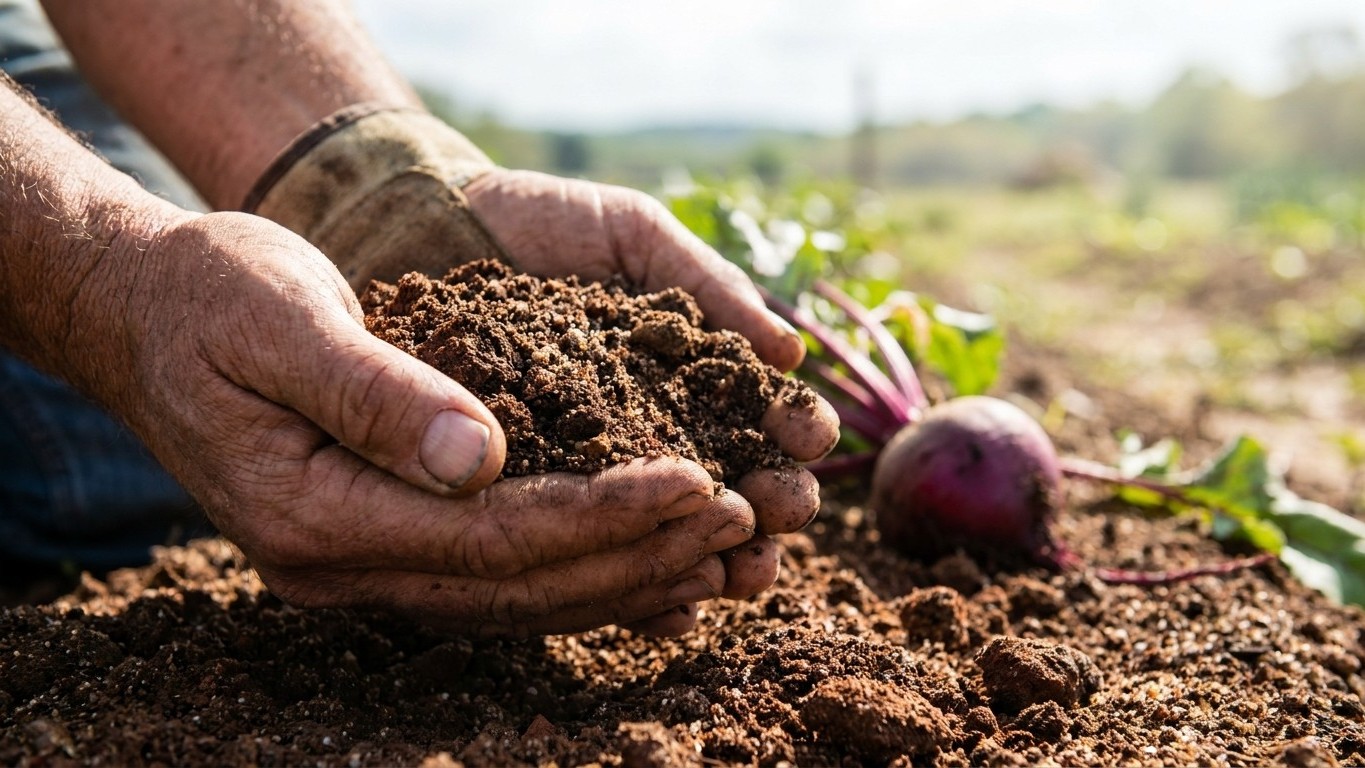

Mississippi’s official state ground is silty, only mildly acid and drains well, which sounds close to what a beet wants. But it carries almost none of the organic matter beets prefer and the state’s warm, swinging spring puts young roots at real risk of bolting before summer heat even shows up. The soil is a starting point, not a verdict on any one garden.
The short answer
Mississippi’s official state soil is the Natchez series, and it was named the state soil by Mississippi law in 2003 under the USDA NRCS State Soils programme. It’s an Inceptisol, meaning it’s geologically young and hasn’t built up the strong, distinct layers older soils have. The surface horizon runs about 5 percent sand, 13 percent clay and 82 percent silt, which puts it in loam-to-silt territory rather than the sandy loam beets actually favor. Surface pH sits around 6.2, slightly acid but close enough to neutral that most beet growers won’t need to adjust it much. Organic matter averages about 1.8 percent, which is thin. Drainage is classed as well drained, a genuine point in its favor.
For a beet, that combination is mixed news. Well-drained ground means roots won’t sit in standing water after a storm, which beets hate. But a soil that’s four-fifths silt and short on organic matter tends to compact and crust at the surface once it dries, which can choke seedlings before they ever push through. Utah State University Extension’s guidance is specific here: beets want soil that’s deep, sandy and well drained, and rich in organic matter, worked in at no more than 1 inch of composted material per 100 square feet. The Natchez profile clears the drainage bar and misses the sand and organic-matter bars, which tells a Mississippi gardener where the amending effort needs to go.
Mississippi spans hundreds of mapped soil series, and the ground in any one yard, whether it’s Delta bottomland, red clay hill country, or a subdivision lot built on fill dirt from a construction crew, can look nothing like the Natchez profile. Treat these figures as a description of what the region’s soil tends to do (hold moisture at the surface, run close to neutral, resist deep drainage problems) rather than a number to write on a seed packet. A soil test from a county extension office is the only way to know what’s actually under a specific bed.
On heat, published day-counts above 90 F for a specific Mississippi reference station aren’t part of the figures gathered for this page, so no number is offered here. What is documented is the beet’s own threshold: heat above 85 F combined with water stress makes the root turn woody. Mississippi’s growing season reliably clears 85 F for extended stretches from late spring into summer, which means the margin for error on watering narrows fast once the calendar turns warm.
The six weeks that decide it here
Beets are sown directly in the ground, never transplanted, and the standard guidance is to get seed in 2 to 3 weeks before the last spring frost. For the NOAA reference weather station used in these figures, the 1991-2020 Climate Normals put the last spring freeze somewhere between March 6 and March 22. That means direct sowing in much of the state lines up with mid-to-late February through early March, and the first six weeks of root growth, the window Utah State flags as the one where water stress does the most damage, lands squarely in Mississippi’s early spring.
That’s a season known for swinging rather than settling. Deep South spring weather moves in fronts: a stretch of cold, wet days followed by a run of warm, dry ones, sometimes within the same week. For a beet seedling with roots still shallow in silty ground, that pattern is exactly the setup Utah State warns about. A dry spell of a week or two, especially one riding on a warm front, can pull enough moisture out of that upper silt layer to trigger the water stress that causes beets to bolt, flower prematurely, and abandon root growth for good.
The risk here isn’t a single dry month. It’s the gap between rain events. Silty soil like the Natchez profile can look fine on the surface and still be dry an inch down, because silt doesn’t hold water the way a true loam or a well-amended sandy bed does once it’s crusted over. A gardener who sowed on schedule 2 to 3 weeks ahead of frost and then trusts a rainy forecast to carry the bed through six weeks is taking a real chance in a state where the same spring can flip from soggy to bone dry in under two weeks.
Home gardens outside city limits typically see their own last frost later than the reference station’s March 6 to March 22 window, sometimes by one to two weeks, and more at higher elevation. That pushes the sowing date later too, which shifts the entire six-week risk window further into a season that’s usually warmer and drier by the day. Checking a county-level frost date, rather than relying on the reference figures alone, changes when that six-week clock actually starts.
What goes wrong here
- Bolting from early water stress. A dry stretch in the first six weeks after sowing, common in Mississippi’s swinging spring pattern, pushes the plant to flower instead of building a root. The fix is even moisture through that window specifically, not just watering whenever it’s convenient; a rain gauge or simple soil probe check twice a week during the first six weeks catches the dry stretch before the plant reacts to it.
- Woody roots from later heat plus thirst. Once temperatures clear 85 F, any water stress on top of that heat toughens the root’s texture. This is a separate failure from bolting; it happens after the six-week window, once the crop is sizing up. Consistent watering through the hot stretch, rather than letting the bed dry out between waterings, keeps the texture from turning fibrous.
- Surface crusting from silt-heavy ground. The Natchez profile’s near-82-percent silt content means the surface can bake into a crust after it dries, which is exactly the texture beets don’t want since they need loose, sandy conditions to swell properly. Working in up to 1 inch of composted organic matter per 100 square feet loosens that surface without overdoing it.
- Thin organic matter limiting root development. At roughly 1.8 percent organic matter, the state soil offers little cushion for a root vegetable that wants richer ground. Building that up gradually, at the 1-inch-per-100-square-foot rate Utah State recommends, avoids overcorrecting into a bed that’s too loose to hold moisture at all.
- Assuming the state soil describes a specific yard. Because Mississippi holds hundreds of distinct soil series, a garden on river bottomland, clay hills, or disturbed fill dirt can behave nothing like the Natchez series. A soil test remains the only way to confirm actual texture, pH and drainage before planting.
Common questions
Does Mississippi’s state soil need lime for beets?
At a surface pH near 6.2, the Natchez series sits close enough to neutral that most beet plantings won’t need lime. That figure describes the mapped surface horizon of this series specifically, not any individual garden, so a soil test is still the way to confirm pH before amending.
How early can beets go in the ground in Mississippi?
The general rule is 2 to 3 weeks before the last spring frost. For the NOAA reference station’s 1991-2020 Climate Normals, that frost date falls between March 6 and March 22, though gardens outside city limits often see frost linger one to two weeks later, which pushes sowing back accordingly.
Why did my beets bolt instead of forming roots?
Premature flowering traces back to water stress in the first six weeks after sowing, the period Utah State University Extension identifies as decisive. In Mississippi’s swinging spring pattern, a dry stretch between rain events during that window is the most common trigger.
Why are my beet roots tough and woody?
That’s a different problem from bolting. Woodiness shows up when temperatures climb above 85 F while the plant is also short on water, typically later in the season than the bolting risk. Keeping the bed consistently moist once summer heat arrives is the remedy, separate from the early-season watering that prevents bolting.