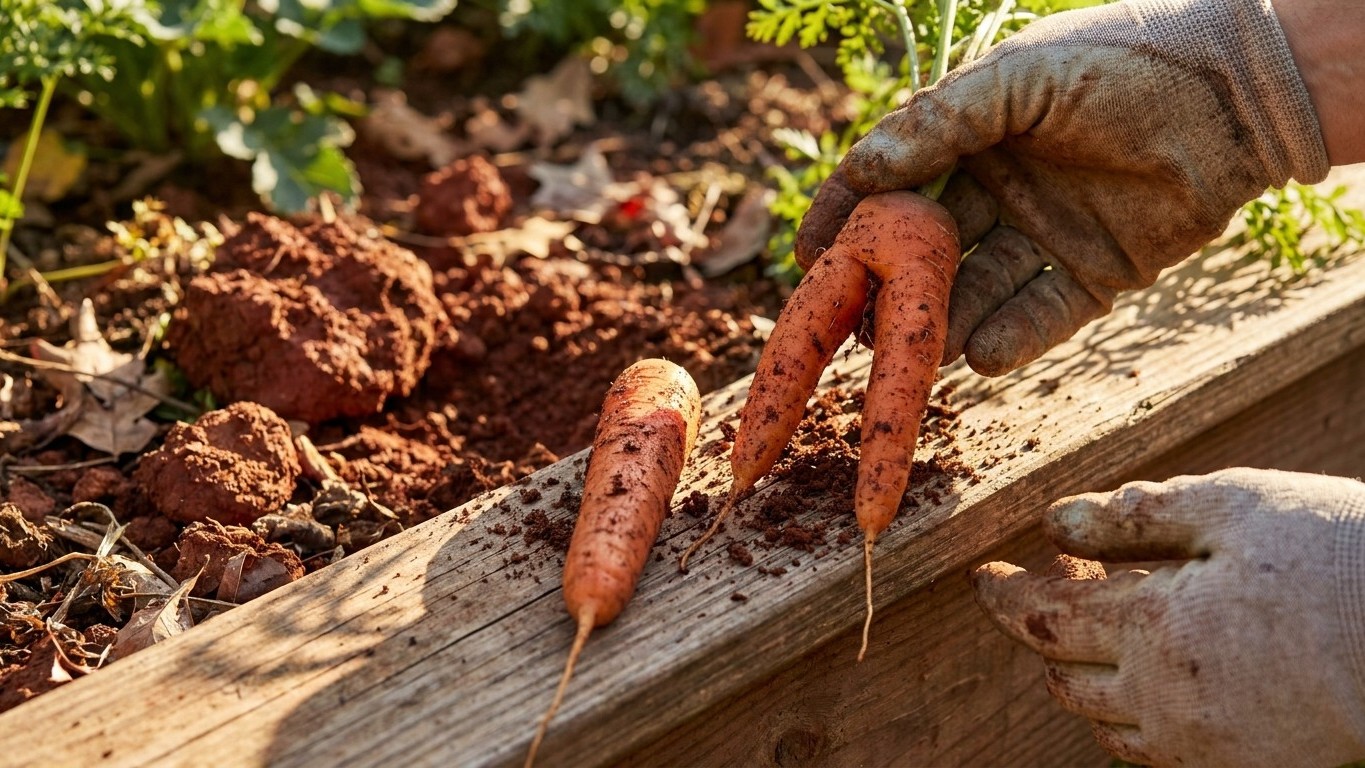

Missouri’s benchmark soil is a well-drained silt loam, not a heavy clay, so carrots have a decent shot at growing straight rather than forked. But that same soil is silty enough to crust after a hard rain, and a crusted surface can still twist a young root sideways just as effectively as clay does. Whether your carrots actually fork depends far more on the dirt in your own bed than on any statewide figure.
The short answer
The soil USDA lists as representative of Missouri is the Menfro series, an Alfisol, a forest soil of moderate natural fertility that holds onto nutrients reasonably well. In the surface horizon, the Menfro series runs about 4 percent sand, 19 percent clay, and 77 percent silt, with organic matter around 2.0 percent and a surface pH near 6.2, slightly on the acid side. It’s classified as well drained.
Run those numbers against what carrots actually need. Utah State University Extension is direct about it: carrots want deep, sandy, well-drained soil rich in organic matter, and heavy or rocky ground makes the root fork. At only 19 percent clay, Menfro doesn’t qualify as “heavy” in the clay-brick sense that traps roots and splits them outright. That’s the good news. The catch is the silt. A soil that’s 77 percent silt tends to seal itself into a crust once it dries after a rain, and a crust does two things to a carrot: it slows the taproot’s straight downward push, and it forces germinating seedlings to struggle through a hardened cap, sometimes emerging bent or twin-rooted before they’ve even gotten started.
So the plain answer for ground that resembles the state’s benchmark soil: forking is possible but not guaranteed, and it’s driven more by surface compaction than by dense clay underneath. The fix Utah State recommends for heavy or difficult ground applies here too, plenty of compost worked in and double digging to break up any compacted layer, loosening the soil to a full spade’s depth so the taproot never meets resistance. A raised bed filled with a looser, compost-heavy mix sidesteps the problem entirely, since you control the texture instead of inheriting whatever the native ground happens to be.
None of this is a diagnosis of your yard. Missouri spans hundreds of distinct soil series, river-bottom ground that’s mostly sand, hill country with rock close to the surface, and any lot a builder graded or filled with subsoil from somewhere else entirely. The Menfro figures describe a mapped, undisturbed surface horizon, not a dug and amended vegetable bed. Treat the state soil as a starting point for what the region’s ground tends to do, not a substitute for checking your own dirt.
The test that settles it in your own garden
- Dig a hole at least a foot deep where you plan to sow carrots, and look at what changes as you go down. If you hit rock, a hardpan layer, or dense clay well before that foot mark, the taproot will meet the same obstruction and is likely to fork or stop growing straight down.
- Check for stones and rubble in the soil you just removed. Even small buried stones near the surface can split a taproot into two forks as it grows around them, something no amount of pH adjustment will fix.
- Grab a handful of moist soil from a few inches down and squeeze it. If it forms a slick, sticky ribbon that holds its shape, you’re dealing with clay-heavy ground. If it falls apart into loose, gritty crumbs, it leans sandy. Something in between, holding together but crumbling with a little pressure, is closer to a loam.
- Watch what the surface does after the next rain. If it dries into a hard, cracked crust you can see and feel, that’s the sealing behavior typical of silt-heavy soil, and it’s worth breaking up before sowing rather than after seedlings are already fighting through it.
- Fill the same test hole with water and time how long it takes to drain. Water sitting for hours points to a drainage problem that compost and raised beds solve far more reliably than any amount of extra watering.
What goes wrong here
- Forking in compacted or crusted ground: even without heavy clay underneath, a sealed silt surface or a shallow compacted layer forces the taproot sideways or splits it. Work in compost and double dig the bed before sowing, loosening the soil well past where the root will grow.
- Poor germination during a hot spell: carrot seed is slow to sprout under the best conditions, and a dry, crusted silt surface baking in a stretch of hot weather makes it worse, since seedlings can’t push through a hardened cap. Keep the top inch of the seedbed consistently moist until seedlings are up, and break up any crust that forms with a light raking before it sets hard.
- Splitting from uneven watering: carrots that dry out and then get soaked, a common pattern between a dry week and a heavy rain, tend to split as the root expands unevenly. A layer of mulch and a steady watering routine, rather than letting rain alone dictate moisture, keeps growth even.
- Rocky pockets causing double roots: even a well-drained loam like Menfro can carry small stones near the surface in places it’s been disturbed. Sifting the top layer of a bed before sowing removes the obstacles a growing taproot would otherwise split around.
Common questions
Does a well-drained soil guarantee straight carrots?
No. Drainage class only describes how quickly water moves through the ground, not whether the surface will crust, whether there are stones near the surface, or whether the bed has been loosened deeply enough for a taproot to grow straight down.
Should I add sand to a silt-heavy bed to grow carrots?
The University Extension guidance points to compost and double digging as the fix for difficult ground, not to changing the base texture with added sand. Loosening the existing soil and enriching it with organic matter is the recommended approach.
How deep should I loosen the soil before sowing carrots?
Double digging means working the soil to roughly a full spade’s depth, breaking up any compacted or crusted layer so the taproot has no obstruction to grow around. The exact depth needed depends on how deep the compaction goes in your own bed, which the test hole will show.
Are carrots transplanted, or does the 70 to 100 day window start at sowing?
Carrots are sown directly in place; they aren’t transplanted. The 70 to 100 day maturity window is counted from the day the seed goes into the ground, not from any later transplant date.