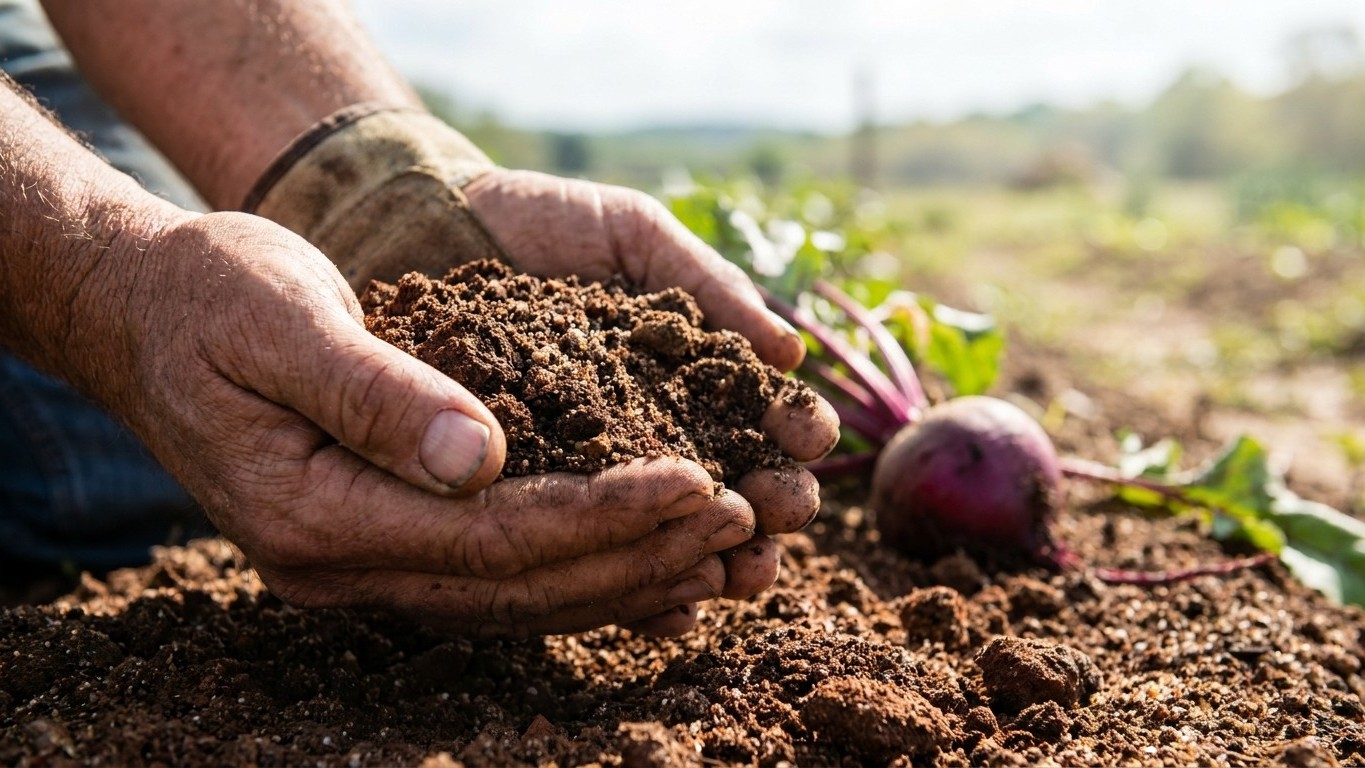

New Hampshire’s representative ground, the Marlow series, is a sandy, strongly acid soil built under conifer forest. It drains well and carries almost no clay, which suits a beet’s need for loose ground. The catch is the pH: a surface reading of 3.5 is far more sour than most vegetable roots tolerate, and it’s a signal to test before you plant, not a number to accept as your own.
The short answer
The Marlow series is what USDA NRCS lists as representative of New Hampshire, and it tells a specific story. The surface horizon runs 57 percent sand, 5 percent clay and 38 percent silt, classified well drained, with a surface pH around 3.5, which is strongly acid. That texture, sand-dominant with almost no clay, is close to what a beet wants: loose enough for a round root to push down without fighting compacted ground, and drained enough that water moves through rather than sitting and rotting the crown.
The organic matter figure recorded for this series, about 85 percent, needs a caution attached. A reading that high on a surface horizon means the mapped ground is a natural forest litter or peat layer, the kind you’d find under standing timber, not a worked garden bed. No cultivated plot carries organic matter anywhere near that level, so don’t treat it as a target or a comparison point for your own soil test results. It’s a description of undisturbed forest floor, useful for understanding the parent material, not for planning an amendment.
The pH is the number that actually changes how you garden. At 3.5, this soil sits well outside the range where most root vegetables thrive, and a beet grown in ground that acid, unamended, tends to come up stunted and pale regardless of how well the texture suits it. This is exactly why a soil test matters more than a state-level reference: your yard may have been limed for decades, built on fill, or sit on a completely different series a mile from where the county line was drawn.
On heat, the published record used for this page doesn’t carry a count of days New Hampshire’s reference city spends above 90 F, so that figure isn’t stated here. What the Utah State University Extension guidance does establish is a threshold that matters regardless of the exact day count: heat above 85 F combined with water stress is what turns a beet root woody. New Hampshire summers run cooler than most of the country, which works in a gardener’s favor, but a dry stretch in July can still push a stressed root past that 85 F line on its worst afternoons.
Keep in mind that a state spans hundreds of soil series. The Marlow series is a starting point for understanding what New Hampshire ground tends to do, not a description of the dirt under your own raised bed.
The six weeks that decide it here
Beets are sown directly in the ground, never transplanted, and the standard advice is to get seed in 2 to 3 weeks ahead of the last frost. For the reference city, NOAA NCEI’s 1991-2020 climate normals put that last spring freeze between April 16 and April 27, based on the airport weather station’s 32 F freeze probabilities. That puts a typical sowing window somewhere in late March to mid-April, with the first six weeks of root development landing squarely in the state’s variable early spring.
That window matters because the first six weeks after sowing is when a beet is most vulnerable to bolting, and bolting is triggered by water stress, not heat. New Hampshire spring doesn’t run one predictable way. Mud season can leave ground saturated well into April, then a dry, windy stretch in May can pull moisture out of sandy topsoil fast, especially in ground built on the Marlow series’ sand-heavy surface. The risk in this state isn’t a long, punishing dry spell like you’d see further south and west. It’s the swing: wet ground that suddenly dries once the sun gets stronger, catching a gardener who assumed spring rain would carry the crop through.
Sandy, well-drained ground drains fast in both directions. It won’t hold standing water long after a storm, which is good for a beet’s crown, but it also won’t hold moisture through a dry week the way a heavier clay soil would. That means the six-week window after sowing is exactly when a New Hampshire gardener needs to check soil moisture by hand rather than assume rain is doing the job, particularly if April turns dry after a wet March.
One more caution on the frost date itself: it comes from an airport weather station, and suburban and rural gardens routinely see their last frost later, often by one to two weeks, and more at elevation. A garden in the Lakes Region or up toward the White Mountains foothills should expect that April 16 to April 27 window to run later, which pushes the whole six-week bolting-risk period later into the season as well. Check your own county’s frost history before setting a sowing date from a single city’s record.
What goes wrong here
- Sour soil stunts the root before it starts. A surface pH near 3.5, as recorded for the Marlow series, is far more acid than most root crops tolerate. Test your own bed rather than assume the state figure applies, and follow the lime recommendation your test result gives you rather than guessing at an amount.
- Sandy ground dries out fast during the six-week bolting window. The same drainage that keeps a beet’s crown from rotting also lets moisture disappear quickly once a dry stretch hits. Check soil moisture by hand through the first six weeks after sowing rather than relying on rainfall, and water consistently rather than in occasional heavy soakings.
- A hot, dry stretch later in the season turns roots woody. This is a separate failure from bolting: it happens after the root has set, when heat above 85 F combines with water stress. Keep watering consistent through any hot spell in July or August, even though New Hampshire’s overall summer heat load runs lower than most of the country.
- Over-amending sandy ground backfires. Utah State University Extension’s guidance caps composted organic matter at 1 inch per 100 square feet. Piling on more than that in an attempt to fix poor, acidic ground doesn’t solve the pH problem and can leave roots misshapen. Address acidity through a tested lime application, not through extra compost.
- Trusting a single reference city’s frost date for a rural or elevated garden. The April 16 to April 27 window comes from an airport station. A garden further from that station, especially at higher elevation, should plan for a later last frost and adjust the sowing date, and the whole six-week risk window, accordingly.
Common questions
Is the Marlow series actually the soil in my New Hampshire garden?
Probably not exactly. It’s the series USDA NRCS lists as representative of the state as a whole, drawn from measurements across 215 mapped components. Your own yard, especially if it sits in a river bottom, on fill, or in a different part of the state entirely, can differ completely in texture, drainage and pH. Use a soil test to get your own numbers.
When should I sow beets in New Hampshire?
The general rule is 2 to 3 weeks before the last frost. For the reference city used in NOAA NCEI’s climate normals, that last frost falls between April 16 and April 27. Rural and suburban gardens, and anything at elevation, typically see a later last frost, so adjust your date based on your own county’s frost history rather than this single station’s record.
How do I fix acidic soil for beets?
Start with a soil test rather than adding lime blind. A surface pH around 3.5, which is what’s recorded for New Hampshire’s representative soil series, is strongly acid, and the correction depends on your specific test result, not a standard amount. Follow whatever lime recommendation your test report gives.
How many days does a beet take from sowing to harvest?
Beets are direct sown, never transplanted, and the days-to-harvest count runs from the seed going into the ground. Utah State University Extension’s guidance places typical growth from seeding through harvest at 60 to 80 days, though that range depends heavily on the six-week establishment window staying free of the water stress that triggers early bolting.