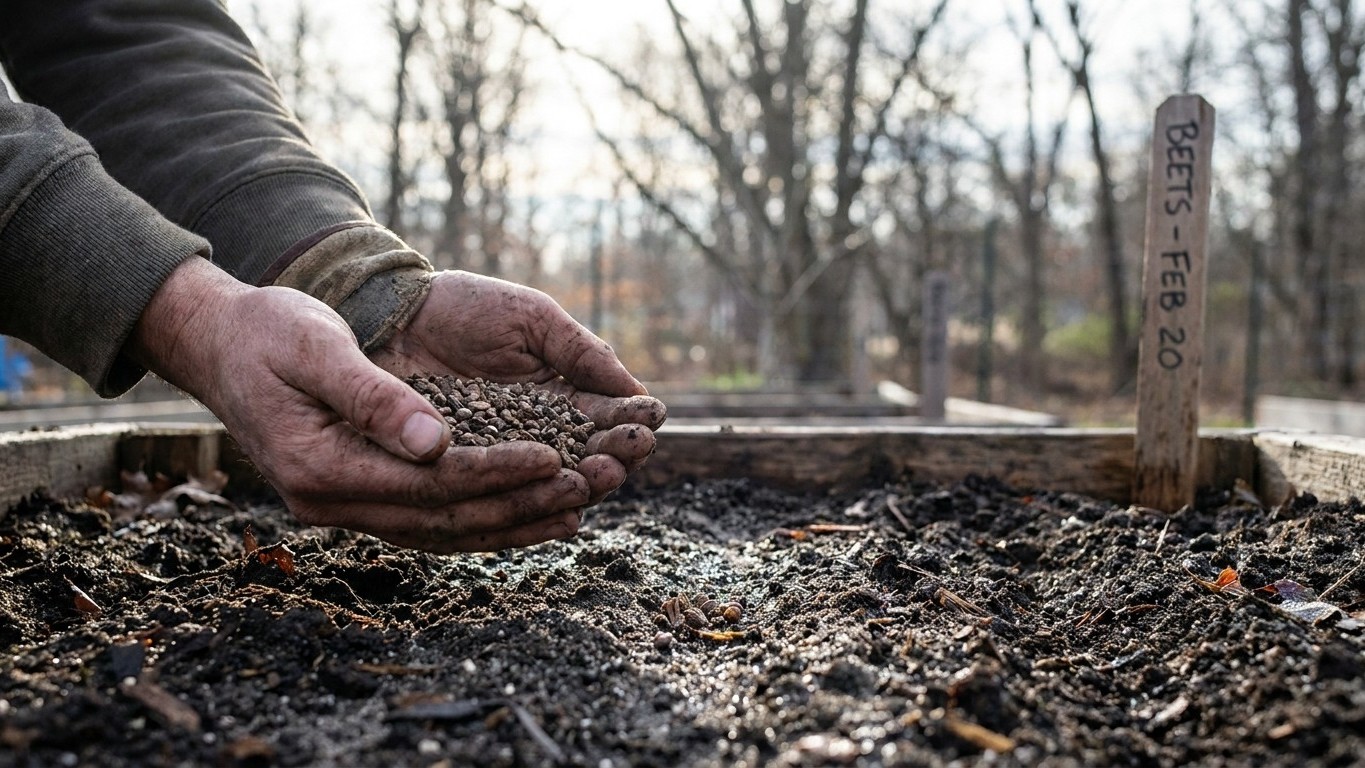

Direct-seed beets in New Hampshire two to three weeks before the last spring frost. Since the reference weather station’s last spring freeze falls between April 16 and April 27, that puts the sowing window at roughly late March through the first half of April, straight into garden soil, no transplanting. The exact week still depends on how wet and cold your own ground runs that spring.
The short answer
New Hampshire’s representative soil, the Marlow series, is a Spodosol, the kind of sandy, acid, strongly leached ground that typically forms under conifer stands. The surface horizon runs 57 percent sand, 38 percent silt, and just 5 percent clay, with a surface pH around 3.5, strongly acid, and it drains well. That texture is actually good news for beets: Utah State University Extension notes that beets want deep, sandy, well-drained soil rich in organic matter, and the Marlow series’ sand-heavy profile fits that description closely. Drainage isn’t the fight here.
The pH is. A surface reading of 3.5 is well below what most root vegetables tolerate, and beets are no exception. Whatever this series measures as organic matter on paper, a figure near the high end of what’s typically recorded for a natural forest floor, that number describes an undisturbed woodland surface layer, not a dug and amended vegetable bed. If your garden shows dark, fibrous surface soil like that, you’re looking at duff or peat, not finished compost, and it behaves differently once it’s tilled and exposed to air.
On heat, the published record here doesn’t give a count of days above 90 degrees for the reference station, so that figure isn’t available on this page. What Utah State does specify is a threshold worth planning around anyway: temperatures above 85 F combined with water stress push beet roots toward woodiness. That’s a lower bar than 90, and it’s the one to watch through a New Hampshire summer, particularly during a dry stretch in July or August when a bed hasn’t been watered in a week.
None of this is a verdict on your particular plot. New Hampshire spans hundreds of mapped soil series, from river-bottom silt to ledge-close hill soils to whatever a contractor backfilled around a newer house. The Marlow series is simply what USDA lists as representative of the state as a whole. Treat it as a reasonable starting assumption, sandy, quick-draining, acid, and then confirm your own numbers with a soil test before you decide how much lime or organic matter your bed actually needs.
The six weeks that decide it here
Sowing two to three weeks ahead of the April 16-27 last-frost window lands the first six weeks of a beet’s life somewhere between late March and the middle of May. That stretch is when a beet seedling either establishes a strong taproot or gets pushed into premature flowering, and Utah State is specific about the trigger: water stress during those first six weeks is what causes bolting, not heat, not day length on its own, but a lack of consistent moisture at the root zone while the plant is still small.
Late March into May in New Hampshire is not a settled season. It’s the tail end of mud season in much of the state, when snowmelt and spring rain can leave beds saturated one week and then, as soils warm and drain, dry out fast the next, especially in the sandy, well-drained texture the state’s representative soil carries. That swing matters more than either extreme on its own. A bed that goes from waterlogged to bone-dry in the space of ten days is exactly the kind of instability that stresses a young beet root, and the sandy Marlow-type profile drains fast enough that a gardener can be caught off guard by how quickly a wet bed turns thirsty once a sunny stretch arrives.
The practical takeaway isn’t to water on a fixed schedule and call it done. It’s to check the bed through that six-week window rather than assuming spring rain will handle it, particularly once the soil has drained and the calendar moves toward the back half of that stretch. A beet that bolts doesn’t recover into a usable root that season; the plant redirects its energy into a flower stalk instead of the taproot you planted it for, and there’s no watering your way back from that once it’s started.
Remember too that this is the reference station’s frost window, not a statewide guarantee. Suburban and rural gardens, especially at elevation or away from the coast, commonly see a later last frost than an airport station records, sometimes by a week or two. If your garden sits in a frost pocket or up in hill country, push your sowing date later than the April 16-27 range would suggest and watch your own soil temperature rather than the calendar alone.
What goes wrong here
- Seeds struggle to germinate in acid soil. A surface pH near 3.5 is far more acidic than beets tolerate well. Run a soil test before sowing and lime according to the results rather than guessing; beets are more pH-sensitive than many root crops, and germination is where that sensitivity shows up first.
- Gardeners over-amend based on the mapped organic-matter figure. If your bed’s surface looks like the high-organic-matter reading the state soil carries, that’s likely a natural duff layer, not finished compost, and it won’t behave the same once cultivated. Utah State’s guidance caps additions at 1 inch of composted organic matter per 100 square feet; more than that in a sandy bed can throw off structure rather than help it.
- Beets bolt from thirst during mud-season swings. A bed that dries out fast after snowmelt drains, right in the first six weeks after sowing, is the classic bolting setup here. Check soil moisture by hand through that window rather than trusting spring rain to be enough, especially once the ground has drained and a dry, sunny stretch sets in.
- Roots turn woody in a dry, hot stretch later in summer. This is a separate failure from bolting: it happens once the plant is established and temperatures push past 85 F while the bed goes dry. Mulch to hold moisture and water deeply during hot spells rather than lightly and often.
- Fast drainage means water needs come more often than expected. The sandy, well-drained texture that’s good for avoiding rot also means the bed won’t hold moisture long between waterings. Plan on checking a sandy New Hampshire bed more frequently than you would a heavier clay soil, particularly during any stretch without rain.
Common questions
Can I sow beets directly, or do they need to start indoors?
Beets are sown in place. The commonly cited 60 to 80 days to maturity run from the seeding date in the garden bed, not from a transplant, so there’s no head start to gain by starting them indoors and moving them out later.
Does the last-frost date apply to my whole town, or just the airport?
The April 16-27 window comes from a specific reference weather station, and it’s a starting point rather than a town-wide guarantee. Gardens away from that station, especially in low spots, at elevation, or inland from any moderating water, often see their last frost run later, sometimes by a week or two. Check your own county’s typical pattern before locking in a sowing date.
What variety of beet should I plant in this soil?
Utah State University Extension’s guidance names several beet varieties suited to home garden production but doesn’t attach specific season length, color, or use differences to any one of them in that source. Variety choice is worth discussing with a local nursery or extension office familiar with what performs well in your specific soil and microclimate.
If my soil tests more alkaline than the state average, does the timing advice change?
The sowing window itself, tied to the last frost date, doesn’t shift based on pH. What changes is how much prep your bed needs beforehand: a less acidic soil than the state’s representative 3.5 reading may need little to no lime, while soil closer to or below that reading likely needs amendment ahead of sowing to give beet seeds a fair shot at germinating.