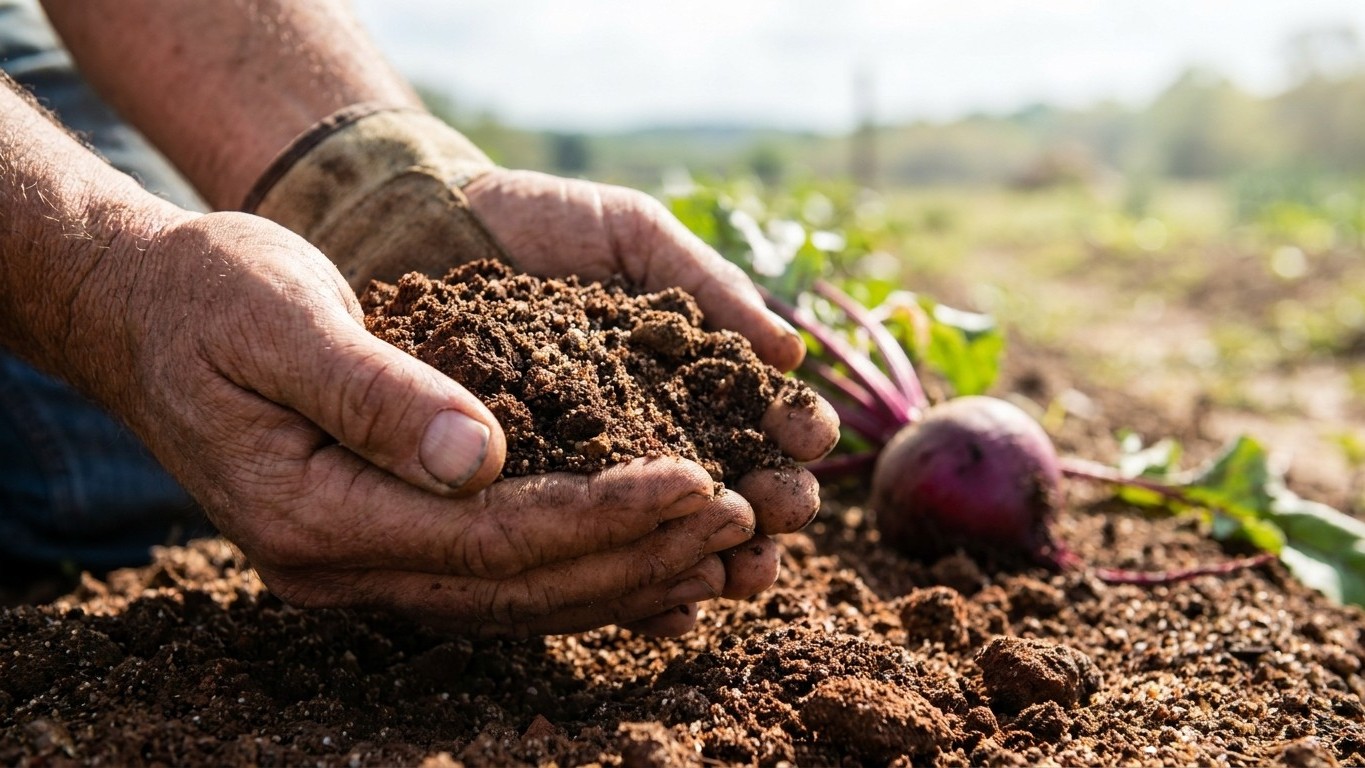

New Jersey’s benchmark soil, the Downer series, is 79 percent sand and drains fast, which is close to what a beet root wants structurally. The catch is what that soil doesn’t have: organic matter sits around 1.2 percent, and the surface runs slightly acid at pH 6.3. Add a spring that can swing dry without warning, and the two failures that follow, bolting and woodiness, come from different mechanics entirely.
The short answer
USDA’s Soil Data Access lists the Downer series as representative of New Jersey. It’s an Ultisol, an old, heavily weathered soil type that’s been leached of nutrients over a long time. The surface horizon runs 79 percent sand, 6 percent clay, and 15 percent silt, with organic matter around 1.2 percent and a pH near 6.3. It’s classified well drained.
For a beet, that texture is mostly good news. Utah State University Extension describes beets wanting deep, sandy, well-drained soil, and a soil that’s four-fifths sand with almost no clay to seal it up checks that box without much argument. Water moves through it, roots push down without hitting a compacted layer, and there’s no standing moisture to rot a taproot.
The organic matter number is where the Downer series falls short of what a beet bed wants. At roughly 1.2 percent, this soil has less to feed on and less capacity to hold water between rains than a garden bed built up over seasons. Utah State’s guidance caps amendment at one inch of composted organic matter per 100 square feet, worked in before sowing, which is the ceiling to aim for rather than a floor to exceed. Overdoing it doesn’t fix sand’s core problem, which is that it drains before a beet’s shallow early roots can pull much from it.
The heat side of the equation matters too. Utah State’s research ties root woodiness to heat above 85 F combined with water stress, not to heat alone. No count of days per year that a specific New Jersey city crosses 90 F is published in the sources behind this page, so that number isn’t stated here. What can be said is that Downer soil’s fast drainage means a hot stretch late in the root’s development finds less reserve moisture in the ground to buffer it, which raises the odds that heat and thirst hit at the same time.
None of this describes a single garden. New Jersey spans hundreds of mapped soil series, and the Downer series is simply the one USDA’s State Soils program lists as representative of the state as a whole. A yard near a river, a lot with imported fill, or ground carved out of woodland can differ completely from what’s described above. A soil test of the actual bed is the only way to know its real pH, texture, and organic matter, and it’s worth doing before amending anything.
The six weeks that decide it here
Beet seed goes into the ground directly, never as a transplant, and the standard advice is to sow it two to three weeks ahead of the last spring frost. For the reference weather station NOAA uses in its New Jersey climate normals, that last freeze falls between March 29 and April 6. Sowing on that schedule lands the first six weeks of a beet’s life, the window Utah State identifies as the period when water stress triggers premature bolting, squarely in early-to-mid spring in this region.
That’s the stretch that decides whether a New Jersey beet crop bolts before it roots out. Early spring here is known for swinging conditions: a wet week followed by a dry, windy one isn’t unusual, and a sandy, fast-draining soil like the Downer series doesn’t hold much reserve moisture to smooth over the gaps. A beet doesn’t need drought to bolt. It needs a stretch of days where the topsoil dries out while the seedling is still building its root, and sandy soil dries out faster than loam or clay every time.
This is a different failure than the heat-driven woodiness described above, and the two shouldn’t be treated as the same problem solved by the same fix. Bolting is a response to stress signaling the plant to skip straight to seed production, and it happens early, in that first six-week window, when the plant is small and vulnerable to a dry spell. Woodiness happens later, closer to harvest, when a root that’s already sizing up gets hit by heat above 85 F on top of dry soil. A bed can avoid one problem and still run into the other.
Frost timing itself carries a caveat worth repeating. The March 29 to April 6 window comes from a single weather station, and suburban and rural gardens across the state typically see their last frost land later, sometimes by one to two weeks, more at higher elevation. A gardener sowing by that reference date without checking their own county’s typical last frost risks planting into a frost that hasn’t actually passed yet.
What goes wrong here
- Bolting after a dry snap in the first six weeks. Sandy Downer-type soil sheds water fast, and a beet seedling under moisture stress in its first six weeks tends to bolt rather than build a root. Keep the seedbed evenly moist through that window with light, frequent watering rather than deep soaks spaced far apart, since sandy soil can’t bank a big watering the way clay can.
- Woody roots from a hot, dry finish. Utah State ties woodiness to heat above 85 F arriving alongside water stress, which tends to show up in the weeks before harvest rather than right after sowing. A layer of mulch over the row holds soil moisture through a hot spell and keeps the root from toughening up before it’s pulled.
- Weak growth from low organic matter. At around 1.2 percent organic matter, Downer-type soil doesn’t have much reserve fertility or water-holding capacity to begin with. Work in up to one inch of composted organic matter per 100 square feet before sowing, per Utah State’s guidance, rather than adding more later once roots are already forming.
- Nutrients washing through before the root can use them. Sand at 79 percent doesn’t hold nutrients in place the way finer-textured soil does, so a single fertilizer application early on can leach past the root zone before the beet needs it. Splitting feeding into smaller applications across the season keeps more of it available when the root is actually sizing up.
- Guessing at pH instead of testing it. The Downer series runs slightly acid at 6.3, but that number describes the mapped state soil, not any individual garden bed. A soil test of the actual planting area is the only way to know whether a bed needs lime or any other adjustment before beets go in.
Common questions
Is sandy soil actually good for beets, or does it just drain fast?
Both, in this case. Utah State University Extension lists deep, sandy, well-drained soil as what beets want, so the texture of a soil like the Downer series works in a beet’s favor. The tradeoff is that the same sand that lets roots push down easily also drains moisture quickly, which raises the stakes on watering consistently through the first six weeks.
How many days does it take a beet to mature from seeding in New Jersey?
That count runs from the day seed goes into the ground, since beets are sown directly and never started as transplants. Neither the Downer soil data nor the frost-date source behind this page publishes a New Jersey-specific maturity range, so gardeners should check seed packet guidance for the variety planted and count from the sowing date, not from any later thinning or transplant step.
Does the March frost date apply to every part of the state?
No. That March 29 to April 6 window comes from NOAA’s climate normals for a single reference weather station, and it’s a starting point rather than a guarantee. Suburban and rural areas across New Jersey commonly see their last frost land one to two weeks later than that station’s figure, with elevation pushing it later still, so checking local frost history is worth the extra step.
Should I test my own soil instead of trusting the state’s representative soil data?
Yes. The Downer series is what USDA lists as representative of New Jersey as a whole, drawn from measurements across 133 mapped components, not a reading of any specific yard. A state holds hundreds of distinct soil series, and a bed near a river, on fill, or on cleared woodland can differ entirely from the figures above. A direct soil test remains the only way to know an actual garden’s pH, texture, and organic matter.