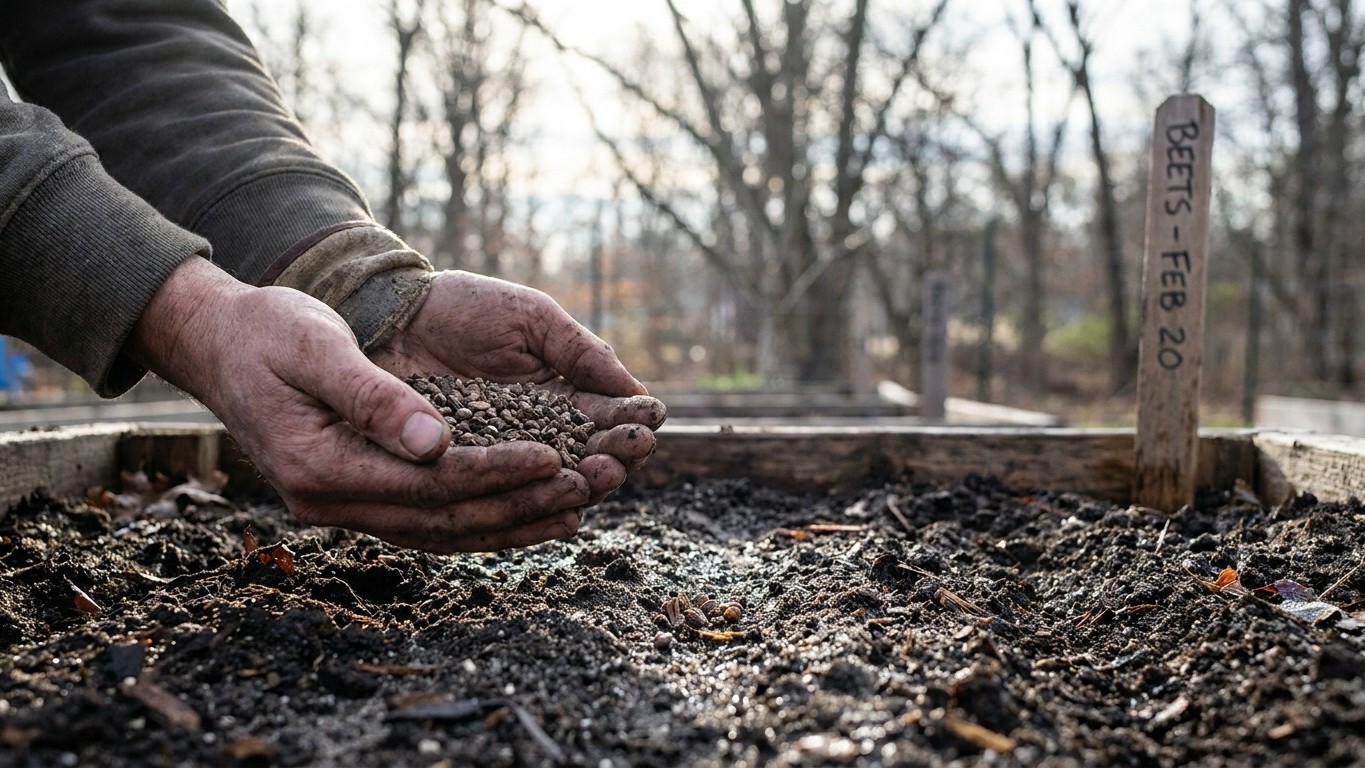

In most of New York, the safe window to sow beet seed runs from roughly early March to mid-April downstate, sliding into late April or May farther north and at higher elevation. That timing comes straight from the last spring frost date and a soil type that drains well but dries out fast on top, which changes how much room for error you actually have once seed hits the ground.
The short answer
New York’s representative soil, the one the USDA lists as the state’s benchmark, is the Honeoye series: an Alfisol, which is a forest soil of moderate natural fertility that holds onto nutrients reasonably well. The surface horizon runs 26 percent sand, 19 percent clay and 55 percent silt, a silt loam texture, with organic matter around 3.0 percent and a surface pH near 6.3, just on the acid side of neutral. It’s classed well drained, which for a beet is mostly good news: roots don’t like sitting in standing water, and a silt loam that drains freely lets a taproot push down without hitting a waterlogged wall.
The catch is that same drainage cuts both ways. A well-drained silt loam sheds water quickly after rain, which means the top few inches, exactly where a newly germinated beet seedling is trying to root, can dry out faster than the gardener expects. Utah State University Extension’s guidance on beets is blunt about what that dryness does: beets want deep, sandy, well-drained soil rich in organic matter, and water stress in the first six weeks causes premature flowering, what gardeners call bolting. Honeoye’s moderate organic matter (about 3.0 percent) is a reasonable starting point, but it’s not rich, and the extension guidance caps additions at no more than 1 inch of composted organic matter per 100 square feet worked into that bed, not a heavier dose.
On heat, the same source draws a separate line: temperatures above 85 F combined with water stress push a beet root toward woodiness later in the season. That’s a different failure from bolting, tied to the growing months rather than the first six weeks, and it matters more the farther the crop pushes into a hot stretch. A specific count of how many days New York’s reference city spends above 90 F a year isn’t published in the sources behind this page, so it won’t be guessed at here, but the 85 F threshold from the extension guidance is the number to watch regardless of the exact day count.
None of this describes any one backyard. New York spans hundreds of mapped soil series, from sandy Long Island outwash to heavy Hudson Valley clay to thin, stony hill soils upstate. Honeoye is the state’s representative series, a useful sketch of what the ground tends to do, not a stand-in for a soil test on an actual garden bed.
The six weeks that decide it here
Sowing beets 2 to 3 weeks ahead of the last spring frost is the standard rule, and in New York City that frost date falls between March 23 and April 3, based on 1991-2020 climate normals from NOAA’s National Centers for Environmental Information. That puts a downstate sowing date somewhere around early to mid March, with the first six weeks of root development landing squarely in New York’s early spring, a season that tends to swing rather than settle. Cold snaps can follow a warm stretch within days, and a dry week can sit right on top of a soaked one, especially as snowmelt drains out of silt loam ground that, per the Honeoye numbers, is built to shed water rather than hold it.
That swing is exactly what puts bolting risk in play. The extension guidance is specific: it’s water stress in those first six weeks, not cold alone, that pushes a beet toward flowering instead of root growth. A well-drained silt loam like Honeoye doesn’t stay wet long after a rain, so a gardener who sows early and then hits a dry, windy stretch in late March or April, common enough in a New York spring, can lose soil moisture at the surface exactly when the seedling’s shallow roots depend on it most. The risk isn’t the frost itself; it’s the dry gap that can follow a wet snowmelt period once the soil starts to drain.
Upstate and in the Adirondacks, the calendar shifts later. The NOAA normals cited here are specific to the New York City site; the same source flags that this is a dense urban station, and colder regions of the state freeze later in spring and earlier in fall. No comparable date is offered here for those regions, so upstate growers should treat the March 23-April 3 window as a downstate reference point and expect their own six-week window to open later, likely into April or May, based on local frost history rather than a single statewide figure.
What goes wrong here
- Bolting after a dry spring stretch. A well-drained silt loam like Honeoye loses surface moisture quickly once a dry snap follows spring rain, and that’s precisely the window when a young beet is most sensitive to water stress. Water regularly through the first six weeks after sowing rather than relying on rainfall alone, and don’t let the top few inches go bone-dry between waterings.
- Woody roots from a hot, dry summer stretch. This is a separate problem from bolting: once temperatures climb past 85 F, added water stress toughens the root. Keep watering consistent as the season warms, especially if a hot week arrives with no rain behind it, and don’t assume spring watering habits are enough once summer heat sets in.
- Crusting on a silt-heavy surface. At 55 percent silt, Honeoye-type ground can crust after a hard rain, which makes it tougher for small beet seedlings to push through. A light mulch or a shallow scratch of the surface after a heavy rain, before seedlings emerge, keeps the crust from sealing the row.
- Overworking organic matter into the bed. Adding heavy compost past the extension’s 1-inch-per-100-square-foot guidance can overload a soil that already carries about 3.0 percent organic matter in its natural state, throwing off the balance beets actually need rather than helping.
- Assuming the state soil is the garden’s soil. Honeoye is well drained and slightly acid at pH 6.3, but a low spot, a filled lot or a river-bottom garden nearby can behave completely differently, holding water long after a rain or running considerably more acidic or alkaline. A soil test on the actual bed remains the only way to know which failure above is the real risk in that specific yard.
Common questions
How many weeks before the last frost should beets go in the ground in New York?
The general rule is 2 to 3 weeks ahead of the last spring frost. In New York City, where NOAA’s 1991-2020 normals place that frost between March 23 and April 3, that puts sowing in early to mid March. Upstate and in higher elevations, where frost lingers later into spring, that window shifts later accordingly, though no specific upstate date is published in the sources behind this page.
Do beets need transplanting, or are they sown directly?
Beets are sown directly in place; they aren’t started indoors and transplanted. Any days-to-maturity figure for a beet crop counts from the seeding date in the garden bed, not from a transplant date.
What’s the difference between bolting and woody roots?
They’re two separate failures with two separate causes. Bolting happens when a young beet suffers water stress in its first six weeks and flowers prematurely instead of building a root. Woodiness happens later, when temperatures climb above 85 F and water stress hits an already-developing root, toughening its texture. Watering early doesn’t prevent the second problem, and watering late doesn’t undo the first.
Does New York’s state soil tell me what’s in my own garden?
Not directly. The Honeoye series is the soil USDA lists as representative of New York, a well-drained silt loam with moderate fertility and a slightly acid surface pH near 6.3, but the state contains hundreds of other mapped soil series. A garden built on filled ground, river-bottom soil or a different regional series can behave nothing like Honeoye, so a soil test on the actual bed is the only reliable way to confirm texture, drainage and pH before sowing.