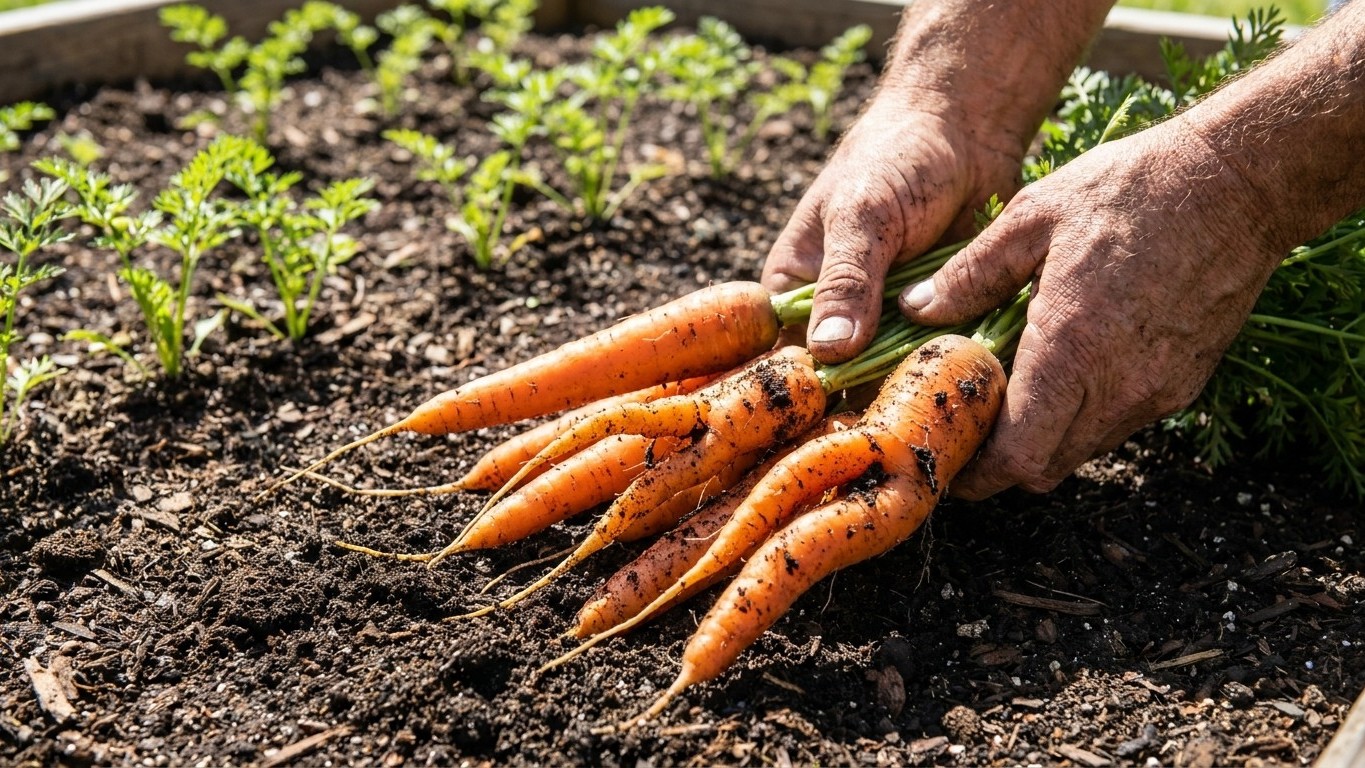

In North Carolina, the calendar matters less than the dirt under your boots. Carrots go straight into the ground where they’ll grow, no transplanting involved, and take 70 to 100 days from seed to harvest. Before you circle a date working backward from frost, know this: the soil type that represents the state isn’t naturally built for straight, unforked carrots. Whether your seed becomes a clean root or a bent one depends on what you do to that soil first.
The short answer
North Carolina’s representative soil carries a name: the Cecil series, an Ultisol that USDA lists as characteristic of the state. It’s old ground. Ultisols form over long stretches of time in warm, humid climates, weathered and leached until much of the natural fertility has washed down and out. The surface layer of a typical Cecil profile runs about 68 percent sand, 13 percent clay, and 20 percent silt, with organic matter sitting around 0.8 percent. It’s naturally acid, with a surface pH near 5.5, and it’s classified as well drained.
That combination is a mixed bag for a carrot. Utah State University Extension puts the requirement plainly: carrots want deep, sandy, well-drained soil rich in organic matter, and heavy or rocky ground makes the root fork instead of growing long and straight. On the sand and drainage counts, Cecil soil checks the right boxes. Sandy, well-drained ground is exactly the texture a carrot root pushes through with little resistance.
The catch is what’s missing. Organic matter under 1 percent is thin, nowhere close to what “rich” implies. A carrot seed doesn’t need much to germinate, but the root that follows grows best in loose, humus-filled ground that holds moisture without crusting or compacting. Cecil soil, untouched, doesn’t offer much of that. It also runs acid, which shapes how available nutrients are to a shallow-rooted crop, and while the clay fraction (13 percent) is low enough that clay alone shouldn’t be the state’s main forking risk, any denser layer sitting close to the surface will still bend a taproot around it.
The fix, per Utah State University Extension, isn’t a different carrot variety. It’s soil preparation. Heavy or compacted ground calls for generous compost worked in and double digging, breaking up the profile a foot or two down so the root has nowhere to bend around. Where the ground is shallow, rocky, or sits on a hardpan close to the surface, a raised bed sidesteps the problem entirely, giving the carrot the depth of loose material it needs from day one.
None of this is a verdict on your specific yard. The Cecil series is what USDA lists as representative of North Carolina, but the state spans hundreds of mapped soil series. River bottoms, hillsides, and any lot a builder has graded or filled can carry soil nothing like Cecil. This section tells you what the region tends toward. Your own plot needs its own answer.
The test that settles it in your own garden
The Cecil series describes a map unit, not your raised bed or your backyard plot. Soil type shifts block to block, sometimes yard to yard, especially anywhere a subdivision stripped and regraded the topsoil before building. The only way to know what you’re actually working with is to check it yourself, and it doesn’t take special equipment.
- Dig a hole at least a foot deep where you plan to sow. Watch the sides as you go: does the color and texture change partway down, or does it stay uniform? A sudden band of dense, different-colored soil close to the surface is the kind of layer a carrot root will bend around instead of pushing through.
- Check for stones and rubble. Run a hand along the sides of the hole and through the loose soil at the bottom. Gravel, leftover construction debris, or a solid rocky layer within the top foot are the most common reasons a home-grown carrot forks, splits, or simply stalls before it reaches full length.
- Feel the texture between your fingers. Grab a handful of moist soil and squeeze it. Soil that ribbons out smooth and stays in a slick lump is clay-heavy. Soil that falls apart and feels grainy is sandy. Something in between that holds a loose shape but crumbles under light pressure is closer to the loam carrots prefer.
- Watch how water drains. Fill the hole with water and time how long it takes to soak in. Water still standing after several hours points to poor drainage and ground that will need raised beds or heavy amendment before carrots go in. Water gone within an hour or so points to soil on the sandy, well-drained end.
None of these four checks require a lab. Together, though, they tell you more about your actual carrot bed than any state-level soil map ever could.
What goes wrong here
Two forces run through North Carolina growing conditions that trip up carrots more than most vegetables: soil texture and heat. Here’s what tends to happen, and what fixes each one.
- Forking roots in heavy or compacted ground. Where soil runs denser than the state’s sandy representative type, or where a hardpan sits close to the surface, the taproot hits resistance and splits into two or three legs instead of growing straight down. Utah State University Extension’s answer is to work in compost and double dig the bed, loosening the soil a foot or more, or to build a raised bed filled with loose material so the root never meets that resistance in the first place.
- Poor germination during a hot, dry stretch. Carrot seed is slow to sprout even under good conditions, and a run of hot weather can dry out the surface inch of soil before the seed ever germinates. Keeping that top layer consistently damp, with light, frequent watering rather than one heavy soak, gives the seed the steady moisture it needs to break through.
- Splitting roots from uneven watering. A carrot that goes through a long dry spell followed by a heavy rain or deep watering tends to split lengthwise as the root swells faster than its outer layer can stretch. Even, regular watering on a set schedule, rather than watering only when the bed looks visibly dry, keeps growth steady and the skin intact.
None of these three problems trace back to the seed itself. They trace back to what’s happening at root level, in soil that’s either too dense, too dry on top, or too inconsistent in how it gets watered from one week to the next.
Common questions
Do carrots need to be transplanted in North Carolina?
No. Carrots are sown directly into the bed where they’ll grow. There’s no transplant step and no transplant date to count from; the 70 to 100 days to maturity run from the day the seed goes into the ground.
Does North Carolina’s soil naturally suit carrots?
Partly. The state’s representative soil, the Cecil series, is sandy and well drained, both traits carrots need. But it’s also naturally acid and low in organic matter, around 0.8 percent at the surface, which is far from the humus-rich ground carrots grow best in without added compost.
What’s the fastest way to fix heavy soil before sowing carrots?
Utah State University Extension recommends working in generous compost and double digging to loosen compacted ground a foot or more down. Where the soil is shallow or sits on a hardpan, a raised bed filled with loose material solves the same problem without disturbing the ground underneath.
How do I know if my garden’s soil is different from the state’s representative soil?
Dig a test hole at least a foot deep and check for color changes, stones, texture, and how fast water drains out of it. The Cecil series describes a mapped soil type across the state, not any individual yard, and a quick hands-on check tells you far more about your own bed than the state-level description does.