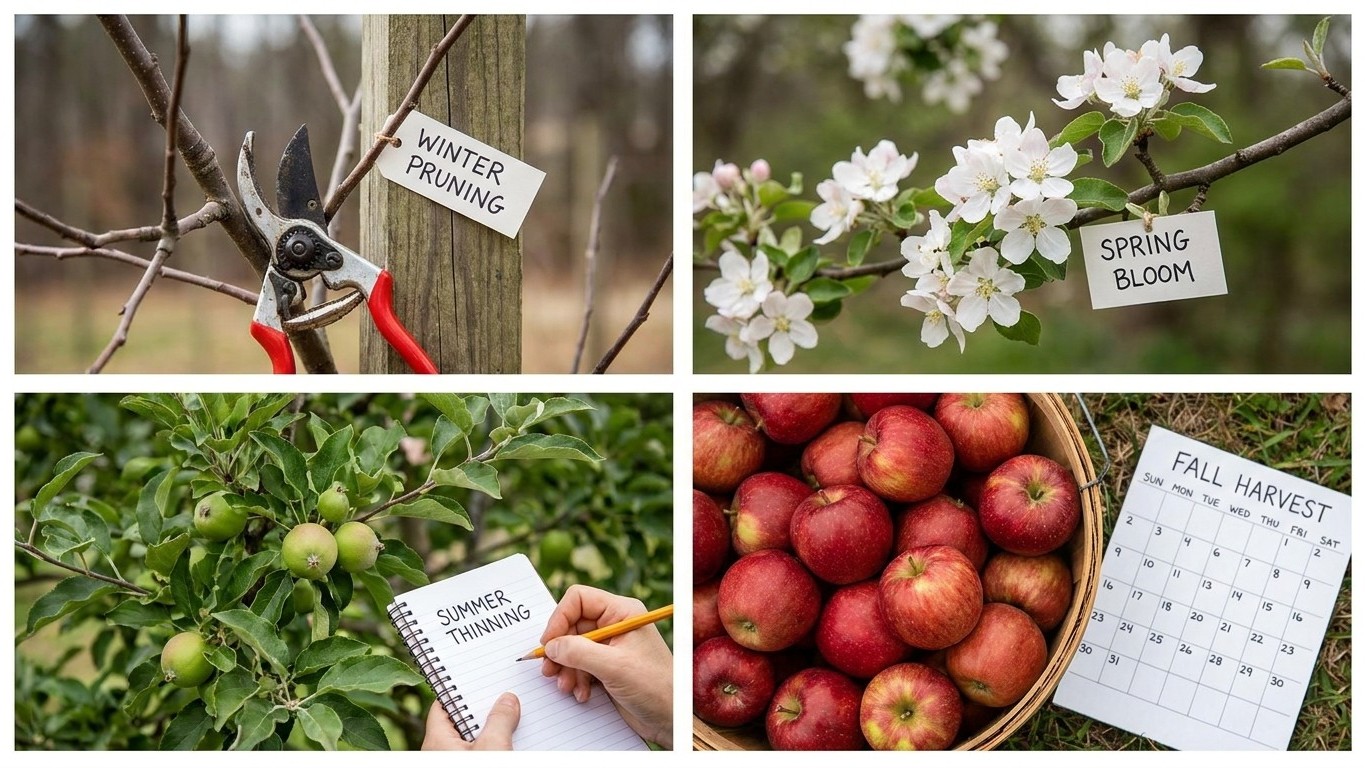

North Carolina’s apple calendar runs from bare dormancy in winter through harvest in late summer or fall, but the date that actually decides a crop is when the tree reaches bloom relative to the last hard freeze. Around Charlotte, in the Piedmont, NOAA’s 1991-2020 climate normals put that last spring freeze between March 23 and April 5, and the first fall freeze between October 30 and November 8. Check bud stage against that window before you plan a spray, a planting, or a thinning pass, because a tree in bloom during a late freeze loses its crop no matter what the wall calendar says.
The short answer for North Carolina
Piedmont apple bloom lands in early April around Charlotte, and that one date is the calendar in miniature — everything before it is dormancy, everything after it is fruit racing the last frost. Move higher into the Blue Ridge and bloom slides weeks later; drop onto the coastal plain and it comes weeks earlier. Winter chill sets the other boundary: Charlotte’s mean January low of 29.6°F breaks dormancy in standard cultivars but shuts out the true low-chill types bred further south.
The frost window
What that answer depends on is where in the state you’re standing. The Charlotte figures are Piedmont figures. Higher into the Blue Ridge, spring runs weeks behind that window, and the coastal plain runs ahead of it. Your own last-frost date matters more than any date printed in a catalog or in this article, because bloom timing is fixed by the cultivar’s genetics while frost timing is fixed by your elevation and terrain.
The chill requirement
The other variable is winter chill, and it’s a different filter from frost. NOAA’s 1991-2020 climate normals put Charlotte’s coldest month at a mean daily minimum of 29.6°F, which rules out the true low-chill apples bred for the Deep South and confirms that most standard cultivars sold for the mid-Atlantic will get enough winter cold to break dormancy properly and flower on schedule. That number tells you what will grow, not when it will bloom. For the actual list of cultivars that hold up against those numbers, with their chill needs and ripening windows named, The Best Apple Varieties for North Carolina covers it by name. Read the tree by stage, not by month, once you get past this baseline, because dormancy and bloom shift by a week or more with the swings in any given winter.
Working through it

Once you’ve settled on a cultivar and gotten it in the ground, the rest of the season is a sequence of visible stages, each one triggering a different job. Anchor every stage on the Piedmont’s own frost dates, not on a date printed on a seed packet, because the stage is what a late freeze actually threatens.
Dormancy

From leaf drop in fall through the coldest weeks of winter, the tree sits with tight, scaly buds and does nothing visible. This is when you prune, because cuts made while the tree is dormant heal cleanly and don’t invite the disease that summer cuts do. It’s also the only safe window to plant bare-root trees, timed for whenever the ground isn’t frozen or waterlogged.
Green tip

Buds swell and a sliver of green leaf pushes through the scales, usually as days lengthen toward the Piedmont’s last-frost window that NOAA’s 1991-2020 normals set between March 23 and April 5 at Charlotte. Green tip is the last easy stage to apply a dormant oil for scale and mite eggs, before foliage expands enough to trap the spray on tender new tissue and burn it.
Pink

The blossom cluster swells and shows color before it opens, still closed tight enough to shrug off a light frost that would kill an open flower outright. This is the stage to start a fungicide program against apple scab, because the fungus infects the same tissue that’s about to become a flower.
Bloom

Open white blossoms are the plan’s most exposed point. A flower killed by frost never sets fruit, and because bloom in the Piedmont tends to land close to the tail end of the March 23 to April 5 freeze window, a late freeze in early April can still wipe out a crop that looked perfectly on schedule two weeks earlier. This is the stage where the tree’s own timing matters more than the calendar on the wall, since two cultivars planted the same day can bloom two weeks apart.
Petal fall

Petals brown and drop, littering the ground under the tree, and the small green swelling behind each spent flower is the fruit starting to form. Thinning starts here or shortly after, while removing excess fruitlets is cheap, instead of later, when propping up overloaded limbs gets expensive.
Fruit set

Fruitlets that survive the tree’s own natural early-summer drop are the ones that will size up. A second, lighter thinning pass here pays for itself, spacing the remaining apples so each gets enough leaf area to finish at a decent size instead of a handful of small ones.
Harvest
Ripening runs from late summer into fall depending on the cultivar, well ahead of the first fall freeze that NOAA’s 1991-2020 normals put at Charlotte between October 30 and November 8, so frost rarely limits this end of the season. Picking by firmness and background color, not by a date on the calendar, is what actually gets each variety off the tree at its best. Once fruit is coming in, Growing Apples in North Carolina goes into storage and the ripening window for common cultivars in more depth.
What changes across North Carolina
The Charlotte figures above are Piedmont figures, and North Carolina runs from sea level to well over a mile high, so nothing about that calendar travels unchanged across the state.
| Region | Spring frost timing | Fall frost timing | Winter chill |
|---|---|---|---|
| Piedmont (Charlotte, NOAA 1991-2020 normals) | March 23 to April 5 | Oct 30 to Nov 8 | Moderate, coldest month mean minimum 29.6°F |
| Blue Ridge / mountain counties | Later than Charlotte | Earlier than Charlotte | Colder winters, higher chill accumulation |
| Coastal plain | Earlier than Charlotte | Later than Charlotte | Milder winters, lower chill accumulation |
The mountains
In the Blue Ridge and the western mountain counties, elevation pushes both frost dates later in spring and earlier in fall than the Charlotte window, so dormancy breaks later and bloom lands later too. That later spring actually protects bloom, since blossoms stay closed further into the season, but the tradeoff is a shorter growing season and less time to finish ripening a late cultivar before the season’s first freeze.
The coastal plain
Toward the coastal plain, the pattern flips. Frost eases earlier in spring and holds off later in fall than in the Piedmont, so trees break dormancy and bloom sooner and get more time to color and size fruit at the other end. The catch is winter chill: cultivars bred for a long, cold dormancy can fail to break bud evenly or flower well in a mild coastal winter, which is a chill problem, not a frost date problem, and it needs a different fix than watching the thermometer.
Cold air and terrain
Cold air behaves like water. It pools in low ground and drains off slopes and ridgetops. A valley bottom or a frost pocket anywhere in the state, mountain or Piedmont, will run colder on a still, clear night than a slope forty feet above it, sometimes by several degrees. That’s the reasoning behind planting on a slope or ridge rather than the lowest point on a property, regardless of which region you’re in. No single date in this article applies statewide, and a grower in the mountains, the Piedmont, and the coastal plain is working three different calendars off the same species of tree.
The mistakes this climate punishes
Blooming into a late freeze
Planting an early-blooming cultivar in a spot where the local last frost runs late is the single most common way to lose a crop in this state. An early bloomer that opens while the Piedmont’s freeze window, March 23 to April 5 by NOAA’s 1991-2020 normals at Charlotte, is still active can flower straight into a freeze that a later-blooming cultivar would have missed entirely. This shows up as a tree that looked fine at bloom and then set almost no fruit, usually noticed in June when fruitlets should be sizing up and aren’t there.
Not enough winter chill
Choosing a long-chill cultivar bred for a colder climate than a mild Piedmont or coastal winter actually delivers runs the opposite direction from the first mistake, and it’s just as costly. If the tree’s chill requirement isn’t met, buds break unevenly, bloom drags out over weeks instead of clustering tightly, and pollination suffers because flowers aren’t open together long enough for good crossing. This shows up as a tree covered in leaves but thin on fruit, and it usually gets blamed on pollinators when the real cause is chill.
Feeding and pruning at the wrong end of the season
Fertilizing in mid to late summer pushes soft new growth right when the tree should be hardening off for winter, and that soft growth is what gets killed first when the season’s first fall freeze arrives, sometime between October 30 and November 8 by the Charlotte normals. The damage isn’t always fatal to the tree, but it costs vigor the following spring and opens wounds that invite disease. Stop nitrogen well before that window and let the tree finish the season on what it’s already carrying. Pruning too late in spring, after green tip, is a smaller version of the same mistake: cuts made once sap is moving bleed more and heal slower, right when the tree needs its energy for bloom instead of wound repair.
Checking this against your county
Every figure above comes from one weather station near Charlotte, and it’s a starting point, not your county’s answer. NC State Extension, the state’s land-grant cooperative extension service at ces.ncsu.edu, keeps county-level offices that track local frost data and cultivar performance specific to your elevation and region. Call or visit your county extension office before you commit to a planting date or a cultivar, especially if you’re west of the Piedmont in the mountains or east toward the coastal plain, where the Charlotte numbers in this article don’t hold.
Common questions
How do I know if my apple tree got enough winter chill?
Look for uneven bud break in spring, where some branches leaf out and bloom weeks ahead of others on the same tree, and for a bloom period that drags on instead of clustering into a tight window. Both point to a chill shortfall rather than a pest or disease problem, and your county extension office can help confirm it against local records.
Can I grow apples near the North Carolina coast?
Yes, but the mild coastal winters push you toward lower-chill cultivars rather than the classic northern varieties, and frost is less of a concern there than chill accumulation. The Best Apple Varieties for North Carolina names cultivars by their chill requirement so you can match one to a coastal winter instead of guessing.
My tree bloomed but didn’t set any fruit. What happened?
The three usual culprits are a late frost that killed the open blossoms, a chill shortfall that spread bloom out too thin for good pollination, or a lack of a compatible second variety nearby for cross-pollination, since most apple cultivars don’t set fruit reliably on their own pollen. Check which stage the tree was at during any late-season cold snap first, since that’s the easiest one to rule in or out.
Do I need to spray on a set schedule, or does it matter what stage the tree is at?
Stage matters more than the calendar date. Dormant oil belongs at green tip, before foliage expands enough to trap it, and a scab fungicide program should start at pink, before the blossom tissue that’s most vulnerable actually opens. Spraying by a fixed date instead of by stage means you’ll sometimes catch the tree too early and sometimes too late, depending on how the season is running that year.