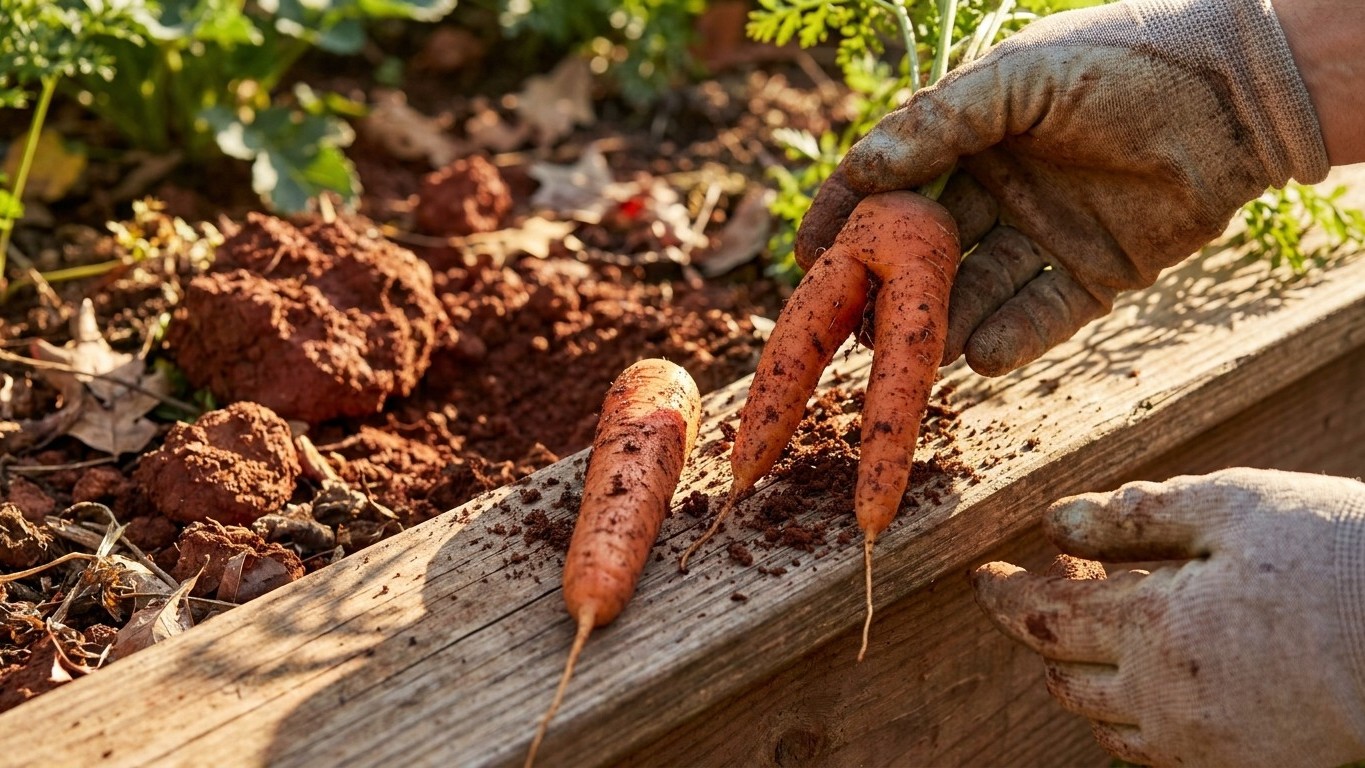

Straight roots are the likely outcome in Northwest Territories’ most common ground, but not for the reason most gardeners expect. The territory’s dominant soil carries very little clay, so classic fork-inducing heavy ground isn’t the main risk here. The real threat to a clean, tapered carrot is permafrost sitting close under the surface, which can stop a root cold long before it reaches full length.
The short answer
The most commonly mapped soil across Northwest Territories is a Cryosol, a soil defined by permafrost within the profile, where only a shallow active layer thaws each summer. This soil order covers 99 percent of the mapped agricultural surface, with Regosolic soils making up most of the rest. No median pH is published for this ground. Texture runs loam to silt: 55 percent sand, 6 percent clay, and 39 percent silt, with organic matter around 2.4 percent. Drainage is classed as well drained. That data comes from Agriculture and Agri-Food Canada’s Canadian Soil Information Service, drawn from the Soil Name Table and Soil Layer Table for the surface horizons of 80 mapped soil components in the province.
Carrots want deep, sandy, well-drained soil rich in organic matter, according to Utah State University Extension. Heavy or rocky soil is what makes the root fork, and the fix for that kind of ground is generous compost and double digging, or building a raised bed instead of fighting the native profile. Measured against that standard, this soil’s low clay share and well-drained rating are actually favorable signs. Six percent clay is nowhere near the heavy, sticky ground that typically splits a taproot into legs.
The organic matter figure, about 2.4 percent, sits on the lean side for a crop that rewards rich ground, and it’s worth building up with compost regardless of texture. But the bigger variable this dominant profile hints at is depth, not density. A Cryosol’s defining trait is permafrost lurking beneath a shallow thawed layer each summer. Carrots need room to grow straight down, and a root that meets frozen or compressed ground partway through the season can stall, curve, or split into forks even in soil that has almost no clay to blame. That’s a mechanical obstruction problem, closer to hitting a buried rock than to the sticky-clay scenario Utah State describes, but the visible result on the root can look similar.
None of this settles the question for any one yard. Northwest Territories spans hundreds of individual soil series, and the Canadian Soil Information Service survey itself covers only the agricultural regions of the province, leaving the far north unrepresented. River bottoms, muskeg, and any ground a builder has cut, filled, or graded will differ from this profile entirely. Treat the dominant soil as a starting point for what the region’s ground tends to do, not a diagnosis of the dirt behind your own house.
The test that settles it in your own garden
The state’s dominant soil profile can tell you what to expect in general, but your own raised bed or backyard plot is the only ground that actually grows your carrots. A short walk outside answers more than any regional average can.
- Dig a test hole at least a foot deep where you plan to sow. Note how far down you can go before you hit rock, a hardpan layer, or, in far northern spots, frozen ground. Carrots need that column of loose soil open all the way down.
- Check for stones and debris as you dig. Rocks the size of a golf ball or larger sitting in the root zone are a common, overlooked cause of forked and twisted carrots, separate from any clay or permafrost issue.
- Feel the texture by rubbing a handful of moist soil between your fingers. Gritty and loose suggests a sandier mix closer to the well-drained profile mapped for the province; sticky, ribbon-forming soil means more clay than the regional average and a higher chance of forking without amendment.
- Run a drainage check by filling the test hole with water and timing how long it takes to disappear. Water that lingers for hours points to a compacted or clay-heavy pocket that needs organic matter and raised planting rather than direct sowing.
- Watch the bed after a hard rain over the following days. Puddling that sits on the surface, or ground that stays soggy while the rest of the yard dries, flags a spot better suited to a raised bed than an in-ground carrot row.
None of these checks require a lab, and none of them replace one either. A basic home soil test kit or a submitted sample can tell you pH and nutrient levels this territory-wide survey simply doesn’t publish for the mapped surface here. The dig-and-feel routine above is about structure and drainage, the two things that decide whether a carrot grows down in a straight line or gives up and splits.
What goes wrong here
- Forking from obstructed depth. Even in low-clay, well-drained ground, permafrost sitting under a shallow active layer or a buried rock can stop a taproot mid-season and send it splitting into two or three legs. The remedy is a raised bed built with loose, amended soil to a depth well beyond what the root needs, keeping the growing root away from the frozen layer entirely.
- Poor germination in a hot spell. Carrot seed germinates slowly and unevenly if the surface dries out during a warm stretch, since seeds sown in place have no root system yet to draw on deeper moisture. Keep the seedbed lightly and consistently moist from sowing until seedlings are up, checking daily rather than watering on a fixed schedule.
- Splitting from uneven watering. A dry spell followed by a heavy soak makes roots swell too fast and crack along their length. Steady, even watering through the growing season, rather than occasional deep drenching, keeps root growth uniform.
- Slow, thin roots from lean organic matter. With organic matter around 2.4 percent in the region’s dominant soil, carrots can come up spindly without extra feeding. Working compost into the bed before sowing addresses this directly, and it’s the same fix Utah State University Extension recommends for heavy ground, useful here even though the clay content itself isn’t the main problem.
- Stunted growth from cold, wet pockets. Well-drained on paper doesn’t mean well-drained in every low spot or shaded corner of a yard, especially where snowmelt collects late into the season. Raised beds or mounded rows lift the root zone above standing water and let the soil warm faster once sowing time arrives.
Common questions
Does low clay content mean carrots won’t fork in this soil at all?
No. Six percent clay is low enough that clay-driven forking, the classic problem Utah State University Extension describes in heavy ground, is less likely here. But forking also happens when a root hits any obstruction, including shallow permafrost or buried rock, so low clay alone doesn’t guarantee a straight root.
Is the region’s soil pH known for growing carrots?
No median pH is published for the mapped surface of Northwest Territories in the source data used here. A home soil test is the only way to know the pH of your specific bed.
How long do carrots take to mature from seed here?
Carrots are sown directly in place rather than transplanted, and maturity generally runs 70 to 100 days counted from the seeding date, per Utah State University Extension. No transplant date applies to this crop.
Is a raised bed necessary everywhere in the territory?
Not necessarily. The dominant mapped soil is well drained with fairly low clay, which is workable ground for carrots in many spots. A raised bed becomes the practical answer where your own test hole reveals shallow frozen ground, heavy standing water, or a stony subsoil, none of which the territory-wide average can predict for your yard.